
About this medicine
Lustral and the US name Zoloft refer to sertraline. A familiar brand name does not establish that its formulation or licence applies in another country.
Sertraline is taken regularly, not only when distress appears. Benefit builds over time; early bowel or sleep effects do not reliably predict the eventual response. Continuing treatment after improvement can reduce recurrence, so duration is discussed separately from the starting dose.
What is this medicine used for?
The checked UK licence covers the uses listed above. Childhood licensing is specifically for OCD, not depression. NICE CG113 discusses sertraline for generalised anxiety disorder; that use is outside the indications of these Lustral products. NICE guidance does not itself establish identical access across the four UK nations.
Childhood depression treatment is off-labelOff-labelUse of a licensed medicine outside the terms of its UK marketing authorisation.Read the full definition of Off-label for this product. NICE considers sertraline or citalopram as second-line options only after defined criteria are met, with senior child-and-adolescent psychiatric advice, informed discussion and close monitoring. This is different from an OCD licence or a routine first antidepressant for a child.
Which warning signs need help?
New self-harm thoughts need urgent assessment. Fever, confusion and twitching may signal serotoninSerotoninA chemical messenger involved in several functions, including sleep, mood and digestion. It acts through different receptors, with effects that depend on the cell.Read the full definition of Serotonin syndrome. Breathing difficulty or swelling needs emergency care. An overdose needs urgent medical advice even before symptoms develop. Use emergency services for the country you are physically in.
MHRA’s October 2026 communication announced the rollout of a prominent boxed warning in UK antidepressant patient leaflets about self-harm and suicidal behaviour, alongside a patient safety card. This UK patient-information measure is not the US FDA Boxed Warning designation. Read the leaflet supplied with your medicine, seek prompt professional help for new or worsening mood or behaviour changes, and do not stop treatment suddenly without advice.
A painful red eye with blurred vision, a seizure, severe confusion or unusual heavy bleeding needs urgent assessment. Marked overactivity with little need for sleep may indicate mania rather than recovery from depression. Tell the treating team about abrupt changes in behaviour or agitation.
How do I take it safely?
Product reference for adults: depression/OCD usually starts at 50 mg daily; panic disorder, PTSD and social anxiety start at 25 mg daily for one week, then 50 mg. Subsequent increases are at least a week apart, up to 200 mg daily. These are prescribing references, not instructions to adjust treatment. The 50 mg Lustral tablet can provide equal halves.
It may be taken in the morning or evening at a consistent time. Childhood OCD has age-specific starting doses: the label starts ages 6–12 at 25 mg daily and ages 13–17 at 50 mg; subsequent changes take account of lower body weight and response. This is not a dosing plan for childhood depression. Severe liver impairment is outside the label’s recommended use; kidney impairment does not by itself require the same adjustment.
Rosemont’s 20 mg/mL concentrate must be diluted: measure with its syringe, mix with about 120 mL of an approved liquid such as water, and take immediately. The leaflet lists the permitted alternatives; do not prepare doses ahead or drink concentrate undiluted.
Colonis 50 mg/5 mL suspension is a different, less concentrated liquid. Shake for at least ten seconds, measure with the supplied syringe, take into the mouth and have a glass of water. It does not use the concentrate’s dilution procedure. A switch requires confirmation of concentration and volume.
What side effects should I know about?
Nausea, diarrhoea, headache, dry mouth, disturbed sleep, dizziness and sexual difficulties are recognised effects. Persistent or troublesome symptoms deserve review.
MHRA is adding the term post-SSRI sexual dysfunction (PSSD) to patient leaflets describing persistent sexual difficulties after stopping certain antidepressants, including this medicine. Their frequency and causes remain under study. Persistent symptoms deserve support; this does not mean everyone taking the medicine will experience them.
Who needs extra care with this medicine?
Discuss epilepsy, previous mania, bleeding problems, glaucoma, diabetes and liver disease. Low blood sodium is a particular concern in older people or those taking diuretics.
The Colonis suspension contains propylene glycol, requiring particular review in pregnancy, breastfeeding, and kidney or liver disease. Its preservatives can cause allergic reactions. Check the exact liquid’s ingredients rather than assuming tablet precautions cover every formulation.
Can it affect my other medicines?
MAO inhibitors and pimozide must not be combined with sertraline. Other serotonergic medicines and St John’s wort increase risk. Anticoagulants and anti-inflammatory painkillers can increase bleeding. Avoid grapefruit juice.
The checked Lustral leaflet requires at least two weeks after an MAOI before sertraline and at least one week after sertraline before an MAOI. The other medicine’s instructions may require a longer interval, so these are not a self-directed switching schedule. Prescription painkillers, migraine medicines and over-the-counter products should be included in the interaction review.
The alcohol-containing Rosemont concentrate must not be used with disulfiram or for fourteen days after disulfiram is stopped. This product-specific restriction must not be inferred solely from the name sertraline.
What check-ups will I need?
Review mood, tolerability and unusual behavioural changes early. NICE recommends an earlier, one-week review for adults aged 18–25 or when suicide risk is a concern.
What about pregnancy, breastfeeding and age?
Pregnancy and breastfeeding require an individual discussion; needed treatment may continue. Babies may require observation after birth. Children treated for OCD need specialist oversight and monitoring of growth and development.
Late-pregnancy exposure can be followed by newborn breathing, feeding or adaptation problems, and serotonergic antidepressants can increase bleeding after delivery. The care team weighs these possibilities alongside the risks of untreated illness. A positive pregnancy test is a reason for timely review, not abrupt self-withdrawalWithdrawalSymptoms that may occur after reducing or stopping a medicine or substance to which the body has adapted.Read the full definition of Withdrawal.
What if I miss a dose or want to stop?
If a dose is missed, skip it and take the next day’s dose normally. Do not double up. Stopping usually needs a gradual reduction over weeks or months.
Dizziness, disturbed sleep, nausea, anxiety and unusual sensory sensations can occur during withdrawal. Some people need a slower reduction than an initial plan anticipated. Symptoms after a dose change should be discussed, rather than assumed to prove that the original disorder has immediately returned.
How does it work?
Sertraline changes how nerve cellsNeuronA nerve cell that receives and sends information. Neurons work in connected groups, rather than carrying a whole thought on their own.Read the full definition of Neuron pass messages using serotonin, a chemical messenger involved in mood, sleep and other functions. It slows the return of released serotonin into the cell that sent it, leaving more available between cells. This can help with symptoms, but it does not mean that depression or anxiety is simply a shortage of serotonin.
How Brain Cells Communicate
Nerve cells, also called neurons, use chemical messengers called neurotransmitters to communicate across tiny gaps called synapses. Once released, serotonin can attach to a receptor, a protein that detects the message and changes the receiving cell’s activity. Another protein, the serotonin transporter or SERT, carries serotonin back into the sending cell. This return is called reuptake and helps control how long the message stays available.
What is known: Serotonin is released between nerve cells and can be taken back up by SERT.
What remains uncertain: Serotonin activity alone cannot explain a person’s mood or symptoms.
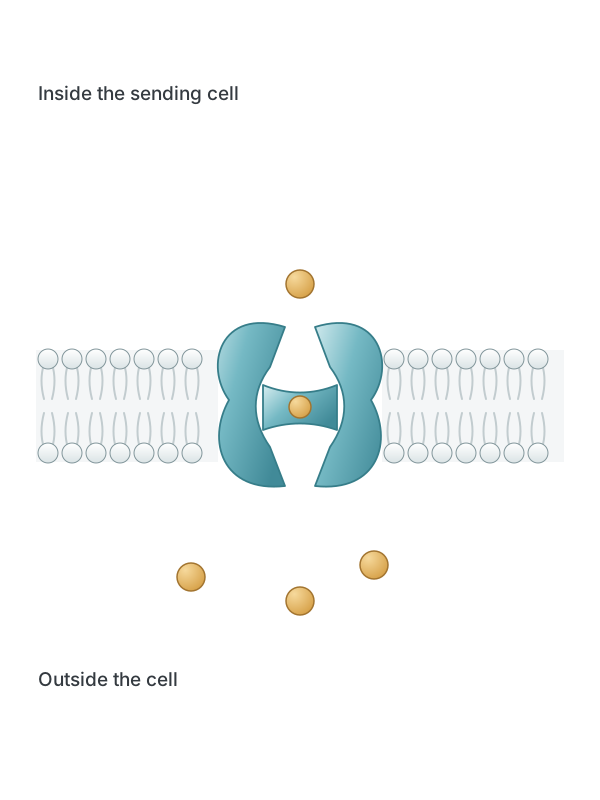
- Serotonin
The messenger is shown outside the sending cell.
- SERT
The serotonin transporter returns serotonin into the cell.
- Return into the cell
The arrow shows transport direction, without a measured rate.
Simplified teaching model. Protein shapes, sizes, particle counts and arrows are illustrative, not measurements or experimental structures.
About this illustration
Before medicine: reuptake: A transporter returns serotonin from the space outside the nerve cell into the cell. Serotonin activity alone cannot explain a person’s mood or symptoms.
How the Medication Changes Signaling
Sertraline inhibits SERT, meaning it reduces this transporter’s activity. Less released serotonin is taken back up, so more remains available to interact with receptors. Sertraline mainly affects this return pathway, rather than directly switching on serotonin receptors. This is why it is called a selective serotonin reuptake inhibitor, or SSRI: it chiefly reduces the reuptake of serotonin.
What is known: Sertraline reduces the reuptake of serotonin.
What remains uncertain: The amount of reuptake inhibition does not directly measure symptom relief.
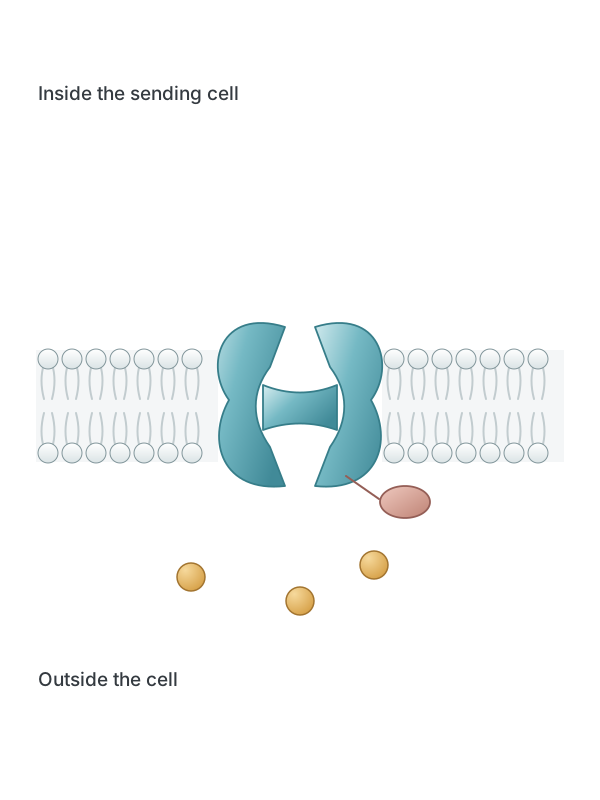
- Serotonin
The messenger is shown outside the sending cell.
- SERT
The serotonin transporter returns serotonin into the cell.
- Sertraline: uptake inhibited
The interrupted arrow names the action; the symbol is not a molecular shape or binding position.
Simplified teaching model. Protein shapes, sizes, particle counts and arrows are illustrative, not measurements or experimental structures.
About this illustration
With sertraline: Sertraline inhibits this reuptake process. The amount of reuptake inhibition does not directly measure symptom relief.
How does it affect my body?
Serotonin signalling also matters outside the brain. Bleeding, bowel symptoms and sexual difficulties can therefore accompany treatment.
A new inability to sit still can be akathisiaAkathisiaAkathisia is distressing inner restlessness with a strong urge to move, sometimes caused by medication. It may lead to pacing, rocking or difficulty sitting still.Anxiety involves fear or worry; agitation is a broader state of distress or restlessness. These can overlap with akathisia, but the compelling urge to move is an important clue. Tell your prescriber promptly about new or worsening restlessness so the cause can be assessed., particularly early in treatment. It deserves review and should not automatically be treated by increasing the dose. Sexual effects and sleep changes are important outcomes even when mood improves.
How does my body process it?
Your liver breaks down sertraline. On average, it takes about 26 hours for the amount in your blood to fall by half; this is called its half-lifeThe time for a measured drug level to fall by halfThe time it takes for the concentration of a medicine in a body fluid, usually blood, to decrease by half during elimination.Read the full definition of Half-life. Liver disease can make the medicine stay in your body longer.
How do treatment options differ?
Unlike escitalopram’s UK adult-only licence, these sertraline products include childhood OCD. Different SSRI licences do not establish which medicine will suit an individual.
A closer look at the science
Its main action is inhibition of serotonin uptake, with much weaker effects on noradrenaline and dopamineDopamineA chemical messenger involved in movement, learning and emotion. Its name does not describe one feeling or one role throughout the brain.Read the full definition of Dopamine uptake. It is not a direct substitute for serotonin.
Sertraline hydrochloride is a salt of sertraline. The drawing shows the neutral sertraline parent with its specified stereochemistry; the hydrochloride component is not drawn. The chemical species shown here do not specify the composition of a particular product.
Chemical formula: C17H17Cl2N · HCl
The formula shown describes the hydrochloride salt. C, H, Cl and N stand for carbon, hydrogen, chlorine and nitrogen. The dot separates the parent compound from the hydrochloride component. This identity does not predict clinical benefit.
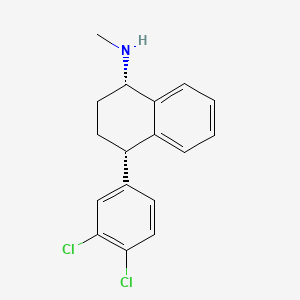
The depicted parent and the salt formula describe different explicitly identified species.
How was this medicine developed?
The cited Lustral authorisation record dates from June 2009. That is the product’s recorded authorisation history, not sertraline’s discovery date.
Sources and References
- Lustral 100 mg: UK SmPC
Product covered: Lustral 100 mg film coated tablets. Marketing authorisation holder: Viatris Products Limited. Label text revised 2025-12; source record updated 2026-02-02. Product identity and links checked 2026-10-19; this does not change the article’s clinical check date.
Company-supplied UK Patient Information Leaflet hosted by emc — patient text revised 2025-12. PIL covers 50 mg and 100 mg tablets; selected SmPC is the 100 mg product. emc is a publisher of company-supplied product information, not the MHRA regulator.
Product information published on the electronic Medicines Compendium (emc); supplied by pharmaceutical companies.
Scope: United Kingdom product information.
- Lustral 100 mg film coated tablets — Company-supplied UK Patient Information Leaflet hosted by emc
- Lustral 50 mg: UK SmPC
Product information published on the electronic Medicines Compendium (emc); supplied by pharmaceutical companies.
Scope: United Kingdom product information.
- Lustral: patient leaflet
Product information published on the electronic Medicines Compendium (emc); supplied by pharmaceutical companies.
Scope: United Kingdom product information.
- NHS: Sertraline
Scope: NHS website for England — general medicine education, not a four-nation service pathway.
- NICE CG113: Generalised anxiety disorder and panic disorder
Scope: England guidance; applicability or adoption in other UK nations requires separate consideration.
- NICE NG222: Depression in adults, recommendations
Scope: England guidance; applicability or adoption in other UK nations requires separate consideration.
- Cipralex: UK adult licence for comparison
Product information published on the electronic Medicines Compendium (emc); supplied by pharmaceutical companies.
Scope: United Kingdom product information.
- Antidepressants: use and safety
Scope: United Kingdom.
- Sertraline 20 mg/mL concentrate for oral solution — Rosemont UK SmPC
Product information published on the electronic Medicines Compendium (emc); supplied by pharmaceutical companies.
Scope: United Kingdom product information.
- Sertraline 20 mg/mL concentrate — Rosemont UK patient leaflet
Product information published on the electronic Medicines Compendium (emc); supplied by pharmaceutical companies.
Scope: United Kingdom product information.
- Sertraline 50 mg/5 mL oral suspension — Colonis UK SmPC
Product information published on the electronic Medicines Compendium (emc); supplied by pharmaceutical companies.
Scope: United Kingdom product information.
- FDA: Zoloft label, revised August2023
- NIH: What Is a Neurotransmitter?
- Sertraline: MedlinePlus Drug Information — mechanism explanation
Scope: Mechanism explanation only. Source sections checked: Why is this medication prescribed?; How should this medicine be used?..
- Depression in children and young people — recommendations
Scope: United Kingdom; NICE recommendations require attention to national implementation and local pathways.
- A qualitative investigation into the effects of akathisia - Health Research Authority
- Extrapyramidal side effects- Management
- Anxiety and panic attacks - NHS
- Agitation: MedlinePlus Medical Encyclopedia
Shared scientific background. Some references are US product pharmacology or international chemical records; UK product details and prescribing information are verified separately.
Article Information
- Edition
- United Kingdom
- Content updated
- 2026-10-30
- Source check dates
- Listed with each reference above; retained dates for shared scientific content.
- Scope
- exact products checked
Source and coverage limits
- Educational summaries cover the named UK products, not every brand, strength, formulation or prescribing circumstance.
- No claim of pharmacy stock or uniform NHS access is made.
- UK SmPC warnings are used; a US FDA boxed warning is not presented as a UK regulatory designation.
- Generalised-anxiety guideline wording was checked through the official NICE indexed recommendations; direct NICE page retrieval returned an access error.
- Selected UK concentrate and suspension were separately checked; their concentrations and preparation differ. Additional manufacturers and generic tablet strengths are not automatically interchangeable.