
What should I know first?
Selective serotonin reuptake inhibitors, or SSRIs, affect the return of serotonin into nerve cellsNeuronA nerve cell that receives and sends information. Neurons work in connected groups, rather than carrying a whole thought on their own.Read the full definition of Neuron. Sertraline is the example used here; Lustral is a UK product containing this medicine.
This UK lesson checks the mechanism against Lustral’s UK product information. It does not import the uses, age limits or formulations of the American Zoloft products.
This is a mechanism lesson, not a complete medicine guide. A diagram cannot choose treatment, predict your response, or tell you how to change a prescription.
How Brain Cells Communicate
Serotonin is a chemical messenger. At a chemical synapseSynapseA communication junction between cells. At a chemical synapse, a released messenger crosses a narrow gap; electrical synapses allow more direct electrical communication.Read the full definition of Synapse, it is released into a small gap and can act at receptorsReceptorA protein that recognizes a signal and helps a cell respond. Different receptor types can produce different responses to the same messenger.Read the full definition of Receptor. A transporter is a protein that carries a substance across a cell membraneCell membraneThe thin boundary of a cell. It separates the inside from the surroundings and contains proteins that control transport and signaling.Read the full definition of Cell membrane.
The serotonin transporter, often shortened to SERT, returns serotonin into the sending nerve cell. This return is called reuptake. A transporter moves a messenger; a receptor responds to it.
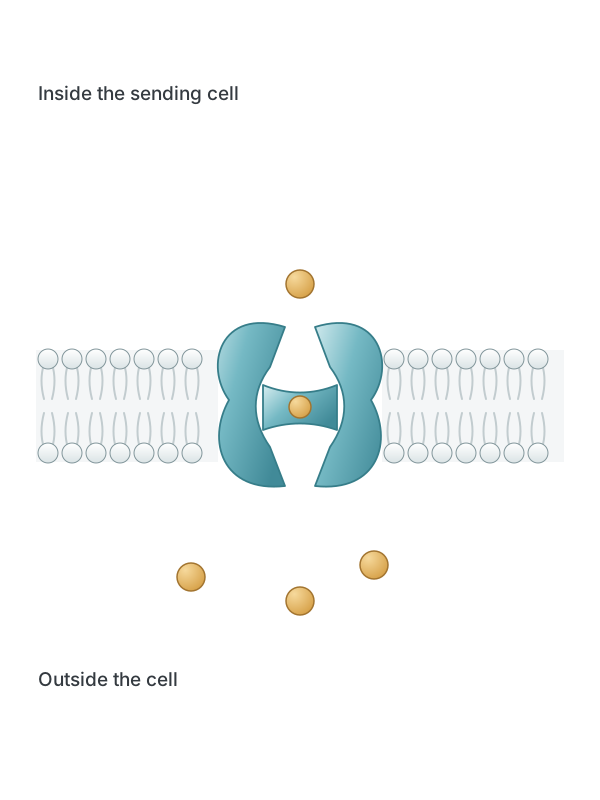
- Serotonin
The messenger is shown outside the sending cell.
- SERT
The serotonin transporter returns serotonin into the cell.
- Return into the cell
The arrow shows transport direction, without a measured rate.
Simplified teaching model. Protein shapes, sizes, particle counts and arrows are illustrative, not measurements or experimental structures.
About this illustration
A transporter returns serotonin from the space outside the nerve cell into the cell. The arrow points inward; it does not show a measured transport rate.
How the Medication Changes Signalling
Sertraline inhibits neuronal serotonin reuptake. This changes serotonin availability and signalling. The medicine marker in the diagram names that action without showing an exact molecular binding position.
The static teaching diagram separates transport from receptor response. It does not imply that all brain connections respond together or that a clinical response occurs as quickly as a molecular interaction.
A Closer Look at the Molecular Level
Known action: sertraline affects serotonin reuptake. The label describes uptake findings in human platelets and laboratory animal preparations; these findings are not a direct movie of a living human synapse.
Clinical uncertainty: a transporter effect alone cannot explain who will benefit, how long benefit will take, or every side effectAn effect beyond the intended treatment effectAn effect of a treatment in addition to its intended effect. It may be unwanted, harmful or sometimes beneficial.Read the full definition of Side effect. Depression is not established by this diagram to be a simple serotonin shortage. No receptor occupancy or dose-response scale is shown.
Learn more about sertraline
The UK sertraline article explains checked UK uses, product forms and important safety information. Read that article before treating a mechanism diagram as a medicine guide; the pharmacology lesson does not select a treatment.
Sources and References
- Lustral 100 mg: UK SmPC
Product information published on the electronic Medicines Compendium (emc); supplied by pharmaceutical companies.
Scope: United Kingdom.
- What Is a Neurotransmitter?
Scope: International scientific education; not UK regulatory evidence.
Article Information
- Edition
- United Kingdom
- Content updated
- 2026-10-17
- Sources checked
- Listed with each reference above; retained dates for shared scientific content.
- Publication status
- Published
- Scope
- How this medicine works, with UK product information.
Source and coverage limits
- A mechanism lesson is not a complete medicine profile, dosing schedule or individual treatment recommendation.
- Original qualitative SVG diagrams explain direction and target type; they do not measure biological rates, binding geometry or clinical response.