
About this medicine
Cipramil is a verified UK brand; Celexa is an American alias. The checked UK products include panic disorder as well as depression, so US licence wording should not be copied across.
Citalopram and escitalopram have related chemistry but are distinct medicines. Check the full name and formulation on a prescription or package: similar names and shared SSRI membership do not justify substitution. The UK account includes the current heart-rhythm and antidepressant safety context.
What is this medicine used for?
The checked licence covers depressive illness and prevention of its return, and panic disorder with or without agoraphobia. It does not establish a paediatric indication.
Panic disorder can include repeated unexpected panic attacks and fear of recurrence; agoraphobia concerns situations where escape or help feels difficult. The licensed indication does not mean every transient period of fear needs medication. DiagnosisDiagnosisA clinical conclusion about the condition that best explains a person’s symptoms and other findings.Read the full definition of Diagnosis, impairment, psychological treatment and preferences still matter.
Childhood depression treatment is off-labelOff-labelUse of a licensed medicine outside the terms of its UK marketing authorisation.Read the full definition of Off-label for this product. NICE considers sertraline or citalopram as second-line options only after defined criteria are met, with senior child-and-adolescent psychiatric advice, informed discussion and close monitoring. This is different from an OCD licence or a routine first antidepressant for a child.
Which warning signs need help?
Seek urgent assessment for fainting, irregular heartbeat, severe bleeding, self-harm thoughts, or fever with confusion and twitching. A serious allergic reaction needs emergency care. Overdose needs urgent medical advice.
MHRA’s October 2026 communication announced the rollout of a prominent boxed warning in UK antidepressant patient leaflets about self-harm and suicidal behaviour, alongside a patient safety card. This UK patient-information measure is not the US FDA Boxed Warning designation. Read the leaflet supplied with your medicine, seek prompt professional help for new or worsening mood or behaviour changes, and do not stop treatment suddenly without advice.
Marked agitation with fever, stiffness or twitching can signal serotoninSerotoninA chemical messenger involved in several functions, including sleep, mood and digestion. It acts through different receptors, with effects that depend on the cell.Read the full definition of Serotonin syndrome rather than ordinary early nausea. Severe confusion or a seizure may also reflect low sodium or another serious problem. Obtain urgent assessment rather than attempting a dose change to diagnose the cause.
How do I take it safely?
Adult tablet reference: depression usually starts at 20 mg daily, maximum 40 mg. Panic disorder starts at 10 mg for one week, then 20 mg. The maximum is 20 mg in adults over 65 and in liver impairment.
Drops are more bioavailable: 16 mg (8 drops) corresponds to the usual 20 mg tablet dose; the general adult drops maximum is 32 mg. The drops contain alcohol. Product-specific conversion must be prescribed, not guessed.
The lower starting dose for panic disorder helps reduce early worsening of anxiety. Doses are reviewed against response and tolerability rather than automatically increased. Known CYP2C19 poor metabolisers also have a 20 mg tablet maximum under the checked label. The UK older-adult threshold is over 65, not the American over-60 rule.
Representative Milpharm generic 10 mg and 40 mg tablets were checked separately from Cipramil 20 mg. The named 40 mg tablet can be divided into equal halves according to its label; do not assume every score line on every product has the same purpose. These tablet strengths do not change the different milligram-dose relationship of Cipramil drops.
What side effects should I know about?
Nausea, sweating, dry mouth, headache, sleep problems, bowel changes and sexual difficulties are recognised. Dizziness or drowsiness can make driving unsafe.
MHRA is adding the term post-SSRI sexual dysfunction (PSSD) to patient leaflets describing persistent sexual difficulties after stopping certain antidepressants, including this medicine. Their frequency and causes remain under study. Persistent symptoms deserve support; this does not mean everyone taking the medicine will experience them.
Sexual difficulties can be hard to raise but deserve discussion alongside nausea or sleep problems. Symptoms may relate to illness, medicines or other causes; persistence after stopping should be assessed rather than dismissed or assumed to have one certain explanation.
Who needs extra care with this medicine?
Known long-QT syndrome and QT-prolonging combinations are contraindicationsA medical reason a medicine should not be usedA medical reason a medicine should not be used in a particular situation because it may be harmful.Read the full definition of Contraindication. Discuss epilepsy, prior mania, glaucoma, diabetes, low blood salts and liver disease before treatment.
Can it affect my other medicines?
MAO inhibitors and other QT-prolonging medicines must not be combined with citalopram. Omeprazole or cimetidine can raise concentrations. Anticoagulants, anti-inflammatory painkillers, tramadol and St John’s wort require review.
The UK MAOI intervals are product-specific: at least 14 days after an irreversible MAOI before citalopram, and seven days after citalopram before an MAOI; reversible agents have their own instructions. These are safety boundaries, not a home switching plan. A pharmacist must review the exact drugs and circumstances.
What check-ups will I need?
For cardiac disease, consider a pretreatment ECG and correct potassium or magnesium disturbances. Palpitations, fainting or seizures require assessment for arrhythmia.
Follow-up also assesses mood, daily functioning, adherence and new self-harm thoughts, especially after starting or changing a dose. A normal ECG does not replace review of symptoms or interacting medicines, and heart monitoring is selected according to clinical risk.
What about pregnancy, breastfeeding and age?
It may be used during pregnancy or breastfeeding after individual assessment. Tell the maternity team; baby and maternal monitoring may be needed around birth. Under-18 treatment is outside the checked licence.
The discussion should weigh untreated illness as well as medicine exposure. Inform the maternity team about treatment so that possible newborn adaptation symptoms and bleeding around birth can be considered. If breastfeeding, discuss any concerns about the baby's feeding, alertness or growth with a healthcare professional.
What if I miss a dose or want to stop?
Plan gradual withdrawalWithdrawalSymptoms that may occur after reducing or stopping a medicine or substance to which the body has adapted.Read the full definition of Withdrawal with the prescriber. If nearly time for the next dose, leave out the missed dose; never double up.
Withdrawal may involve dizziness, unusual sensations, sleep disturbance, anxiety or nausea. A gradual plan may need adjustment to symptoms; the fact that a label mentions a minimum reduction period does not mean everyone can stop comfortably within that period.
How does it work?
Citalopram changes communication between nerve cellsNeuronA nerve cell that receives and sends information. Neurons work in connected groups, rather than carrying a whole thought on their own.Read the full definition of Neuron by slowing the return of serotonin, a chemical messenger, into the cell that released it. This leaves more serotonin available between cells. The change is thought to contribute to improvement in depression, although the full chain of events leading to benefit is not established. Improvement can take several weeks.
How Brain Cells Communicate
Nerve cells, or neurons, communicate partly by releasing chemical messengers called neurotransmitters into small gaps between cells. Serotonin can attach to receptors, proteins that detect the message and change a cell’s activity. Another protein, the serotonin transporter or SERT, carries serotonin back into the sending cell. This return is called reuptake and helps regulate the duration of the message.
What is known: SERT carries released serotonin back into nerve cells.
What remains uncertain: Serotonin availability does not provide a simple explanation of depression.
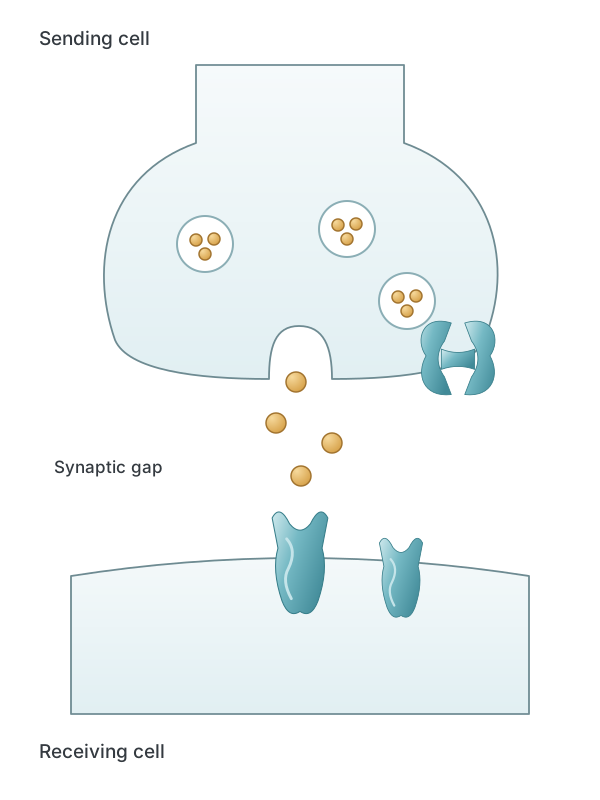
- Sending cell
Vesicles hold chemical messengers before release.
- Chemical messengers
A few illustrated particles identify the messengers; their number and spacing are illustrative.
- Return into the sending cell
A transporter returns some messenger from the gap; it is distinct from the receiving receptor.
- Receiving receptor
A receptor responds to an appropriate messenger.
Simplified teaching model. Protein shapes, sizes, particle counts and arrows are illustrative, not measurements or experimental structures.
About this illustration
Released messengers act across a synapse; transporters return some messenger into the sending cell. Serotonin availability does not provide a simple explanation of depression.
How the Medication Changes Signaling
Citalopram inhibits SERT, meaning it reduces the transporter’s activity. It is called a selective serotonin reuptake inhibitor, or SSRI, because its main uptake effect is on serotonin. Laboratory studies find much less effect on the reuptake of norepinephrine and dopamine, two other chemical messengers. This describes which transport process the medicine mainly changes, rather than predicting how much a person’s mood will improve.
What is known: Citalopram mainly reduces serotonin reuptake.
What remains uncertain: Selectivity is not a guarantee of either benefit or freedom from side effects.
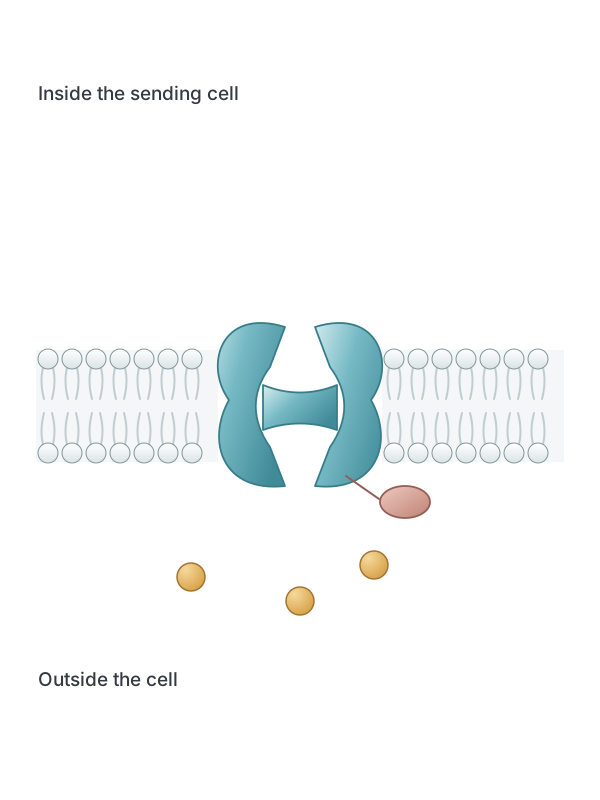
- Serotonin
The messenger is shown outside the sending cell.
- SERT
The serotonin transporter returns serotonin into the cell.
- Citalopram: uptake inhibited
The interrupted arrow names the action; the symbol is not a molecular shape or binding position.
Simplified teaching model. Protein shapes, sizes, particle counts and arrows are illustrative, not measurements or experimental structures.
About this illustration
Citalopram inhibits serotonin reuptake. Selectivity is not a guarantee of either benefit or freedom from side effects.
How does it affect my body?
Alongside mood effects, citalopram can alter digestion, sexual function and the heart’s electrical recovery interval.
The QT interval is part of the heart's electrical recovery, measured on an ECG. Citalopram's dose-related effect can very rarely be associated with a dangerous rhythm. This is why dose ceilings and interaction checks are safety requirements, not simply administrative prescribing limits.
How does my body process it?
It is metabolised in the body and has a half-lifeThe time for a measured drug level to fall by halfThe time it takes for the concentration of a medicine in a body fluid, usually blood, to decrease by half during elimination.Read the full definition of Half-life of roughly one and a half days. Liver impairment can require lower dosing.
A half-life describes the time for the amount in the body to fall by roughly half; it is not the time until symptoms improve or a missed dose becomes safe to double. CYP2C19 metabolism and liver function help explain why some people need lower limits even at ordinary adult ages.
How do treatment options differ?
A liquid is not automatically dose-equivalent to a tablet. Cipramil drops illustrate why formulations must be checked even when the ingredient is unchanged.
Escitalopram contains one of citalopram's two mirror-image forms, but it is a separate prescription with its own UK dose limits. Other SSRIs differ in licences, interactions and tolerability. No medicine is universally preferable solely because its chemical structure appears simpler.
A closer look at the science
Citalopram contains R and S molecular forms. Escitalopram contains the S form alone; the medicines have different doses and must not be treated as interchangeable.
Citalopram hydrobromide is a salt of citalopram. The neutral parent drawing does not show the bromide component and does not select one of citalopram’s two mirror-image forms. A structural diagram identifies the chemical; it cannot predict an individual response or a safe dose.
Chemical formula: C20H21FN2O · HBr
This formula describes the citalopram hydrobromide salt. Element symbols identify atoms; the dot separates the parent compound from the acid component. The drawing below shows the neutral parent, a different explicitly identified species. Chemical identity alone does not predict clinical benefit.

The parent drawing omits the salt counterion. Formulation ingredients and release coatings are not depicted.
How was this medicine developed?
Cipramil tablets were first authorised in March 1995; the drops followed in August 1998. Later heart-rhythm safety advice changed dose ceilings.
Sources and References
- Cipramil 20 mg: UK SmPC
Product information published on the electronic Medicines Compendium (emc); supplied by pharmaceutical companies.
Scope: United Kingdom product information.
- Cipramil Drops: UK SmPC
Product information published on the electronic Medicines Compendium (emc); supplied by pharmaceutical companies.
Scope: United Kingdom product information.
- Citalopram — mechanism explanation
Scope: Mechanism explanation only. Source sections checked: How to take citalopram—time before symptom improvement..
- MHRA: Citalopram and escitalopram—QT interval prolongation
Scope: United Kingdom medicines safety.
- Antidepressants: use and safety
Scope: United Kingdom.
- Citalopram 10 mg tablets (Milpharm): UK SmPC
Product information published on the electronic Medicines Compendium (emc); supplied by pharmaceutical companies.
Scope: United Kingdom product information.
- Citalopram 40 mg tablets (Milpharm): UK SmPC
Product information published on the electronic Medicines Compendium (emc); supplied by pharmaceutical companies.
Scope: United Kingdom product information.
- FDA: Celexa prescribing information and Medication Guide
- NIH: What Is a Neurotransmitter?
- Lexapro prescribing information — mechanism explanation
Scope: Mechanism explanation only. Source sections checked: 11 Description; 12.2 Pharmacodynamics..
- Depression in children and young people — recommendations
Scope: United Kingdom; NICE recommendations require attention to national implementation and local pathways.
Shared scientific background. Some references are US product pharmacology or international chemical records; UK product details and prescribing information are verified separately.
Article Information
- Edition
- United Kingdom
- Content updated
- 2026-10-30
- Source check dates
- Listed with each reference above; retained dates for shared scientific content.
- Scope
- exact products checked
Source and coverage limits
- Educational summaries cover the named UK products, not every brand, strength, formulation or prescribing circumstance.
- No claim of pharmacy stock or uniform NHS access is made.
- UK SmPC warnings are used; a US FDA boxed warning is not presented as a UK regulatory designation.
- The older MHRA safety article mentions indications more broadly; licensed-use claims here follow the exact current Cipramil SmPC instead.