
About this medicine
Cipralex is a checked UK brand. Lexapro remains a useful American search alias, but its US age indications and formulations must not be assumed to apply here.
What is this medicine used for?
UK Cipralex products cover major depression, panic disorder with or without agoraphobia, social anxiety, generalised anxiety and OCD. Their licence is for adults; use below 18 is outside this licensed scope.
Enalto has the adult depression, panic, social anxiety, generalised anxiety and OCD indications described here. Its label does not support use below 18; dissolving in the mouth does not confer a childhood licence or remove escitalopram’s cardiac and interaction precautions.
Which warning signs need help?
Fainting or a fast irregular heartbeat may indicate a serious rhythm problem. Fever with confusion or twitching may indicate serotoninSerotoninA chemical messenger involved in several functions, including sleep, mood and digestion. It acts through different receptors, with effects that depend on the cell.Read the full definition of Serotonin syndrome. Seek urgent help for self-harm thoughts or overdose; severe allergic reactions require emergency care.
MHRA’s October 2026 communication announced the rollout of a prominent boxed warning in UK antidepressant patient leaflets about self-harm and suicidal behaviour, alongside a patient safety card. This UK patient-information measure is not the US FDA Boxed Warning designation. Read the leaflet supplied with your medicine, seek prompt professional help for new or worsening mood or behaviour changes, and do not stop treatment suddenly without advice.
How do I take it safely?
Adult product reference: most indications begin at 10 mg daily, with a 20 mg maximum. Panic disorder begins at 5 mg for one week. Older adults start at 5 mg, with a 10 mg maximum. The drops contain alcohol; use the supplied dropper and exact prescribed number, not a kitchen spoon.
Tablets are taken once daily, with or without food. Liver impairment and known slow CYP2C19 metabolism require lower starting doses and careful review; severe kidney impairment also warrants caution.
Enalto provides an orodispersible option: let it disintegrate on the tongue before swallowing. The checked 10 mg tablet is unscored and cannot supply equal half-doses. A lower prescribed amount needs a suitable prescribed presentation, not an assumed half-tablet.
What side effects should I know about?
Nausea, sweating, sleep changes, headache, sexual difficulties, dizziness and appetite or weight changes are recognised. Some effects settle; persistent problems deserve review.
MHRA is adding the term post-SSRI sexual dysfunction (PSSD) to patient leaflets describing persistent sexual difficulties after stopping certain antidepressants, including this medicine. Their frequency and causes remain under study. Persistent symptoms deserve support; this does not mean everyone taking the medicine will experience them.
Who needs extra care with this medicine?
Known long-QT syndromes and combinations with QT-prolonging medicines are contraindicationsA medical reason a medicine should not be usedA medical reason a medicine should not be used in a particular situation because it may be harmful.Read the full definition of Contraindication. Epilepsy, prior mania, glaucoma, low sodium, bleeding risk and liver disease need assessment.
Can it affect my other medicines?
MAO inhibitors, including linezolid, must not be combined with escitalopram. Review heart-rhythm medicines, anticoagulants, anti-inflammatory painkillers and St John’s wort. Omeprazole can increase escitalopram exposure.
What check-ups will I need?
MHRA advises considering an ECG before treatment in cardiac disease and correcting low potassium or magnesium. New palpitations or fainting require cardiac assessment.
Follow-up checks mood, everyday functioning, sleep, sexual effects and restlessness, especially after starting or changing the dose. Diabetes control can change; bleeding risk and susceptibility to low sodium also need consideration.
What about pregnancy, breastfeeding and age?
Discuss pregnancy and breastfeeding with the prescriber; needed treatment may continue after an individual assessment. Infants may need observation. UK licensing should not be inferred from Lexapro’s American paediatric indications.
The Cipralex SmPC advises against breastfeeding during treatment. This product wording should be discussed with the maternity or prescribing team rather than treated as an instruction to stop abruptly. Late-pregnancy exposure can cause newborn feeding, breathing or adaptation problems and is associated with increased bleeding around delivery.
What if I miss a dose or want to stop?
Gradual dose reduction helps limit withdrawalWithdrawalSymptoms that may occur after reducing or stopping a medicine or substance to which the body has adapted.Read the full definition of Withdrawal. If a dose is forgotten, follow the packet instructions and never take two doses to compensate.
Withdrawal may include dizziness, electric-shock sensations, disturbed sleep, nausea or anxiety. It can be severe or prolonged; a prescriber-guided reduction may take weeks or months rather than a fixed short course.
How does it work?
Escitalopram changes how nerve cellsNeuronA nerve cell that receives and sends information. Neurons work in connected groups, rather than carrying a whole thought on their own.Read the full definition of Neuron communicate using serotonin, a chemical messenger involved in mood and other functions. It slows the return of released serotonin into the cell that sent it, leaving more available between cells. This is thought to contribute to its benefit, although the full connection between this action and relief from symptoms is not established.
How Brain Cells Communicate
Nerve cells, also called neurons, release chemical messengers called neurotransmitters into tiny gaps between cells, known as synapses. Serotonin can then attach to receptors, proteins that detect the message and change a cell’s activity. The serotonin transporter, or SERT, carries some serotonin back into the sending cell. This return process is called reuptake and helps regulate how long the messenger remains available.
What is known: SERT carries released serotonin back into nerve cells.
What remains uncertain: Serotonin signaling is only one part of the biology of mood.
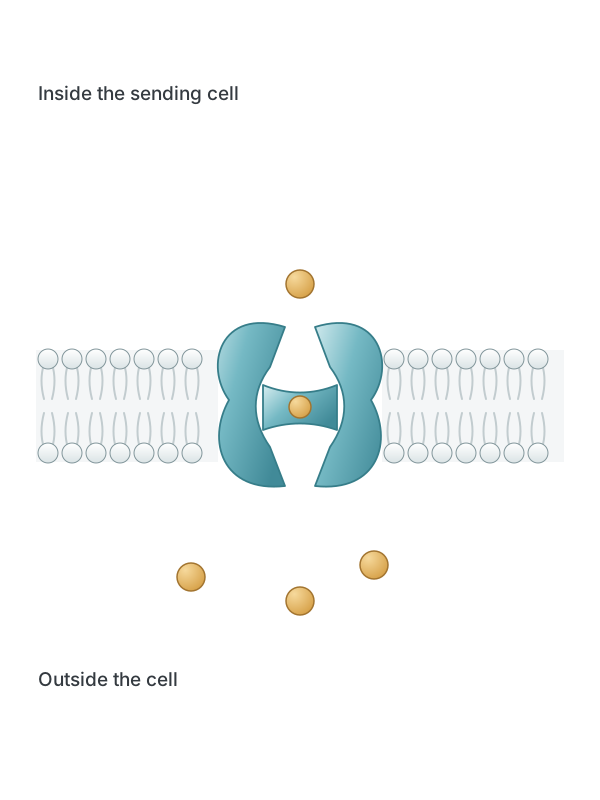
- Serotonin
The messenger is shown outside the sending cell.
- SERT
The serotonin transporter returns serotonin into the cell.
- Return into the cell
The arrow shows transport direction, without a measured rate.
Simplified teaching model. Protein shapes, sizes, particle counts and arrows are illustrative, not measurements or experimental structures.
About this illustration
Before medicine: reuptake: The serotonin transporter returns serotonin into a nerve cell. Serotonin signaling is only one part of the biology of mood.
How the Medication Changes Signaling
Escitalopram inhibits SERT, meaning it reduces the transporter’s activity. This slows serotonin reuptake and changes the amount of serotonin available to interact with receptors. Escitalopram is called a selective serotonin reuptake inhibitor, or SSRI, because this is its main transport effect. Laboratory studies find much less effect on the reuptake of norepinephrine and dopamine, two other chemical messengers.
What is known: Escitalopram primarily inhibits serotonin reuptake.
What remains uncertain: Selectivity in laboratory tests cannot predict an individual’s benefit or side effects.
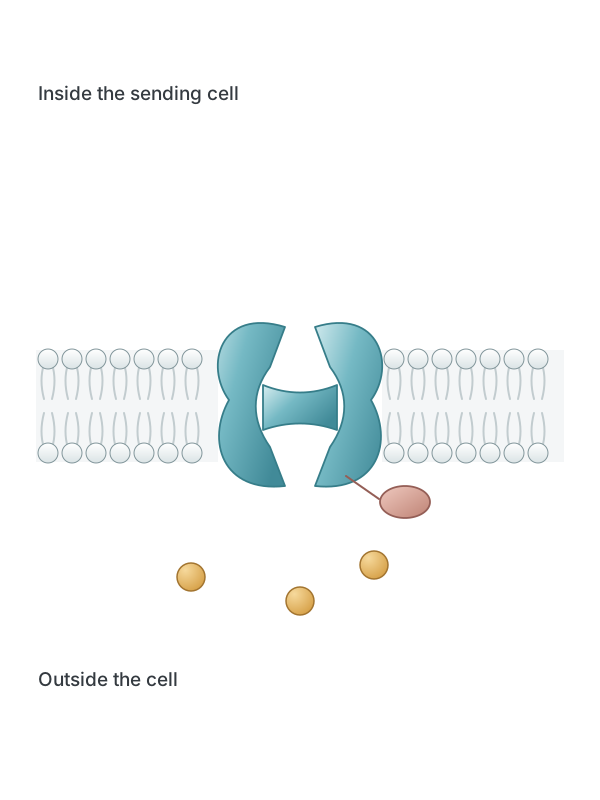
- Serotonin
The messenger is shown outside the sending cell.
- SERT
The serotonin transporter returns serotonin into the cell.
- Escitalopram: uptake inhibited
The interrupted arrow names the action; the symbol is not a molecular shape or binding position.
Simplified teaching model. Protein shapes, sizes, particle counts and arrows are illustrative, not measurements or experimental structures.
About this illustration
With escitalopram: Escitalopram inhibits serotonin reuptake. Selectivity in laboratory tests cannot predict an individual’s benefit or side effects.
How does it affect my body?
Effects extend beyond mood: bowel symptoms and sexual difficulties can occur, and heart electrical recovery may be prolonged.
How does my body process it?
CYP2C19 is the principal liver enzyme involved. The half-lifeThe time for a measured drug level to fall by halfThe time it takes for the concentration of a medicine in a body fluid, usually blood, to decrease by half during elimination.Read the full definition of Half-life is about 30 hours; slower metabolism can raise exposure.
How do treatment options differ?
Escitalopram and citalopram are related but are separate medicines with different milligram doses. They must not be exchanged milligram for milligram.
A closer look at the science
It is the S form of citalopram. Besides its main transporterTransporterA protein that moves a substance across a cell membrane. Some transporters help remove released chemical messengers from the space around nerve cells.Read the full definition of Transporter-binding site, it binds a second, allosteric site with substantially lower affinity.
Escitalopram oxalate is a salt of escitalopram. The drawing shows neutral escitalopram, the S form, without its oxalate component. Its mirror-related molecular identity distinguishes it from the two-form mixture called citalopram.
Chemical formula: C20H21FN2O · C2H2O4
The formula describes the oxalate salt. C, H, F, N and O represent carbon, hydrogen, fluorine, nitrogen and oxygen. The dot separates the escitalopram and oxalate components; the picture is not a binding model.

The depicted parent and the salt formula describe different explicitly identified species.
How was this medicine developed?
Cipralex’s UK tablet authorisation dates from June 2002. Subsequent MHRA safety advice established lower dose ceilings for older adults and people with liver impairment.
Sources and References
- Cipralex tablets: UK SmPC
Product information published on the electronic Medicines Compendium (emc); supplied by pharmaceutical companies.
Scope: United Kingdom product information.
- Cipralex oral drops: UK SmPC
Product information published on the electronic Medicines Compendium (emc); supplied by pharmaceutical companies.
Scope: United Kingdom product information.
- Cipralex tablets: patient leaflet
Product information published on the electronic Medicines Compendium (emc); supplied by pharmaceutical companies.
Scope: United Kingdom product information.
- NHS: Escitalopram
Scope: NHS website medicines information (England); not a guarantee of identical services across UK nations.
- MHRA: Citalopram and escitalopram—QT interval prolongation
Scope: United Kingdom.
- Antidepressants: use and safety
Scope: United Kingdom.
- Enalto 10 mg orodispersible tablets — SmPC
Product information published on the electronic Medicines Compendium (emc); supplied by pharmaceutical companies.
Scope: United Kingdom; named product information.
- FDA: Lexapro prescribing information and Medication Guide
- NIH: What Is a Neurotransmitter?
- Serotonin syndrome: MedlinePlus Medical Encyclopedia
- Monitoring a person during and after antidepressant switching – NHS SPS - Specialist Pharmacy Service – The first stop for professional medicines advice
Shared scientific background. Some references are US product pharmacology or international chemical records; UK product details and prescribing information are verified separately.
Article Information
- Edition
- United Kingdom
- Content updated
- 2026-10-24
- Source check dates
- Listed with each reference above; retained dates for shared scientific content.
- Scope
- exact products checked
Source and coverage limits
- Educational summaries cover the named UK products, not every brand, strength, formulation or prescribing circumstance.
- No claim of pharmacy stock or uniform NHS access is made.
- UK SmPC warnings are used; a US FDA boxed warning is not presented as a UK regulatory designation.