
About this medicine
Prozac is a recognised fluoxetine alias, retained for search rather than a claim about present UK brand supply. Checked products include a generic capsule, Olena dispersible tablets and a generic oral solution.
What is this medicine used for?
Adults: major depression, OCD and bulimia, the latter alongside psychotherapy. From age 8, the checked SmPC permits moderate-to-severe depression unresponsive to 4–6 psychological-therapy sessions, with continuing psychological therapy and specialist supervision.
Which warning signs need help?
Get urgent help for new self-harm thoughts, seizures, severe bleeding, or fever with agitation and muscle stiffness. A severe allergic reaction is an emergency. Taking too much requires urgent medical advice even if initially well.
MHRA’s October 2026 communication announced the rollout of a prominent boxed warning in UK antidepressant patient leaflets about self-harm and suicidal behaviour, alongside a patient safety card. This UK patient-information measure is not the US FDA Boxed Warning designation. Read the leaflet supplied with your medicine, seek prompt professional help for new or worsening mood or behaviour changes, and do not stop treatment suddenly without advice.
How do I take it safely?
Adult capsule reference: depression and OCD usually start at 20 mg daily; gradual increases may reach 60 mg. Bulimia’s labelled dose is 60 mg daily. Children require a lower starting dose and an appropriate formulation selected by the specialist; a 20 mg capsule is not a 10 mg dose.
Olena’s scored 20 mg tablet supplies equal halves. Swallow the prescribed whole or half tablet with water, or disperse it in half a glass of water immediately before use; do not crush or chew it. Morningside’s solution contains 20 mg in 5 ml. Its volume must match the prescribed milligrams.
What side effects should I know about?
Nausea, headache, diarrhoea or constipation, insomnia, weight changes, dizziness and sexual difficulties occur. Avoid driving if sleepy, dizzy or vision is blurred.
MHRA is adding the term post-SSRI sexual dysfunction (PSSD) to patient leaflets describing persistent sexual difficulties after stopping certain antidepressants, including this medicine. Their frequency and causes remain under study. Persistent symptoms deserve support; this does not mean everyone taking the medicine will experience them.
Who needs extra care with this medicine?
Tell the prescriber about epilepsy, mania, liver disease, diabetes, glaucoma, bleeding risk and heart-rhythm problems. Severe restlessness may worsen with a dose increase.
Both these non-capsule products contain sorbitol and are unsuitable in hereditary fructose intolerance. Olena also contains sulfur dioxide, which can rarely cause serious allergy or bronchospasm. Changing formulation warrants an excipient check, not just a strength check.
Can it affect my other medicines?
Irreversible non-selective MAO inhibitors are incompatible; at least five weeks is normally required after stopping fluoxetine before starting one, sometimes longer. Metoprolol for heart failure is contraindicated. Tamoxifen and other CYP2D6-dependent medicines need review.
Other serotonergic medicines, including some opioids, can cause serotoninSerotoninA chemical messenger involved in several functions, including sleep, mood and digestion. It acts through different receptors, with effects that depend on the cell.Read the full definition of Serotonin syndrome. Anticoagulants and anti-inflammatory painkillers can increase bleeding; medicines affecting heart rhythm need review. Interactions may remain relevant several weeks after the last dose.
What check-ups will I need?
Review mood and tolerability early. NICE recommends one-week review when a new antidepressant prescription is for someone aged 18–25 or suicide risk is a concern.
Children need height, weight and pubertal-development monitoring during and after treatment, with assessment for mania or hypomaniaHypomaniaHypomania is a distinct episode of unusually elevated or irritable mood with increased energy or activity. It describes a clinical mood state, not a standalone psychiatric disorder. A person may feel unusually productive while others notice a change.Read the full definition of Hypomania. Lower body weight can increase exposure. Adults with diabetes may need glucose-treatment review; cardiac risk can justify an ECG.
What about pregnancy, breastfeeding and age?
Pregnancy and breastfeeding need individual risk–benefit discussion. Tell the maternity team about treatment, including medicines recently stopped because fluoxetine persists in the body.
The product describes a possible increased risk of heart defects with early-pregnancy exposure, and newborn adaptation or breathing problems after late exposure. It also identifies increased bleeding risk around delivery. These observational findings inform a balanced discussion of medication and untreated illness, not an instruction to stop suddenly. Fluoxetine and norfluoxetine enter milk; breastfeeding requires a specific benefit–risk decision.
Olena and the checked liquid share the restricted depression indication from age eight after inadequate response to psychological therapy, with therapy continuing. Specialist initiation can use a 10 mg Olena half-tablet or 2.5 ml of this 20 mg/5 ml solution. These are product-specific labelled examples, not permission for unsupervised treatment or childhood OCD prescribing.
What if I miss a dose or want to stop?
Its long persistence does not mean stopping should be unsupervised. Agree a reduction plan with the prescriber. Never double a forgotten dose.
How does it work?
Fluoxetine slows the return of serotonin, a chemical messenger, into the nerve cellsNeuronA nerve cell that receives and sends information. Neurons work in connected groups, rather than carrying a whole thought on their own.Read the full definition of Neuron that released it. This leaves more serotonin available between cells and changes how they communicate. Its action on signalling should not be confused with an immediate sedative effect, meaning sleepiness or reduced alertness. A response to treatment does not establish that symptoms were caused by a simple shortage of serotonin.
How Brain Cells Communicate
Nerve cells release chemical messengers, called neurotransmitters, into tiny gaps between cells, known as synapses. A messenger can attach to a receptor, a protein that detects it and changes a cell’s activity. The serotonin transporter, or SERT, carries some serotonin back into the sending cell. This return process is called reuptake and helps control how long the messenger is available.
What is known: Serotonin communication involves both receptors and a return transporter.
What remains uncertain: One messenger does not account for all the processes involved in mood.
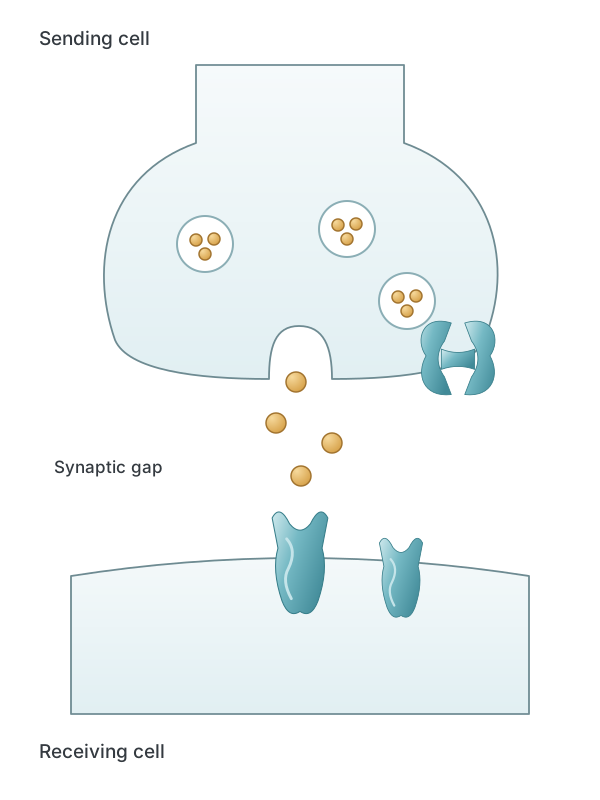
- Sending cell
Vesicles hold chemical messengers before release.
- Chemical messengers
A few illustrated particles identify the messengers; their number and spacing are illustrative.
- Return into the sending cell
A transporter returns some messenger from the gap; it is distinct from the receiving receptor.
- Receiving receptor
A receptor responds to an appropriate messenger.
Simplified teaching model. Protein shapes, sizes, particle counts and arrows are illustrative, not measurements or experimental structures.
About this illustration
Released messengers act across a synapse; transporters return some messenger into the sending cell. One messenger does not account for all the processes involved in mood.
How the Medication Changes Signaling
Fluoxetine inhibits SERT, reducing the transporter’s activity and slowing serotonin reuptake. Its main measured uptake effect is on serotonin, which is why it is called a selective serotonin reuptake inhibitor, or SSRI. A change in the availability of serotonin can alter signaling within connected groups of nerve cells. The complete sequence from this early effect to improvement in symptoms remains uncertain.
What is known: Fluoxetine mainly inhibits serotonin uptake.
What remains uncertain: A transport effect does not provide a direct measure of symptom relief.
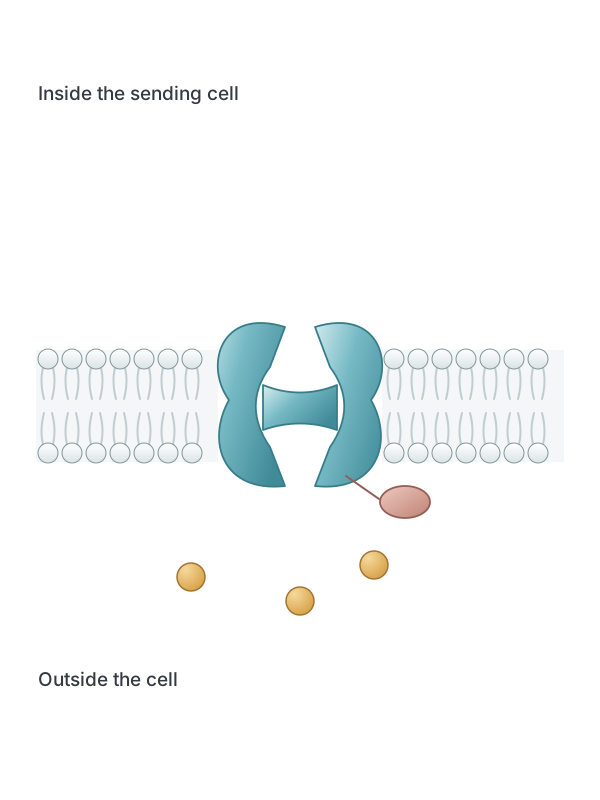
- Serotonin
The messenger is shown outside the sending cell.
- SERT
The serotonin transporter returns serotonin into the cell.
- Fluoxetine: uptake inhibited
The interrupted arrow names the action; the symbol is not a molecular shape or binding position.
Simplified teaching model. Protein shapes, sizes, particle counts and arrows are illustrative, not measurements or experimental structures.
About this illustration
Fluoxetine inhibits serotonin reuptake. A transport effect does not provide a direct measure of symptom relief.
How does it affect my body?
Sleep, appetite, bowel function and sexual function can change. Early restlessness or an unusually elevated mood should be reported.
How does my body process it?
Fluoxetine’s half-lifeThe time for a measured drug level to fall by halfThe time it takes for the concentration of a medicine in a body fluid, usually blood, to decrease by half during elimination.Read the full definition of Half-life is approximately 4–6 days; norfluoxetine’s is 4–16 days. Active substances can persist for weeks after treatment stops.
Liver disease can prolong elimination, so the prescriber may choose a lower or less frequent regimen. A long half-life describes slow clearance, not guaranteed protection against missed doses or relapse.
How do treatment options differ?
Fluoxetine persists much longer than many SSRIs. This can change withdrawalWithdrawalSymptoms that may occur after reducing or stopping a medicine or substance to which the body has adapted.Read the full definition of Withdrawal timing and the interval needed before another medicine is introduced.
A closer look at the science
Its active metabolite, norfluoxetine, contributes to the prolonged effect. Fluoxetine also inhibits CYP2D6, creating interactions beyond its serotonin action.
Fluoxetine hydrochloride is a salt of fluoxetine. Fluoxetine is a racemate: the two mirror-image forms are present together. The verified drawing shows the neutral parent compound without assigning one mirror image; it is not a drawing of a transporter-bound molecule.
Chemical formula: C17H18F3NO · HCl
This formula describes the fluoxetine hydrochloride salt. Element symbols identify atoms; the dot separates the parent compound from the acid component. The drawing below shows the neutral parent, a different explicitly identified species. Chemical identity alone does not predict clinical benefit.
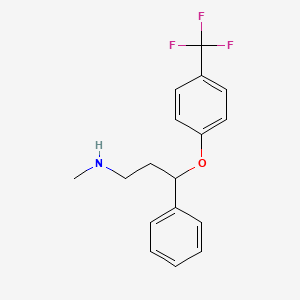
The parent drawing omits the salt counterion. Formulation ingredients and release coatings are not depicted.
How was this medicine developed?
Prozac received its original US approval on 29 December 1987. This international development milestone does not establish UK licensing, current brand availability or the age limits of the UK generic product described here.
Sources and References
- Fluoxetine 20 mg Capsules: UK SmPC
Product information published on the electronic Medicines Compendium (emc); supplied by pharmaceutical companies.
Scope: United Kingdom product information.
- Fluoxetine capsules: patient leaflet
Product information published on the electronic Medicines Compendium (emc); supplied by pharmaceutical companies.
Scope: United Kingdom product information.
- NHS: Fluoxetine
Scope: NHS website medicines information (England); not a guarantee of identical services across UK nations.
- NICE NG222: Depression in adults, recommendations
Scope: NICE guidance for England; application in other UK nations determined separately.
- Drugs@FDA: Prozac original approval history (US history only)
Scope: United States; historical approval only, not UK licence.
- Antidepressants: use and safety
Scope: United Kingdom.
- Olena 20 mg dispersible tablets — SmPC
Product information published on the electronic Medicines Compendium (emc); supplied by pharmaceutical companies.
Scope: United Kingdom; named product information.
- Fluoxetine 20 mg/5 ml oral solution — SmPC
Product information published on the electronic Medicines Compendium (emc); supplied by pharmaceutical companies.
Scope: United Kingdom; named product information.
- FDA: Prozac prescribing information and Medication Guide
- NIH: What Is a Neurotransmitter?
Shared scientific background. Some references are US product pharmacology or international chemical records; UK product details and prescribing information are verified separately.
Article Information
- Edition
- United Kingdom
- Content updated
- 2026-10-24
- Source check dates
- Listed with each reference above; retained dates for shared scientific content.
- Scope
- exact products checked
Source and coverage limits
- Educational summaries cover the named UK products, not every brand, strength, formulation or prescribing circumstance.
- No claim of pharmacy stock or uniform NHS access is made.
- UK SmPC warnings are used; a US FDA boxed warning is not presented as a UK regulatory designation.
- A 2025 SmPC and older linked PIL have differing paediatric detail; licence claims use the newer SmPC.
- NICE review timing was checked in official indexed recommendations; direct page retrieval was blocked.