
About this medicine
Symptoms may improve over days or weeks. Feeling calmer or sleepier early on is not the same as the full treatment effect.
What is this medicine used for?
The checked UK oral licence is for adults with schizophrenia, moderate to severe mania, or bipolar recurrence prevention after response to olanzapine for mania. It does not establish a UK licence for every US use.
Which warning signs need help?
In the UK, call 999 for stroke symptoms, severe breathing difficulty or high fever with stiffness and confusion. Elsewhere use local emergency services. Olanzapine is not recommended for dementia-related psychosisPsychosisPsychosis describes symptoms that affect a person’s ability to tell what is real. These can include hallucinations, delusions and disorganised thinking or speech.Psychosis can occur with different mental or physical health conditions, some medicines or substance use. It does not automatically mean schizophrenia. New symptoms need prompt professional assessment. because mortality and stroke risks increase.
After every Zypadhera injection, observation in a healthcare facility for at least three hours is required because overdose-like sedation or delirium, occasionally coma, can occur. Discharge requires alertness, orientation and no relevant symptoms. Do not drive or operate machinery for the rest of that day; arrange access to help.
How do I take it safely?
Typical adult oral starting doses are 10 mg/day for schizophrenia and 15 mg/day for mania alone, or 10 mg/day alongside other treatment. The checked range is 5–20 mg/day. Older age or organ impairment can require lower starting doses. Take oral tablets with or without food as prescribed.
Zyprexa Velotab 10 mg dissolves on the tongue, or may be dispersed in a full glass of water and taken immediately. It is bioequivalent to coated olanzapine tablets at the same dose and frequency; dissolving does not turn it into an emergency injection. It has the same adult oral indications.
Xyquila is a 10 mg vial for short-acting injection into a muscle, reconstituted to 5 mg/ml by professionals. It treats acute agitation with schizophrenia or mania when oral treatment is unsuitable. Use is short-term, no more than three consecutive days; the combined daily amount from all olanzapine formulations must be checked.
Zypadhera depot vials contain 210, 300 or 405 mg; after preparation the concentration is 150 mg/ml. This is a deep buttock-muscle injection for adult schizophrenia maintenance after oral stabilisation, not acute agitation or a bipolar licence. Prescribed injections are two- or four-weekly according to the prior oral response; do not convert the vial strength into a daily oral dose.
What side effects should I know about?
Common concerns include sleepiness, increased appetite, weight gain, dizziness and constipation. Discuss persistent symptoms and sexual or menstrual changes.
Who needs extra care with this medicine?
Known risk of narrow-angle glaucoma is a contraindicationA medical reason a medicine should not be usedA medical reason a medicine should not be used in a particular situation because it may be harmful.Read the full definition of Contraindication. Diabetes, seizures and Parkinson’s disease need assessment. The checked product is not recommended below 18.
Urinary retention, bowel obstruction risk, reduced white-cell counts and liver disease need attention. Fever or infection symptoms, jaundice, and persistent abnormal movements deserve prompt assessment. Combining olanzapine with valproate can increase low-neutrophil risk.
Can it affect my other medicines?
Fluvoxamine, ciprofloxacin and carbamazepine can affect treatment. Sedatives and alcohol add impairment. Check herbal products and cannabidiol with a pharmacist.
Simultaneous short-acting intramuscular olanzapine and injected benzodiazepines is not recommended because of excessive sedation and cardiorespiratory depression. If an injected benzodiazepine is necessary after Xyquila, the SmPC specifies waiting at least one hour and careful clinical monitoring; this is a supervised-care requirement.
Evidence update — injectable olanzapine and benzodiazepines: A 2024 study reviewed records from 693 emergency-department patients given two injections within 60 minutes. A breathing tube was needed in 5 of 144 patients receiving olanzapine plus a benzodiazepine (3.5%), compared with 21 of 549 receiving two olanzapine doses (3.8%).
This observational study did not detect a significant difference; it does not establish equal safety or exclude serious harm. It studied short-acting injections, not tablets or long-acting depot treatment.
US emergency-care guidance: The American College of Emergency Physicians (ACEP) supports an atypical antipsychotic with midazolam for severe agitation in adults in the emergency department. This is setting-specific guidance, not a change to product labelling or a general recommendation for routine inpatient or home use.
It provides no specific drug recommendation for people older than 65. Product-specific warnings and professional monitoring remain necessary. It does not replace the UK Xyquila timing and monitoring requirements above; Xyquila is for intramuscular use, not intravenous use.
What check-ups will I need?
Check weight, blood pressure, glucose and lipids, alongside response and movement symptoms. Monitoring frequency depends on the treatment phase and individual risk.
The oral SmPC gives examples of glucose checks before treatment, at 12 weeks and annually, and weight checks before treatment, at weeks four, eight and twelve, then quarterly. Lipid surveillance follows the applicable antipsychotic guidance and individual risk. New thirst, frequent urination or weakness can signal high glucose.
Following Xyquila, staff monitor consciousness, breathing, blood pressure and pulse, particularly during the first four hours. Depot monitoring is a separate requirement and cannot be replaced by the routine oral-tablet follow-up schedule.
What about pregnancy, breastfeeding and age?
Pregnancy requires a treatment review without abrupt self-discontinuation. The Zyprexa label advises against breastfeeding; NHS advice permits selected use after discussion, with infant observation. The distinction needs individual professional assessment.
Adolescent studies found greater weight, lipid and prolactin changes than adult studies; this helps explain why the UK product is not recommended below 18 rather than simply inheriting American paediatric indications.
What if I miss a dose or want to stop?
Avoid double doses. Contact the prescriber after two or more missed doses. Planned stopping is usually gradual to reduce withdrawal symptomsWithdrawalSymptoms that may occur after reducing or stopping a medicine or substance to which the body has adapted.Read the full definition of Withdrawal and relapse risk.
How does it work?
Olanzapine changes how brain cells respond to several chemical messengers, including dopamineDopamineA chemical messenger involved in movement, learning and emotion. Its name does not describe one feeling or one role throughout the brain.Read the full definition of Dopamine and serotoninSerotoninA chemical messenger involved in several functions, including sleep, mood and digestion. It acts through different receptors, with effects that depend on the cell.Read the full definition of Serotonin. It attaches to receptorsReceptorA protein that recognizes a signal and helps a cell respond. Different receptor types can produce different responses to the same messenger.Read the full definition of Receptor, proteins that receive these messages, and blocks activation at several types. These actions are well described, but they do not yet provide a complete explanation of its treatment benefits.
How Brain Cells Communicate
Brain cells work in connected networks, passing messages with chemicals called neurotransmitters. A messenger can have different effects at different receptors, so dopamine and serotonin each influence more than one brain function. The response also depends on the other messages a cell receives, which is why one receptor cannot explain an entire experience or illness.
What is known: The same chemical messenger can produce different responses at different receiving sites.
What remains uncertain: A pathway drawing does not establish what caused an individual’s difficulties.
Dopamine: Dopamine receptor
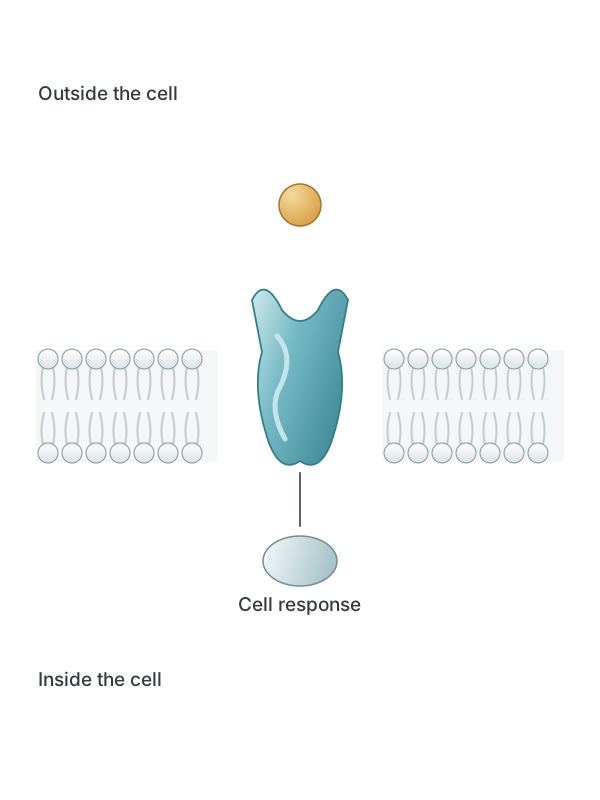
- Dopamine
A messenger can change signaling through its receptor.
- Dopamine receptor
This receptor symbol identifies a function, not a molecular structure.
- Cell response
The arrow represents a signaling response, not movement through a pore.
Simplified teaching model. Protein shapes, sizes, particle counts and arrows are illustrative, not measurements or experimental structures.
Dopamine can activate dopamine receptors and change signaling in the cell.
Serotonin: 5-HT2 receptor
- Serotonin
A messenger can change signaling through its receptor.
- 5-HT2 receptor
This receptor symbol identifies a function, not a molecular structure.
- Cell response
The arrow represents a signaling response, not movement through a pore.
Simplified teaching model. Protein shapes, sizes, particle counts and arrows are illustrative, not measurements or experimental structures.
Serotonin can activate 5-ht2a receptor and change signaling in the cell.
About this illustration
Messages in a network. A pathway drawing does not establish what caused an individual’s difficulties.
A simplified pathway does not establish the cause of an individual’s illness.
Qualitative teaching model
How the Medication Changes Signaling
Olanzapine blocks several dopamine and serotonin receptor types, including dopamine D2 and serotonin 5-HT2A; the letters and numbers identify particular receiving sites. This blocking action is called antagonism. It also acts at histamine receptors involved in wakefulness, adrenergic receptors responding to adrenaline and norepinephrine, and muscarinic receptors responding to acetylcholine, another chemical messenger. Acting across these systems helps explain why effects on alertness, appetite and other body functions need consideration alongside changes in symptoms.
What is known: Olanzapine changes responses at several families of receiving sites.
What remains uncertain: The contribution of each individual receptor action to benefit is not fully established.
Olanzapine: Dopamine receptor
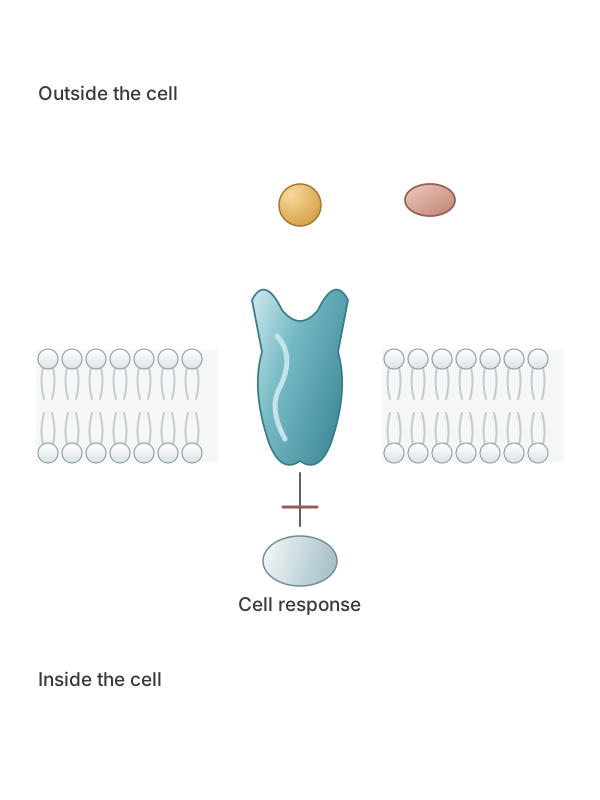
- Dopamine
A messenger can change signaling through its receptor.
- Dopamine receptor
This receptor symbol identifies a function, not a molecular structure.
- Olanzapine: activation opposed
The crossbar marks opposition to receptor activation, not permanent closure.
Simplified teaching model. Protein shapes, sizes, particle counts and arrows are illustrative, not measurements or experimental structures.
Olanzapine antagonizes dopamine receptors. This is one example from a broader receptor profile, not a complete explanation of clinical response.
Olanzapine: 5-HT2 receptor
- Serotonin
A messenger can change signaling through its receptor.
- 5-HT2 receptor
This receptor symbol identifies a function, not a molecular structure.
- Olanzapine: activation opposed
The crossbar marks opposition to receptor activation, not permanent closure.
Simplified teaching model. Protein shapes, sizes, particle counts and arrows are illustrative, not measurements or experimental structures.
Olanzapine also opposes serotonin 5-HT2 receptor activation. The serotonin target is separate from the dopamine receptor.
About this illustration
Several receptor families. The contribution of each individual receptor action to benefit is not fully established.
The full mechanism of clinical effects remains unclear.
Qualitative teaching model
How does it affect my body?
Sleepiness, appetite increase, weight gain and dizziness can affect everyday activities. Blood glucose and cholesterol can rise.
How does my body process it?
CYP1A2 contributes to metabolism. Smoking can increase clearance; changes in smoking need clinical review because exposure may change.
How do treatment options differ?
Choice among antipsychotics involves balancing symptom benefit against side effectsAn effect beyond the intended treatment effectAn effect of a treatment in addition to its intended effect. It may be unwanted, harmful or sometimes beneficial.Read the full definition of Side effect. Oral tablet doses must not be reused as injection instructions.
A closer look at the science
Olanzapine binds to several receptor families, including dopamine, serotonin, histamine, muscarinic and alpha-adrenergic receptors. Receptor findings do not fully predict an individual’s response.
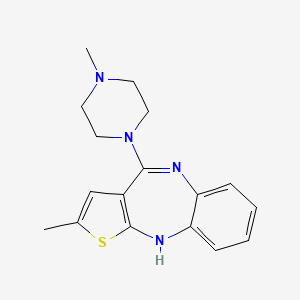
Olanzapine is a small organic molecule. This verified two-dimensional depiction shows chemical connectivity rather than its shape bound to a receptor.
Chemical formula: C17H20N4S
The formula counts atoms in one parent molecule: C is carbon, H hydrogen, N nitrogen, O oxygen, Cl chlorine, F fluorine and S sulfur where present. Atom counts do not specify a clinical dose or predict treatment response.
How was this medicine developed?
The Zyprexa record lists first authorisation in September 1996; its current holder is Neon Healthcare.
Sources and References
- Zyprexa coated tablets — UK SmPC
Product information published on the electronic Medicines Compendium (emc); supplied by pharmaceutical companies.
Scope: United Kingdom product information.
- About olanzapine
Scope: NHS website medicines information (England); not a guarantee of identical services across UK nations.
- Taking olanzapine
Scope: NHS website medicines information (England); not a guarantee of identical services across UK nations.
- Olanzapine side effects
Scope: NHS website medicines information (England); not a guarantee of identical services across UK nations.
- Olanzapine in pregnancy and breastfeeding
Scope: NHS website medicines information (England); not a guarantee of identical services across UK nations.
- Olanzapine interactions
Scope: NHS website medicines information (England); not a guarantee of identical services across UK nations.
- Bipolar disorder: assessment and management (CG185), recommendations
Scope: NICE guidance for England; application in other UK nations determined separately.
- Zyprexa Velotab 10 mg orodispersible tablets — UK SmPC
Product information published on the electronic Medicines Compendium (emc); supplied by pharmaceutical companies.
Scope: United Kingdom product information.
- Zypadhera 210 mg, 300 mg and 405 mg powder and solvent for prolonged-release injection — UK SmPC
Product information published on the electronic Medicines Compendium (emc); supplied by pharmaceutical companies.
Scope: United Kingdom product information.
- Xyquila 10 mg powder for solution for injection — UK SmPC
Product information published on the electronic Medicines Compendium (emc); supplied by pharmaceutical companies.
Scope: United Kingdom product information.
- Zyprexa: current US prescribing information (10/2026)
- Cole et al. (2024): injectable olanzapine with or without a benzodiazepine in the emergency department
- ACEP clinical policy: severe agitation in adult emergency-department patients (approved October 2023; published January 2024)
- NIMH: Understanding psychosis
Shared scientific background. Some references are US product pharmacology or international chemical records; UK product details and prescribing information are verified separately.
Article Information
- Edition
- United Kingdom
- Content updated
- 2026-10-28
- Source check dates
- Listed with each reference above; retained dates for shared scientific content.
- Scope
- exact products checked
Source and coverage limits
- Named oral, short-acting injection and depot products are checked, not every manufacturer, strength or local formulary. Product strengths are not a personal dosing schedule.
- Rapid tranquillisation and oral-to-depot conversion require product-specific professional protocols; this educational article is not an administration manual.
- Breastfeeding advice differs between manufacturer labelling and NHS clinical advice; both are stated.