
About this medicine
It can improve symptoms over several days or weeks. Restlessness is a possible adverse effect and should be discussed if troublesome.
An antipsychotic may be prescribed for psychosisPsychosisPsychosis describes symptoms that affect a person’s ability to tell what is real. These can include hallucinations, delusions and disorganised thinking or speech.Psychosis can occur with different mental or physical health conditions, some medicines or substance use. It does not automatically mean schizophrenia. New symptoms need prompt professional assessment. or for a specific mood episode; its name alone does not establish a person's diagnosisDiagnosisA clinical conclusion about the condition that best explains a person’s symptoms and other findings.Read the full definition of Diagnosis. This record concerns the checked oral products. Psychological, social and physical-health care can remain important alongside medication.
What is this medicine used for?
The UK label covers schizophrenia from age 15 and adult bipolar I mania/selected recurrence prevention. Mania treatment from age 13 is limited to 12 weeks. Depression augmentation and autism-related irritability are not licensed indications in this checked UK product.
The adult prevention indication is specifically prevention of another manic episodeMania versus HypomaniaMania and hypomania both involve an unusual increase in mood and energy or activity. The distinction depends on severity, functional impact, psychosis and duration; it is not simply a difference between feeling very happy and slightly happy.Read the full definition of Mania versus Hypomania in people whose predominantly manic illness responded to aripiprazole. It should not be broadened to prevention of every type of bipolar episode. Tourette's or autism-related uses discussed in American labels are not established by this UK authorisation.
UK long-acting Aripiprazole Otsuka products are for maintenance of schizophrenia in adults already stabilised on aripiprazole; the monthly product specifies oral stabilisation. They do not acquire the oral product's bipolar licence. The separate short-acting Abilify injection is for rapid control of adult agitation in schizophrenia or bipolar-I mania when oral treatment is unsuitable.
Which warning signs need help?
MHRA warns about harmful new gambling and other compulsive urges. Tell the prescriber promptly; do not independently stop treatment. Severe fever with stiffness, loss of consciousness or breathing difficulty needs emergency assessment. UK warnings should not be renamed FDA boxed warnings.
The rapid-acting injection requires regular observation of blood pressure, pulse, breathing and consciousness. Additional injectable benzodiazepines can produce excessive sedation and cardiorespiratory depression. Long-acting injections are not substitutes for immediate management of severe agitation.
How do I take it safely?
Adults with schizophrenia commonly start at 10 or 15 mg once daily; adult mania commonly starts at 15 mg. The checked adult maximum is 30 mg/day. Adolescents begin with lower, staged doses under specialist supervision. Oral medicine can be taken with or without food; liquid needs a measuring device.
For licensed adolescent indications, the product describes staged initiation using 2 mg oral solution before 5 mg and then 10 mg. Bipolar-mania doses above 10 mg are exceptional because additional adverse effects increase; treatment must not exceed the licensed 12 weeks. This is specialist product context, not a family-directed titrationTitrationAdjusting a medicine dose in planned stages, guided by the intended benefit and unwanted effects.Read the full definition of Titration plan.
Dissolving tablets offer another oral option when swallowing is difficult. The checked 10 mg tablet disperses on the tongue; it is not a long-acting injection. It contains aspartame, which matters for phenylketonuria.
The monthly product ordinarily uses 400 mg, with 300 mg considered when adverse effects occur; two-month products ordinarily use 960 mg, with 720 mg for specified circumstances. Starting can require oral cover or a carefully specified two-injection regimen. This is a specialist procedure, not a conversion based on dividing the injection strength by days. Monthly injections use the upper-arm or buttock muscle; the two-month product is gluteal only.
What side effects should I know about?
Headache, constipation, nausea, difficulty sleeping and a sense of inner restlessness are possible. Report persistent restlessness rather than assuming it is worsening illness.
New gambling, spending, sexual or eating urges may not initially seem related to medication. Patients and those close to them can help identify changes early. Reporting a concern does not mean blame or that the person's underlying condition has necessarily worsened.
Who needs extra care with this medicine?
Review cardiac disease, seizure history, diabetes risk and swallowing problems. It is not approved for dementia-related psychosisPsychosisPsychosis describes symptoms that affect a person’s ability to tell what is real. These can include hallucinations, delusions and disorganised thinking or speech.Psychosis can occur with different mental or physical health conditions, some medicines or substance use. It does not automatically mean schizophrenia. New symptoms need prompt professional assessment. in the checked label.
Low white-cell counts in the past, dehydration and swallowing problems also matter when planning care. An older person with dementia requires particular caution: this is not a general medicine to quiet distress or make care easier.
Can it affect my other medicines?
Fluoxetine, paroxetine, certain antifungals, HIV medicines and carbamazepine can interact. Avoid St John’s wort. Sedating medicines and alcohol can add impairment.
An enzyme inhibitor slows a route of breakdown; an inducer can speed it up. Both starting and stopping an interacting medicine can therefore change exposure. Tablet and liquid instructions still need the exact prescribed product, even when the active ingredient is unchanged.
Long-acting products also have distinct adjustment rules for sustained enzyme inhibitors or inducers. Their prolonged exposure means an interaction can outlast the day a medicine is added or removed; the injection team needs the complete medication list.
What check-ups will I need?
Review symptoms, restlessness, impulse-control changes, weight, blood pressure and metabolic health. Additional tests depend on history and other medicines.
Follow functioning and symptom benefit as well as weight and blood tests. Specifically ask about restlessness, unusual urges, changes in sleep and involuntary movements. A new problem after a dose change should not automatically be attributed to the psychiatric condition.
What about pregnancy, breastfeeding and age?
Pregnancy and breastfeeding require individual review. Newborn observation may be needed after late-pregnancy exposure. Aripiprazole may reduce breast-milk production; monitor feeding and seek advice about concerns.
Infant feeding and growth matter because reducing milk production can affect intake even when a medicine's milk concentration is low. Decisions about treatment and feeding require a shared plan rather than abruptly stopping a medicine that is helping maintain stability.
What if I miss a dose or want to stop?
Do not double a forgotten dose. Contact the prescriber after two or more missed doses, or the clinic after a missed injection. Planned withdrawalWithdrawalSymptoms that may occur after reducing or stopping a medicine or substance to which the body has adapted.Read the full definition of Withdrawal is supervised.
A late long-acting injection needs prompt contact with the administering service. The required restart depends on which product was given, how many injections have already been received and how late the dose is; extra oral treatment or a specific restart regimen may be required. Do not borrow tablets or combine injections to catch up.
How does it work?
Aripiprazole changes how brain cells respond to dopamine and serotoninSerotoninA chemical messenger involved in several functions, including sleep, mood and digestion. It acts through different receptors, with effects that depend on the cell.Read the full definition of Serotonin, two chemical messengers. It partly activates some receptors, the proteins that receive these messages, while blocking others. Researchers know these actions occur, but the full connection between them and improvement in symptoms is still being worked out.
How Brain Cells Communicate
Brain cells communicate by releasing chemical messengers called neurotransmitters. Dopamine and serotonin can each act at several types of receptor, and the response depends on the receiving cell and the connections around it. This helps explain why a medicine can have several effects without simply turning one chemical up or down throughout the brain.
What is known: Different receiving sites allow the same messenger to influence cells in different ways.
What remains uncertain: A receptor measurement cannot explain a person’s thoughts, feelings or diagnosis.
Dopamine: D2 receptor
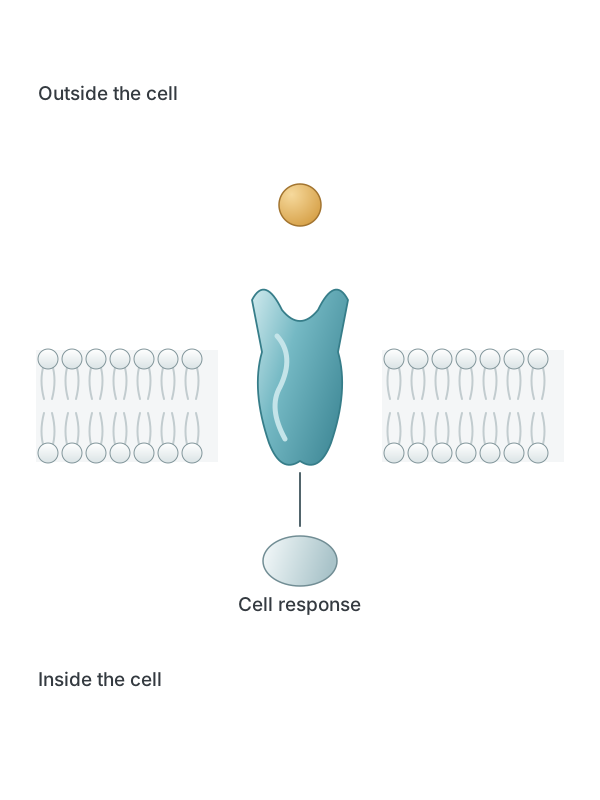
- Dopamine
A messenger can change signaling through its receptor.
- D2 receptor
This receptor symbol identifies a function, not a molecular structure.
- Cell response
The arrow represents a signaling response, not movement through a pore.
Simplified teaching model. Protein shapes, sizes, particle counts and arrows are illustrative, not measurements or experimental structures.
Dopamine can activate d2 receptor and change signaling in the cell.
Serotonin: 5-HT2A receptor
- Serotonin
A messenger can change signaling through its receptor.
- 5-HT2A receptor
This receptor symbol identifies a function, not a molecular structure.
- Cell response
The arrow represents a signaling response, not movement through a pore.
Simplified teaching model. Protein shapes, sizes, particle counts and arrows are illustrative, not measurements or experimental structures.
Serotonin can activate 5-ht2a receptor and change signaling in the cell.
About this illustration
Messenger meets receptor. A receptor measurement cannot explain a person’s thoughts, feelings or diagnosis.
A single messenger or receptor measurement cannot explain an individual psychiatric condition.
Qualitative teaching model
How the Medication Changes Signaling
Aripiprazole partly activates dopamine D2 and serotonin 5-HT1A receptors; the letters and numbers identify particular receiving sites, and 5-HT means serotonin. This is called partial agonism: the medicine activates a receptor, but produces a smaller response than a full activator under comparable conditions. At serotonin 5-HT2A receptors it acts as an antagonist, meaning it blocks activation by the usual messenger. These are different actions at different sites, so describing the medicine as a simple dopamine blocker would miss an important distinction.
What is known: Some receiving sites are partly activated, while others are blocked.
What remains uncertain: The response in a living brain also depends on the surrounding chemical messages.
Aripiprazole: D2 receptor
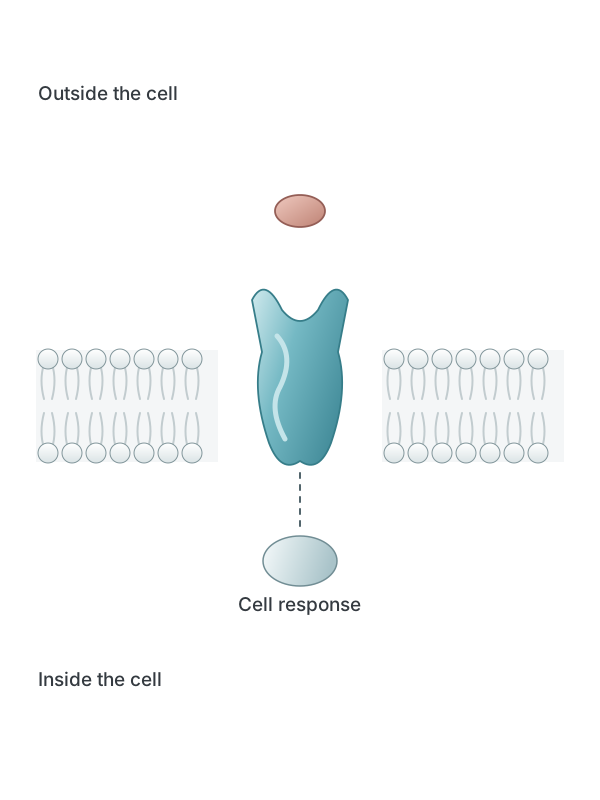
- Aripiprazole
The oval identifies the medicine acting at the D2 receptor. It is a concept symbol, not a molecular shape or binding pose.
- D2 receptor
This receptor symbol identifies a function, not a molecular structure.
- Aripiprazole: partial activation
A dashed arrow marks context-dependent partial activation; it is not a numerical effect scale.
Simplified teaching model. Protein shapes, sizes, particle counts and arrows are illustrative, not measurements or experimental structures.
Aripiprazole has partial agonist activity at dopamine D2 receptors. The response depends on the experimental system; it is not a fixed percentage.
Aripiprazole: 5-HT2A receptor
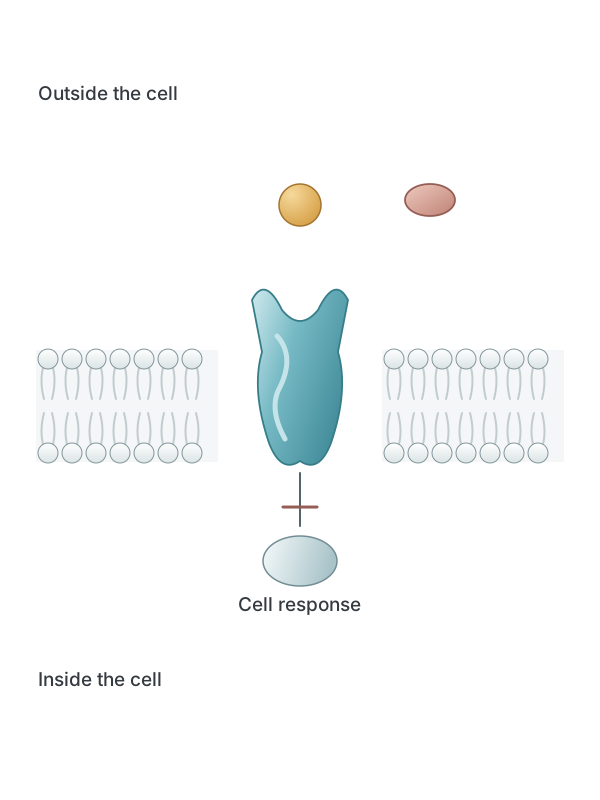
- Serotonin
A messenger can change signaling through its receptor.
- 5-HT2A receptor
This receptor symbol identifies a function, not a molecular structure.
- Aripiprazole: activation opposed
The crossbar marks opposition to receptor activation, not permanent closure.
Simplified teaching model. Protein shapes, sizes, particle counts and arrows are illustrative, not measurements or experimental structures.
Aripiprazole antagonizes serotonin 5-HT2A receptors. This differs from its partial agonist actions at other targets.
About this illustration
Different receptor actions. The response in a living brain also depends on the surrounding chemical messages.
These laboratory actions do not fully explain every clinical effect.
Qualitative teaching model
How does it affect my body?
Insomnia, anxiety, restlessness, nausea, constipation or sleepiness can occur. Weight can change in either direction.
AkathisiaAkathisiaAkathisia is distressing inner restlessness with a strong urge to move, sometimes caused by medication. It may lead to pacing, rocking or difficulty sitting still.Anxiety involves fear or worry; agitation is a broader state of distress or restlessness. These can overlap with akathisia, but the compelling urge to move is an important clue. Tell your prescriber promptly about new or worsening restlessness so the cause can be assessed. is an uncomfortable inner restlessness or need to move. It can resemble anxiety or agitation but deserves a medication review rather than an automatic increase. Partial dopamine agonism does not remove the need to watch for involuntary movements or metabolic adverse effects.
How does my body process it?
CYP2D6 and CYP3A4 process aripiprazole. Clearance varies between people and interacting medicines can change exposure.
The UK label gives an average aripiprazole half-lifeThe time for a measured drug level to fall by halfThe time it takes for the concentration of a medicine in a body fluid, usually blood, to decrease by half during elimination.Read the full definition of Half-life of about 75 hours with usual CYP2D6 metabolism and about 146 hours with poor metabolism. Half-life describes concentration decline, not a safe interval for skipping doses. The active metabolite also contributes.
How do treatment options differ?
Partial dopamine agonism does not make the medicine free of movement or metabolic adverse effects. Injection regimens cannot be inferred from oral doses.
A closer look at the science
Its proposed action combines partial agonism at dopamine D2 and serotonin 5-HT1A receptors with antagonism at 5-HT2A receptors. Partial agonism means less than maximal receptor stimulation.
Aripiprazole is a small organic molecule. This verified two-dimensional depiction shows chemical connectivity rather than its shape bound to a receptor.
Chemical formula: C23H27Cl2N3O2
The formula counts atoms in one parent molecule: C is carbon, H hydrogen, N nitrogen, O oxygen, Cl chlorine, F fluorine and S sulfur where present. Atom counts do not specify a clinical dose or predict treatment response.

How was this medicine developed?
MHRA reports that gambling warnings entered product information in 2012, with other impulse-control warnings added in 2018.
The UK gambling warning history illustrates continuing safety surveillance after authorisation. Later injectable formulations are separate products with their own initiation and missed-dose rules; their development does not turn an oral dose into an injection conversion.
Sources and References
- Abilify 30 mg tablets — UK SmPC
Product information published on the electronic Medicines Compendium (emc); supplied by pharmaceutical companies.
Scope: United Kingdom product information.
- Abilify 5 mg tablets — UK SmPC
Product information published on the electronic Medicines Compendium (emc); supplied by pharmaceutical companies.
Scope: United Kingdom product information.
- Abilify 1 mg/mL oral solution — UK SmPC
Product information published on the electronic Medicines Compendium (emc); supplied by pharmaceutical companies.
Scope: United Kingdom product information.
- About aripiprazole
Scope: NHS.uk public information (England); not a statement of uniform services or funding across the four UK nations.
- Taking aripiprazole
Scope: NHS.uk public information (England); not a statement of uniform services or funding across the four UK nations.
- Aripiprazole side effects
Scope: NHS.uk public information (England); not a statement of uniform services or funding across the four UK nations.
- Aripiprazole in pregnancy and breastfeeding
Scope: NHS.uk public information (England); not a statement of uniform services or funding across the four UK nations.
- Aripiprazole interactions
Scope: NHS.uk public information (England); not a statement of uniform services or funding across the four UK nations.
- Aripiprazole: risk of pathological gambling
Scope: United Kingdom medicines safety.
- Aripiprazole: reminder on known risk of gambling disorder
Scope: United Kingdom medicines safety.
- Bipolar disorder: assessment and management (CG185), recommendations
Scope: NICE guidance (England-based); applicability and implementation in other UK nations require the relevant national pathway.
- Aripiprazole Otsuka 400 mg pre-filled syringe — SmPC
Product information published on the electronic Medicines Compendium (emc); supplied by pharmaceutical companies.
Scope: United Kingdom product information.
- Aripiprazole Otsuka 960 mg pre-filled syringe — SmPC
Product information published on the electronic Medicines Compendium (emc); supplied by pharmaceutical companies.
Scope: United Kingdom product information.
- Abilify 7.5 mg/mL solution for injection — SmPC
Product information published on the electronic Medicines Compendium (emc); supplied by pharmaceutical companies.
Scope: United Kingdom product information.
- Abilify 10 mg orodispersible tablet — SmPC
Product information published on the electronic Medicines Compendium (emc); supplied by pharmaceutical companies.
Scope: United Kingdom product information.
- Abilify: current US prescribing information (1/2025)
- NIMH: Understanding psychosis
- A qualitative investigation into the effects of akathisia - Health Research Authority
- Extrapyramidal side effects- Management
- Anxiety and panic attacks - NHS
- Agitation: MedlinePlus Medical Encyclopedia
Shared scientific background. Some references are US product pharmacology or international chemical records; UK product details and prescribing information are verified separately.
Article Information
- Edition
- United Kingdom
- Content updated
- 2026-10-24
- Source check dates
- Listed with each reference above; retained dates for shared scientific content.
- Scope
- exact products checked
Source and coverage limits
- Named oral tablets, oral solution, dissolving tablets, monthly and two-month maintenance injections, and short-acting injection are separately checked. Not every manufacturer or pack is catalogued; strengths are not personal dosing instructions.
- Full professional initiation, conversion and missed-injection tables are linked rather than reproduced. Some NHS pages display a scheduled review date earlier than this source check; current SmPC and MHRA records also inform the article.