
About this medicine
Food is important for absorption; taking the tablet without food can reduce the amount reaching the bloodstream.
What is this medicine used for?
The UK indication is schizophrenia from age 13. American indications must not be assumed to apply to Latuda in the UK.
Which warning signs need help?
Get urgent help for fever with muscle rigidity or reduced consciousness, severe allergy, or chest pain with breathlessness suggesting a clot.
How do I take it safely?
The labelled starting dose is 37 mg daily. Adult doses may reach 148 mg; ages 13–17 have a 74 mg maximum. Organ impairment or interactions require different limits.
Moderate or severe kidney impairment generally changes the starting dose to 18.5 mg and the maximum to 74 mg/day; severe liver impairment limits the maximum to 37 mg/day. Moderate CYP3A4 inhibitors also require a lower start and ceiling. These distinctions must be prescribed, not inferred from tablet size.
What side effects should I know about?
Reported effects include nausea, restlessness, insomnia, sleepiness and movement symptoms. Weight and metabolic changes remain possible.
AkathisiaAkathisiaAkathisia is distressing inner restlessness with a strong urge to move, sometimes caused by medication. It may lead to pacing, rocking or difficulty sitting still.Anxiety involves fear or worry; agitation is a broader state of distress or restlessness. These can overlap with akathisia, but the compelling urge to move is an important clue. Tell your prescriber promptly about new or worsening restlessness so the cause can be assessed. means an uncomfortable need to move, not simply anxiety. Persistent tongue or facial movements may represent tardive dyskinesiaTardive dyskinesiaTardive dyskinesia is a movement disorder that can develop after exposure to certain medicines, particularly antipsychotics. It causes repeated movements that the person does not intend, such as lip-smacking, chewing motions or tongue movements; other body areas can be affected.The movements may persist after the medicine is stopped. Report new involuntary movements to your prescriber; medication changes should be planned with them.. Raised prolactin can affect periods, sexual function or breast symptoms; report these for review.
Who needs extra care with this medicine?
Discuss heart, kidney or liver disease, diabetes, seizures, Parkinson’s disease and dementia before treatment.
Can it affect my other medicines?
Strong CYP3A4 inhibitors and inducers are contraindicated. Avoid grapefruit; alcohol can worsen impairment. A pharmacist should check the complete medicine list.
Contraindicated examples include clarithromycin, ketoconazole, ritonavir, carbamazepine and St John’s wort. A medicine being available without prescription does not make it compatible.
What check-ups will I need?
Review symptoms, movement effects, weight, blood pressure, glucose and lipids. NICE also includes baseline prolactin and an ECG when indicated.
What about pregnancy, breastfeeding and age?
Pregnancy and breastfeeding need individual discussion. Late-pregnancy exposure may affect the newborn. The checked indication does not extend below age 13.
The SmPC describes limited pregnancy data and recommends use only when clearly necessary. It does not establish whether lurasidone enters human milk; breastfeeding requires explicit assessment. Antipsychotic-class mortality concerns in elderly people with dementia are not an indication to treat dementia with Latuda.
What if I miss a dose or want to stop?
For one missed dose, resume the next day without doubling. Contact the prescriber after two or more missed doses.
How does it work?
Lurasidone changes responses to dopamineDopamineA chemical messenger involved in movement, learning and emotion. Its name does not describe one feeling or one role throughout the brain.Read the full definition of Dopamine and serotoninSerotoninA chemical messenger involved in several functions, including sleep, mood and digestion. It acts through different receptors, with effects that depend on the cell.Read the full definition of Serotonin, chemical messengers used by brain cells. It blocks some receptorsReceptorA protein that recognizes a signal and helps a cell respond. Different receptor types can produce different responses to the same messenger.Read the full definition of Receptor, the proteins that receive these messages, and partly activates another type. These actions may contribute to its benefits, but the full explanation of how symptoms improve remains uncertain.
How Brain Cells Communicate
Brain cells communicate by releasing chemical messengers called neurotransmitters. A receiving cell responds through receptors, and different types of receptor can respond differently to the same messenger. Dopamine and serotonin act in many connected networks, so a change at one receiving site is only part of a much larger pattern of brain activity.
What is known: Messages are received through particular types of receptor.
What remains uncertain: One receiving site cannot account for a whole mood episode or experiences such as hearing voices others cannot hear.
Dopamine: D2 receptor
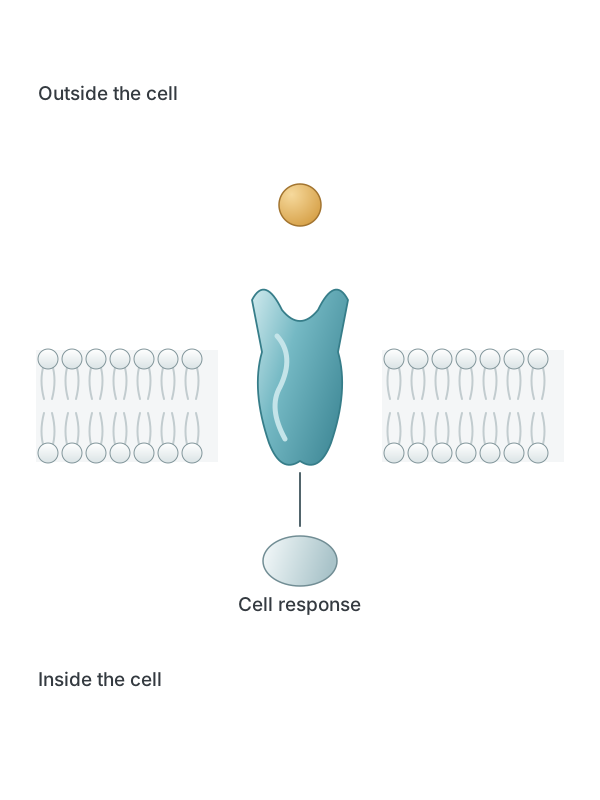
- Dopamine
A messenger can change signaling through its receptor.
- D2 receptor
This receptor symbol identifies a function, not a molecular structure.
- Cell response
The arrow represents a signaling response, not movement through a pore.
Simplified teaching model. Protein shapes, sizes, particle counts and arrows are illustrative, not measurements or experimental structures.
Dopamine can activate d2 receptor and change signaling in the cell.
Serotonin: 5-HT1A receptor
- Serotonin
A messenger can change signaling through its receptor.
- 5-HT1A receptor
This receptor symbol identifies a function, not a molecular structure.
- Cell response
The arrow represents a signaling response, not movement through a pore.
Simplified teaching model. Protein shapes, sizes, particle counts and arrows are illustrative, not measurements or experimental structures.
Serotonin can activate 5-ht1a receptor and change signaling in the cell.
About this illustration
Chemical messages. One receiving site cannot account for a whole mood episode or experiences such as hearing voices others cannot hear.
A receptor diagram cannot represent a whole mood episode or psychotic experience.
Qualitative teaching model
How the Medication Changes Signaling
Lurasidone blocks dopamine D2 receptors and serotonin 5-HT2A and 5-HT7 receptors; these labels identify receiving-site types, and 5-HT means serotonin. Blocking a receptor’s activation is called antagonism. At serotonin 5-HT1A receptors it has partial agonist activity, meaning it activates the receptor but produces a smaller response than a full activator under comparable conditions. Each action changes a different part of communication between cells.
What is known: Lurasidone blocks selected receptors and partly activates another serotonin receptor type.
What remains uncertain: Laboratory findings cannot tell us how much each action contributes to someone’s improvement.
Lurasidone: D2 receptor
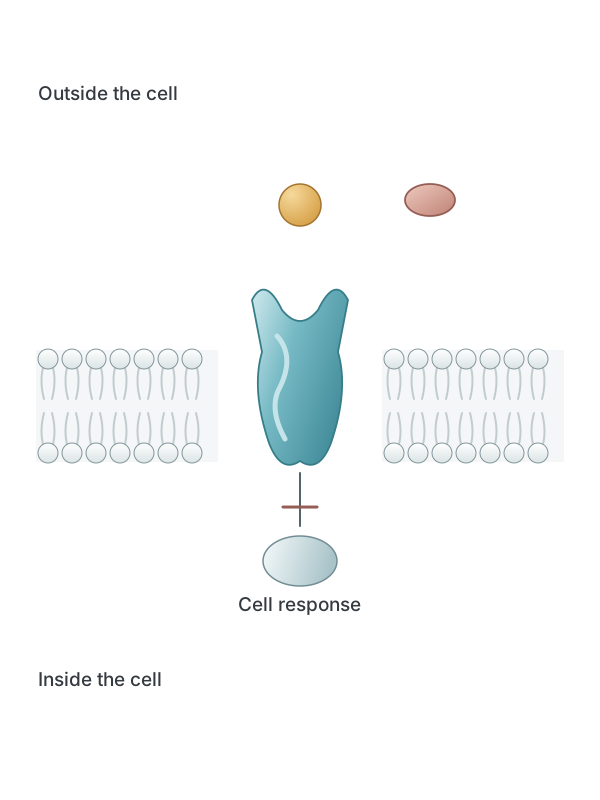
- Dopamine
A messenger can change signaling through its receptor.
- D2 receptor
This receptor symbol identifies a function, not a molecular structure.
- Lurasidone: activation opposed
The crossbar marks opposition to receptor activation, not permanent closure.
Simplified teaching model. Protein shapes, sizes, particle counts and arrows are illustrative, not measurements or experimental structures.
Lurasidone antagonizes D2 receptors; the article also describes its serotonin antagonist actions. This panel is one target example.
Lurasidone: 5-HT1A receptor
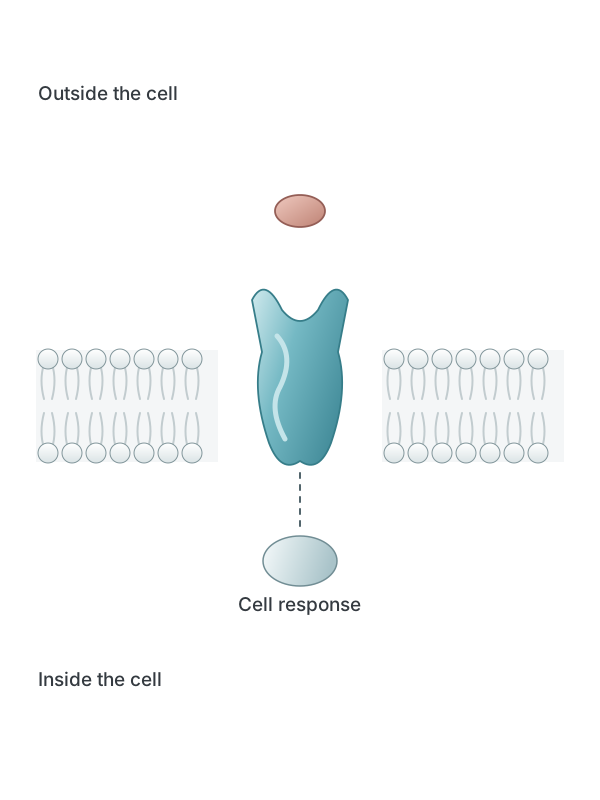
- Lurasidone
The oval identifies the medicine acting at the 5-HT1A receptor. It is a concept symbol, not a molecular shape or binding pose.
- 5-HT1A receptor
This receptor symbol identifies a function, not a molecular structure.
- Lurasidone: partial activation
A dashed arrow marks context-dependent partial activation; it is not a numerical effect scale.
Simplified teaching model. Protein shapes, sizes, particle counts and arrows are illustrative, not measurements or experimental structures.
Lurasidone partly activates 5-HT1A receptors. This action differs from its antagonism at D2, 5-HT2A and 5-HT7 receptors.
About this illustration
Lurasidone actions. Laboratory findings cannot tell us how much each action contributes to someone’s improvement.
Their separate contributions to treatment response cannot be inferred from affinity values alone.
Qualitative teaching model
How does it affect my body?
Restlessness, sleepiness or dizziness can interfere with activities. Avoid driving when affected.
How does my body process it?
CYP3A4 is central to its metabolism, making some enzyme-inhibiting or enzyme-inducing medicines important interaction risks.
How do treatment options differ?
A shared antipsychotic class does not make doses or indications interchangeable. Latuda’s meal requirement matters when comparing treatment routines.
UK strength labels express lurasidone, whereas some international labels express its hydrochloride salt. Do not reinterpret 37 mg as a different prescription merely because another country labels the corresponding salt amount differently.
A closer look at the science
It also blocks 5-HT7 receptors and partially stimulates 5-HT1A receptors. These binding properties do not predict an individual response.
Latuda contains lurasidone hydrochloride, the hydrochloride salt of lurasidone. The organic parent and the chloride component should not be confused with a single neutral parent molecule.
Chemical formula: C28H36N4O2S · HCl
C, H, N, O and S identify carbon, hydrogen, nitrogen, oxygen and sulfur in the lurasidone component; HCl identifies the hydrochloride component. The formula is chemical identity, not a dose-conversion tool.
A single neutral-parent drawing would omit the salt component and can also obscure the specified stereochemistry. The product-specific structural formula is available in section 11 of the linked official label; no unverified or simplified chemical structure is substituted here.
How was this medicine developed?
The manufacturer’s currently listed UK SmPC checked for this record carries a July 2022 revision date; that is a document date.
Latuda first received US approval for schizophrenia in October 2010. That international milestone does not establish UK licensing; the UK product’s indications and strengths are checked separately here.
Sources and References
- Latuda 37 mg tablets — UK SmPC
Product information published on the electronic Medicines Compendium (emc); supplied by pharmaceutical companies.
Scope: United Kingdom product information.
- Latuda 18.5 mg, 37 mg and 74 mg tablets — UK patient leaflet
Product information published on the electronic Medicines Compendium (emc); supplied by pharmaceutical companies.
Scope: United Kingdom product information.
- Psychosis and schizophrenia in adults: recommendations
Scope: NICE guidance for England; application in other UK nations determined separately.
- Drugs@FDA: Latuda approval and regulatory history
Scope: United States; historical approval only.
- Latuda: current US prescribing information (1/2025)
Scope: Shared scientific explanation; source remains US, not UK prescribing authority.
- A qualitative investigation into the effects of akathisia - Health Research Authority
- Extrapyramidal side effects- Management
- Anxiety and panic attacks - NHS
- Agitation: MedlinePlus Medical Encyclopedia
- Tardive dyskinesia: MedlinePlus Medical Encyclopedia
- NIMH: Mental Health Medications
Shared scientific background. US product pharmacology and chemical references do not establish UK licences, doses, formulations or NHS recommendations.
Article Information
- Edition
- United Kingdom
- Content updated
- 2026-10-24
- Source check dates
- Listed with each reference above; retained dates for shared scientific content.
- Scope
- exact products checked
Source and coverage limits
- Current manufacturer listing was checked; its older revision date is retained accurately and does not establish pharmacy stock.
- Other manufacturers were not audited.
- NICE recommendation text was checked through official indexed results; direct retrieval returned HTTP 403.