
About this medicine
Lithium can be taken for years when effective. The amount prescribed is individual; a tablet strength does not identify a safe blood level.
What is this medicine used for?
Priadel covers mania, hypomaniaHypomaniaHypomania is a distinct episode of unusually elevated or irritable mood with increased energy or activity. It describes a clinical mood state, not a standalone psychiatric disorder. A person may feel unusually productive while others notice a change.Read the full definition of Hypomania, bipolar prevention and selected recurrent depression after unsuccessful antidepressants. Its label also includes control of aggressive behaviour or intentional self-harm; this is not a self-treatment recommendation.
Which warning signs need help?
Stop lithium and obtain emergency assessment for suspected toxicity, including confusion, slurred speech, loss of coordination, marked shaking or vomiting. In the UK call 999 or go to A&E; elsewhere use local emergency services. Dehydration can increase risk even without an intentional extra dose.
Toxicity can occur despite an apparently normal measured concentration. Do not wait for the next routine blood test when symptoms suggest toxicity.
How do I take it safely?
Priadel dosing is adjusted to blood results and response. Do not crush or chew the tablets. Different lithium salts and release formulations are not interchangeable milligram for milligram; changing product needs the precautions used when starting treatment.
Take Priadel tablets at a consistent time and keep the prescribed brand and release formulation. The label gives different blood-concentration targets for acute treatment and maintenance; the target also depends on when the sample is taken. A number without its timing and clinical context is not a dosing instruction.
Priadel liquid contains lithium citrate, not the carbonate used in its prolonged-release tablets. Its labelled regimen is divided, ideally twice daily, and its pack supplies a 2.5/5 ml measuring spoon. It contains ethanol. The citrate milligram number must not be substituted for a carbonate dose.
What side effects should I know about?
Nausea, diarrhoea, metallic taste, mild hand tremor and tiredness may occur. Worsening tremor or gastrointestinal symptoms can also signal toxicity.
Who needs extra care with this medicine?
The Priadel label excludes severe kidney impairment, untreated hypothyroidism, low sodium/dehydration, specified cardiac disorders and Addison’s disease. This is not the complete contraindicationA medical reason a medicine should not be usedA medical reason a medicine should not be used in a particular situation because it may be harmful.Read the full definition of Contraindication list.
Keep fluid and salt intake reasonably consistent. Illness, vomiting, diarrhoea or a substantial diet change can alter safety; contact the care team for advice. Priadel does not recommend paediatric use. Older or lower-weight adults may need lower doses.
Can it affect my other medicines?
Some pain medicines, such as ibuprofen, can change lithium levels in your blood. So can some blood-pressure medicines called ACE inhibitors, and water tablets (diuretics), which make you pass more urine. Check with a pharmacist or your care team before starting or stopping any medicine, including medicines bought without a prescription and herbal products.
What check-ups will I need?
Before treatment: weight, kidney function, electrolytes, thyroid, calcium, blood count and appropriate cardiac/pregnancy assessment. Blood lithium is checked after starting or changing dose, then regularly; stable levels are commonly checked every three to six months, with closer monitoring for higher-risk people. Sampling is normally 12 hours after the last dose.
The Priadel SmPC generally limits stable monitoring intervals to two or three months, whereas SPS describes three-to-six-monthly testing after stabilisation and at least three-monthly checks for higher-risk people. Follow the agreed product- and patient-specific plan rather than extending appointments yourself. SPS specifies a 12-hour sample; Priadel also describes 24-hour sampling with different interpretation.
The liquid SmPC treats a product switch as starting treatment again because bioavailability can differ. Levels are checked before changing, again four to seven days after initiation, and weekly until stable. The prescribing team sets the exact dose and sampling time; this is not a home conversion rule.
What about pregnancy, breastfeeding and age?
Pregnancy requires specialist risk–benefit review and extra monitoring. Priadel lists breastfeeding as contraindicated; NHS advice describes selected specialist-supervised breastfeeding with infant monitoring. This distinction must be discussed with the treating team, not resolved by self-adjusting treatment.
The checked Priadel liquid is not recommended for children. A liquid formulation does not itself establish a paediatric indication.
What if I miss a dose or want to stop?
Planned withdrawalWithdrawalSymptoms that may occur after reducing or stopping a medicine or substance to which the body has adapted.Read the full definition of Withdrawal is gradual because sudden stopping can trigger relapse. Never double a missed dose. Emergency withholding for suspected toxicity is a separate situation.
How does it work?
Lithium changes how brain cells handle signals inside the cell. It influences several chemical processes, which can alter how cells respond to messages. Researchers have identified some of these effects, but they have not worked out exactly which ones explain lithium’s ability to help stabilize mood.
How Brain Cells Communicate
Brain cells, also called neurons, pass messages to one another and then respond through a series of chemical reactions inside the cell. Enzymes are proteins that help these reactions happen. Changing an enzyme’s activity can affect how a cell responds to a message, even when the amount of the original messenger has not changed.
What is known: Cells use enzymes and connected chemical reactions to respond to incoming signals.
What remains uncertain: These internal signaling systems have many functions beyond mood regulation.
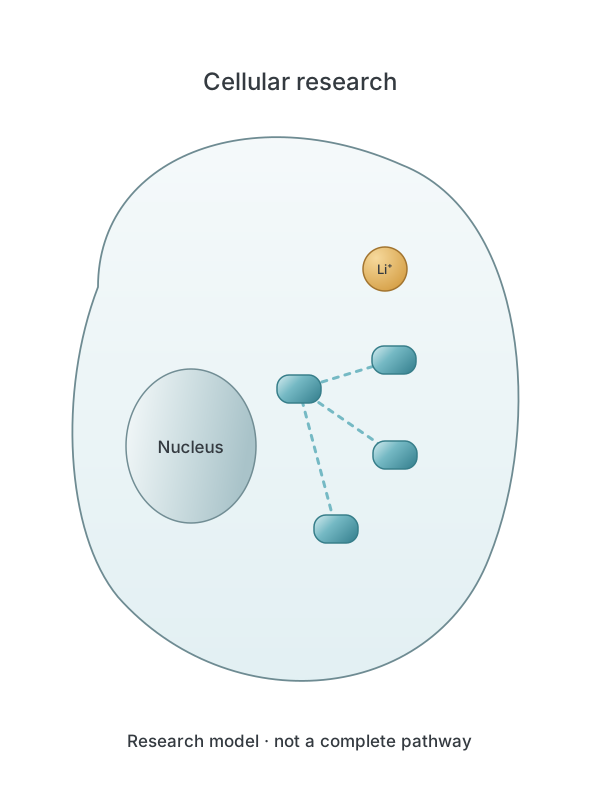
- Lithium ion · Li+
Small ion symbols identify lithium within an illustrative cell.
- Many cell processes
The branches indicate a research context, not a complete or proven therapeutic pathway.
Simplified teaching model. Protein shapes, sizes, particle counts and arrows are illustrative, not measurements or experimental structures.
About this illustration
Cellular signaling: Cells contain many interacting chemical processes. These internal signaling systems have many functions beyond mood regulation.
How the Medication Changes Signaling
One process researchers have studied is inositol recycling. Inositol is a substance cells use to make parts of their internal messaging system, and recycling allows the cell to reuse it. Laboratory studies show that lithium can slow inositol monophosphatase, an enzyme involved in this recycling. This provides one possible way lithium could change signaling inside brain cells.
What is known: Lithium can inhibit an enzyme involved in recycling inositol in laboratory studies.
What remains uncertain: How much inositol recycling contributes to clinical benefit is not established.
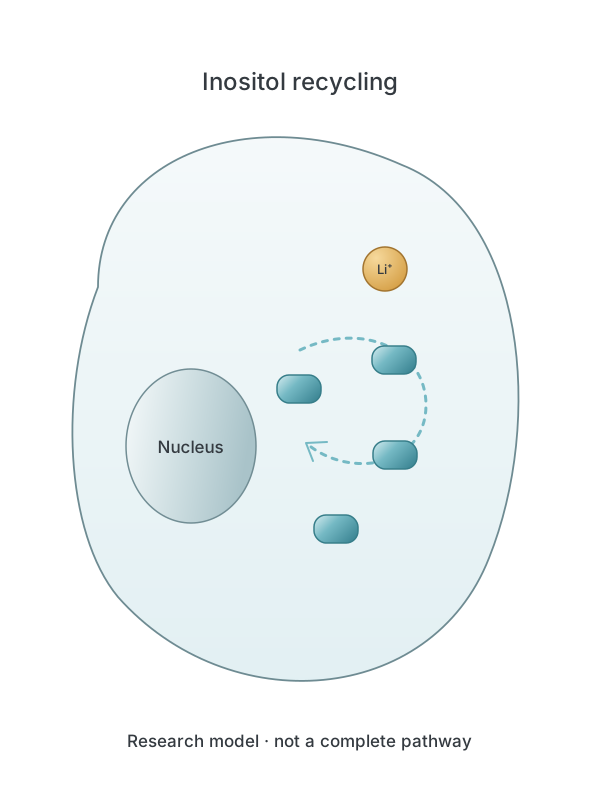
- Lithium ion · Li+
Small ion symbols identify lithium in this intracellular research model; the surrounding proteins are illustrative.
- Inositol recycling
The branches indicate a research context, not a complete or proven therapeutic pathway.
Simplified teaching model. Protein shapes, sizes, particle counts and arrows are illustrative, not measurements or experimental structures.
About this illustration
Inositol recycling research: Lithium inhibited an inositol-recycling enzyme in a bovine brain enzyme preparation. How much inositol recycling contributes to clinical benefit is not established.
How does it affect my body?
It may cause thirst, fine tremor, nausea or slowed thinking. Long-term treatment can affect the thyroid and kidneys.
How does my body process it?
Lithium is not metabolised by the liver. The kidneys remove most of it, making dehydration and changes in kidney function particularly important.
How do treatment options differ?
Unlike many alternatives, lithium requires concentration monitoring. Even two lithium brands may differ in absorption, so substitution needs professional supervision.
A closer look at the science
The active substance supplies lithium ionsIonAn atom or group of atoms with an electrical charge. Movement of ions such as sodium and potassium helps produce nerve-cell electrical signals.Read the full definition of Ion. The label describes changes in neurotransmitterNeurotransmitterA chemical messenger released by a nerve cell. Its effect depends on the receiving cell and the receptor that detects it.Read the full definition of Neurotransmitter turnover and electrolyte handling, without identifying one proven molecular explanation.
Lithium carbonate is a salt that supplies lithium ions, written Li+. The active ion has no carbon skeleton and is not usefully represented as a conventional organic drug drawing.
Chemical formula: Li2CO3
Li2CO3 describes two lithium atoms for each carbonate unit; the salt supplies charged particles in solution. Li+ means a lithium ion with one positive charge. Neither symbol specifies a dose or a proven brain target.
Li+ is a single charged atom. The linked ion and cellular diagrams are appropriate; a conventional organic structure would misrepresent it.
How was this medicine developed?
The checked Priadel 400 mg record dates its first authorisation to August 1985.
Sources and References
- Priadel 400 mg prolonged-release tablets — UK SmPC
Product information published on the electronic Medicines Compendium (emc); supplied by pharmaceutical companies.
Scope: United Kingdom product information.
- How and when to take lithium
Scope: NHS website medicines information (England); not a guarantee of identical services across UK nations.
- Side effects of lithium
Scope: NHS website medicines information (England); not a guarantee of identical services across UK nations.
- Lithium in pregnancy and breastfeeding
Scope: NHS website medicines information (England); not a guarantee of identical services across UK nations.
- Lithium interactions
Scope: NHS website medicines information (England); not a guarantee of identical services across UK nations.
- Lithium monitoring
Scope: NHS Specialist Pharmacy Service (England), professional medicines advice.
- Priadel 520 mg/5 ml liquid — SmPC
Product information published on the electronic Medicines Compendium (emc); supplied by pharmaceutical companies.
Scope: United Kingdom; named product information.
- DailyMed: Hikma lithium carbonate current label and Medication Guide — mechanism explanation
Scope: Mechanism explanation only. Source sections checked: 11 Description; 12.1 Mechanism of Action; 12.3 Pharmacokinetics..
- Hallcher and Sherman: lithium and inositol phosphatase
- Zhang and colleagues: Inhibitory phosphorylation of GSK-3 in response to lithium — mechanism explanation
Scope: Mechanism explanation only. Source sections checked: Abstract: direct and indirect GSK3 regulation..
Shared scientific background. Some references are US product pharmacology or international chemical records; UK product details and prescribing information are verified separately.
Article Information
- Edition
- United Kingdom
- Content updated
- 2026-10-24
- Source check dates
- Listed with each reference above; retained dates for shared scientific content.
- Scope
- exact products checked
Source and coverage limits
- This concise educational record does not audit every UK manufacturer, pack or local formulary. Product strengths are not a personal dosing schedule.
- Priadel carbonate tablets and citrate liquid are checked; other brands are not assumed interchangeable. Breastfeeding advice differs between the checked SmPC and specialist NHS advice; both are identified explicitly.