
What should I know first?
Lithium medicines provide lithium ions, written Li+. An ion is an atom or group carrying electrical charge. Lithium is not an organic drug molecule with a carbon skeleton.
The UK Priadel information confirms that the therapeutic mechanism is not fully understood. Lithium has a narrow safety margin and requires blood monitoring; the linked UK medicine article explains treatment precautions. The cell pathways here provide no dose or monitoring schedule.
This is a mechanism lesson, not a complete medicine guide. A diagram cannot choose treatment, predict your response, or tell you how to change a prescription.
How Brain Cells Communicate
Cells use chains of chemical reactions to carry messages internally, as well as signals between cells. Enzymes are proteins that help particular reactions occur. Changing one enzyme can affect more than one process.
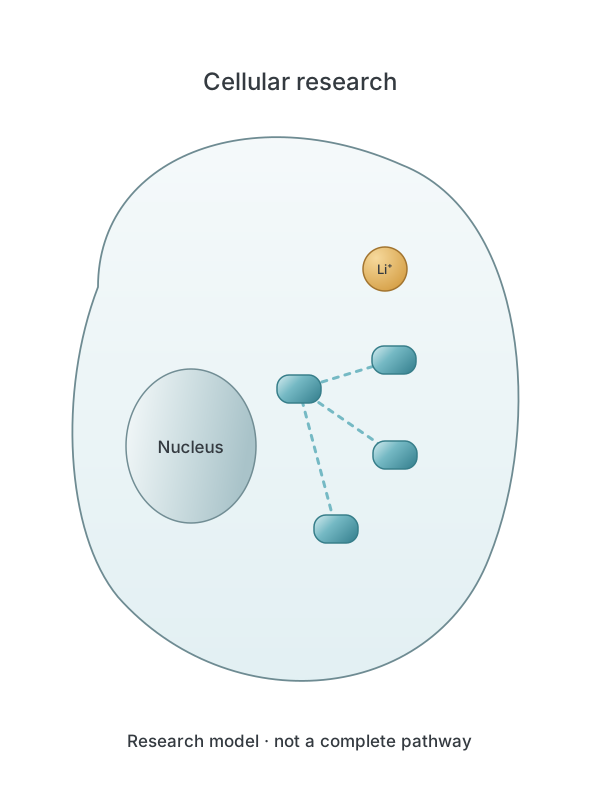
- Lithium ion · Li+
Small ion symbols identify lithium within an illustrative cell.
- Many cell processes
The branches indicate a research context, not a complete or proven therapeutic pathway.
Simplified teaching model. Protein shapes, sizes, particle counts and arrows are illustrative, not measurements or experimental structures.
About this illustration
Cells contain many interacting chemical processes. The Li+ symbol identifies lithium as an ion; the cell outline is only a teaching boundary.
How the Medication Changes Signalling
One research direction concerns inositol recycling. Experiments with an enzyme from bovine brain showed that lithium ions can inhibit inositol monophosphatase, an enzyme involved in making inositol available again.
Another concerns glycogen synthase kinase3, often called GSK3. This enzyme adds phosphate tags to other proteins. Cell and biochemical experiments show direct and indirect effects of lithium on its activity. These are investigated pathways, not a single proven account of mood stabilisation.
A Closer Look at the Molecular Level
Known findings: lithium can affect several cellular targets. Experiments need additional methods to work out which target accounts for a particular effect.
Clinical uncertainty: the current label states that lithium’s mood-stabilising mechanism is unknown. Findings in isolated enzymes, cultured cells and animals cannot alone establish which pathway explains benefit in a person.
Lithium carbonate is a salt; Li+ is the active ionic species discussed here. The Li+ symbol represents an ion, not an organic structure or a verified docking model.
Sources and References
- Priadel 400 mg: UK SmPC
Product information published on the electronic Medicines Compendium (emc); supplied by pharmaceutical companies.
Scope: United Kingdom.
- What Is a Neurotransmitter?
Scope: International scientific education; not UK regulatory evidence.
- Hallcher and Sherman: lithium and inositol phosphatase
Scope: International laboratory research.
- Zhang and colleagues: lithium and GSK3 regulation
Scope: International laboratory research.
Article Information
- Edition
- United Kingdom
- Content updated
- 2026-10-17
- Sources checked
- Listed with each reference above; retained dates for shared scientific content.
- Publication status
- Published
- Scope
- How this medicine works, with UK product information.
Source and coverage limits
- A mechanism lesson is not a complete medicine profile, dosing schedule or individual treatment recommendation.
- Original qualitative SVG diagrams explain direction and target type; they do not measure biological rates, binding geometry or clinical response.