
About this medicine
Valproate products differ in their formulations, doses and licensed uses. A brand match alone cannot establish prescribing equivalence.
For this psychiatric article the independently checked medicine is Depakote semisodium for mania, not every sodium-valproate epilepsy preparation. It is not an acute treatment for every phase of bipolar disorder. Continuing after a manic response requires assessment of effectiveness, adverse effects and the reproductive safeguards.
What is this medicine used for?
The checked indication is bipolar mania when no other treatment is effective or tolerated. Continued treatment may be considered after response.
Which warning signs need help?
For bipolar disorder, valproate is contraindicated during pregnancy. People who can become pregnant must meet Pregnancy Prevention Programme conditions. Do not stop abruptly; contact the specialist urgently if pregnancy is possible.
Severe stomach pain, repeated vomiting, jaundice, unusual bleeding or profound drowsiness/confusion can indicate serious pancreatic, liver, blood or metabolic problems. Seek urgent assessment.
The checked product carries UK additional-monitoring status. This supports reporting suspected reactions; it is not a US boxed-warning designation.
A spreading blistering rash or swelling of the face or throat needs emergency assessment. Lethargy, vomiting and impaired balance can signal excess ammonia even without the usual picture of liver failure. These are not symptoms to manage by adjusting tablets at home.
How do I take it safely?
The adult mania label starts at 750 mg daily in divided doses, then individualises treatment. This describes the product protocol, not a dose recommendation for a reader.
Depakote’s gastro-resistant coating must remain intact. Taking it with or after food can reduce nausea. The adult label describes a usual maintenance range of 1,000–2,000 mg daily, with careful monitoring at higher weight-based exposure; response and tolerability determine the actual prescription. A US extended-release conversion rule must not be used for these UK tablets.
What side effects should I know about?
Nausea, tremor, weight gain and sleepiness are recognised effects. Unexplained bruising or bleeding should be reported.
Who needs extra care with this medicine?
Active liver disease, certain mitochondrial or urea-cycle disorders and other metabolic contraindicationsA medical reason a medicine should not be usedA medical reason a medicine should not be used in a particular situation because it may be harmful.Read the full definition of Contraindication require exclusion before prescribing.
The current product also excludes untreated primary carnitine deficiency. Previous pancreatic problems, suspected inherited metabolic disease and poor nutrition deserve review. A family history suggesting mitochondrial disease can affect the decision to use valproate. In kidney impairment, plasma levels alone may be misleading and the clinical response needs careful assessment.
Can it affect my other medicines?
Valproate slows lamotrigine clearance and can increase serious-rash risk. Carbapenem antibiotics can sharply lower valproate levels; topiramate can increase hyperammonaemia risk.
Other antiseizure medicines, anticoagulants and sedatives can change safety or exposure. Inform clinicians treating an infection that valproate is being taken: the carbapenem interaction can cause a rapid, major fall in its concentration and the combination should be avoided where possible. Combining topiramate and valproate warrants attention to unexplained confusion or reduced alertness.
What check-ups will I need?
Baseline checks include body weight, blood count, liver function and clotting. Liver checks continue early in treatment; stable treatment generally includes six-month and then annual weight, blood-count and liver review. Drug levels are selective, not routine.
A safety review also asks about bruising, abdominal symptoms, appetite, weight and changes in alertness. Before surgery, or if abnormal bleeding develops, clotting and blood-count checks may be needed. Reproductive review and the relevant risk-acknowledgement documentation remain necessary even when routine blood results are normal.
What about pregnancy, breastfeeding and age?
New treatment below age 55 requires two specialists to document independently that alternatives are ineffective or not tolerated, or compelling reasons why reproductive risks do not apply. Existing male treatment does not require two-specialist approval merely to continue. Women able to conceive need the required specialist risk reviews.
As a precaution, MHRA advises effective contraception for men and their female partners during treatment and for three months afterwards, and no sperm donation in that period. Condom advice depends on the partner’s contraception and pregnancy possibility. Discuss plans to father a child with the specialist. Evidence of harm after paternal exposure is inconsistent; causation is uncertain.
Breastfeeding needs individual benefit–risk discussion. Safety and efficacy for bipolar disorder below age 18 are not established.
What if I miss a dose or want to stop?
Never stop treatment independently because of a reproductive warning. Arrange specialist review, including when planning pregnancy or fatherhood.
The Depakote leaflet advises taking a forgotten dose when remembered, without taking a double dose. If the timing is uncertain, ask the pharmacist or prescriber. An overdose needs urgent medical assessment. Stopping and changing preparations are specialist decisions, not interchangeable ways of responding to side effectsAn effect beyond the intended treatment effectAn effect of a treatment in addition to its intended effect. It may be unwanted, harmful or sometimes beneficial.Read the full definition of Side effect.
How does it work?
Valproate changes several processes involved in nerve-cell activity. One proposed effect is to increase the availability of GABA, a chemical messenger that usually makes nerve cellsNeuronA nerve cell that receives and sends information. Neurons work in connected groups, rather than carrying a whole thought on their own.Read the full definition of Neuron less likely to fire. This may contribute to its antiseizure effects, but the full explanation for its benefits, including its effects on mood, is still uncertain.
How Brain Cells Communicate
Nerve cells communicate using both electrical signals and chemical messages. Some messages make the next cell more likely to become active, while others reduce that likelihood. GABA is an important inhibitory messenger, meaning that it usually reduces the chance of an electrical response. These different signals work together across connected groups of cells.
What is known: GABA is one of the nervous system’s main inhibitory chemical messengers.
What remains uncertain: Bipolar disorder and epilepsy cannot be reduced to one messenger being too high or too low.
GABA as a signaling messenger
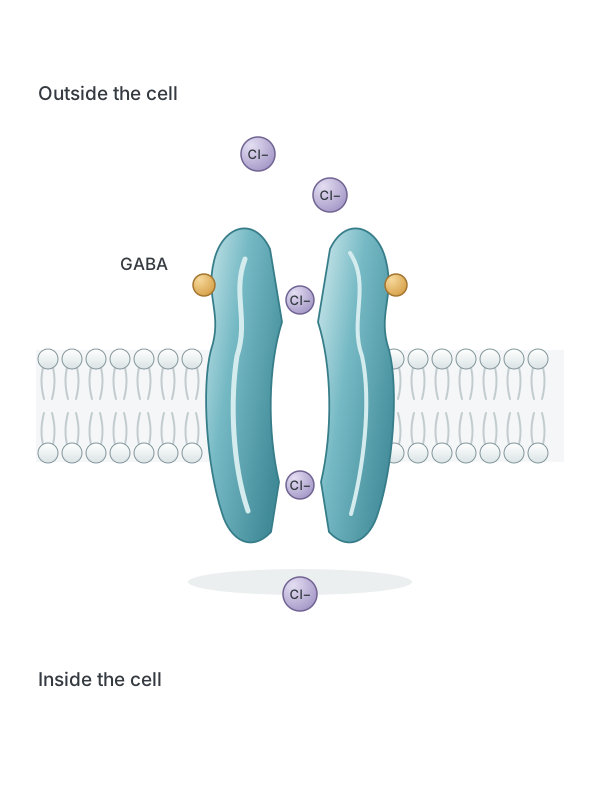
Optional motion shows inward ion movement in this example. Counts and timing are illustrative.
- Chloride · Cl−
Inward movement is a typical mature-cell example; ion gradients can differ.
- GABA-A receptor / channel
GABA activates this ion channel.
- Open channel
The arrow shows a qualitative direction, not an ion count or measured rate.
Simplified teaching model. Protein shapes, sizes, particle counts and arrows are illustrative, not measurements or experimental structures.
GABA can reduce nerve-cell excitability. This baseline channel example is not a drawing of valproate acting directly on the receptor.
About this illustration
Nerve-cell signal; Receptor action; Network activity. Bipolar disorder and epilepsy cannot be reduced to one messenger being too high or too low.
This is a simplified illustration. It does not show exactly how a medicine fits into a protein or predict a dose or response to treatment.
How does it affect my body?
Weight gain, nausea and tremor can affect daily functioning. Reproductive risks require review even when the medicine controls symptoms well.
How does my body process it?
Liver glucuronidation and beta-oxidation are major metabolic routes. Interactions can change exposure or toxicity.
How do treatment options differ?
The balance of reproductive risk, effectiveness and tolerability differs between treatments. Changing product or medicine requires a specialist plan rather than a direct milligram substitution.
Epilepsy formulations cannot acquire Depakote’s psychiatric licence by association, and a different salt or release system is not automatically a direct substitute. Conversely, the absence of a bipolar licence for another product does not prove that all specialist use is inappropriate: off-labelOff-labelUse of a licensed medicine outside the terms of its UK marketing authorisation.Read the full definition of Off-label treatment must be identified and justified separately.
A closer look at the science
Semisodium combines sodium valproate and valproic acid. Labelled strengths express valproic-acid equivalence, not total salt weight.
Valproic acid is a branched-chain carboxylic acid. Valproate semisodium, also called divalproex, combines sodium valproate and valproic acid and delivers the valproate ion.
Chemical formula: C8H16O2
The formula and image show neutral valproic acid, not the semisodium coordination compound. Neither specifies a medicine’s release design.
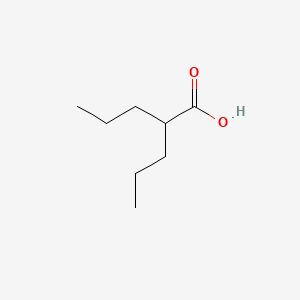
Neutral acid connectivity only. Formulation and salt composition are separate from this drawing.
How was this medicine developed?
MHRA’s February 2025 clarification distinguishes starting valproate from continuing existing male treatment. The checked Depakote SmPC was revised in September 2026.
Sources and References
- About valproic acid
Scope: NHS website for England — general medicine education, not a four-nation service pathway.
- Depakote 500 mg tablets — UK SmPC
Product information published on the electronic Medicines Compendium (emc); supplied by pharmaceutical companies.
Scope: United Kingdom product information.
- Depakote 250 mg and 500 mg tablets — UK patient leaflet
Product information published on the electronic Medicines Compendium (emc); supplied by pharmaceutical companies.
Scope: United Kingdom product information.
- Valproate: reproductive risks
Scope: United Kingdom.
- Valproate: two-specialist review for initiation, not existing male treatment
Scope: United Kingdom.
- Valproate use in men: precautionary contraception advice
Scope: United Kingdom.
- Valproic acid and sodium valproate monitoring
Scope: NHS Specialist Pharmacy Service — professional medicines advice; individual and local implementation.
- Valproate preparations: current prescribing information — mechanism explanation
Scope: Mechanism explanation only. Source sections checked: 12.1 Mechanism of Action; 12.2 Pharmacodynamics; 12.3 Pharmacokinetics..
Shared scientific background. US product pharmacology and international chemical records support molecular explanations only; UK product details and prescribing information are verified separately.
Article Information
- Edition
- United Kingdom
- Content updated
- 2026-10-24
- Source check dates
- Listed with each reference above; retained dates for shared scientific content.
- Scope
- exact products checked
Source and coverage limits
- Other valproate brands, modified-release products, liquids and injections require their own product records.
- Reproductive precautions were checked against MHRA and the current manufacturer information on 17 October 2026; do not infer that observational paternal-risk findings prove causation.
- This concise account does not reproduce the complete Pregnancy Prevention Programme or replace its current forms.