
About this medicine
A psychiatric prescription is off-label; it does not itself establish recommendation or equivalent evidence to licensed bipolar treatments.
The epilepsy licence and a psychiatric treatment decision answer different questions. Calling a medicine a mood stabiliser does not establish a bipolar indication, and the seizure schedules below cannot be used as a psychiatric prescribing protocol.
What is this medicine used for?
Trileptal covers focal seizures, including those progressing to bilateral tonic-clonic seizures, in adults and children aged six or over.
Which warning signs need help?
Get urgent help for a severe or blistering rash, facial swelling or breathing difficulty. Confusion, unusual drowsiness or worsening seizures may indicate dangerously low sodium.
Jaundice, unusual bruising or repeated infections can indicate liver or blood-cell problems and need urgent assessment. A new rash with fever, swollen glands or mouth sores must not be dismissed as a routine side effectAn effect beyond the intended treatment effectAn effect of a treatment in addition to its intended effect. It may be unwanted, harmful or sometimes beneficial.Read the full definition of Side effect. New self-harm thoughts also need immediate professional help.
How do I take it safely?
The adult epilepsy label starts at 600 mg daily in two doses with gradual increases. This is an epilepsy schedule, not a verified bipolar regimen.
In the adult epilepsy label, increases are usually separated by about a week, with response and tolerability guiding the dose; renal impairment can require half the usual starting amount. Children have weight-based epilepsy schedules from age six. These are clinician-managed adjustments, especially when another antiseizure medicine is being reduced.
Take prescribed tablets at consistent times. Their score is a swallowing aid, not a reliable way to produce a smaller dose. US Oxtellar XR release and meal instructions do not apply to the checked UK Trileptal preparations.
For Trileptal suspension, shake vigorously for at least ten seconds, then measure the prescribed volume with the supplied syringe. It can be swallowed from the syringe or mixed with a little water. The leaflet requires directions in millilitres; if the prescription gives only milligrams, ask the pharmacist or prescriber before taking it. Do not guess the volume from a tablet dose.
What side effects should I know about?
Headache, tiredness, nausea, vomiting, sleepiness and visual disturbance can occur. Discuss persistent effects with the prescriber.
Who needs extra care with this medicine?
Past carbamazepine allergy, low sodium and kidney disease need particular attention. Serious-rash susceptibility can be higher in some genetic ancestry groups.
Allergy to oxcarbazepine or eslicarbazepine prevents use. Carbamazepine allergy can recur with oxcarbazepine. Genetic testing may help assess serious-rash risk in relevant ancestry groups, but a negative result does not remove the need to watch for symptoms.
The suspension contains sorbitol and is unsuitable in hereditary fructose intolerance; preservatives can also cause allergic reactions. A liquid is not automatically safer or suitable simply because swallowing tablets is difficult.
Can it affect my other medicines?
Hormonal contraception may become less effective. Review other antiseizure medicines and sodium-lowering treatments; alcohol can increase impairment.
Enzyme induction can reduce exposure to other medicines, while CYP2C19 inhibition can increase phenytoin exposure. Adding or removing an interacting medicine may change the balance over subsequent weeks. Contraceptive review is therefore important even when seizure or mood symptoms appear stable.
What check-ups will I need?
For patients at risk, sodium is checked before treatment, after about two weeks and monthly during the first three months. Children may need thyroid monitoring. Routine MHD levels are not required for everyone.
What about pregnancy, breastfeeding and age?
Discuss pregnancy before conception; some foetal-growth and developmental risks remain uncertain. Do not stop independently. Breastfeeding requires individual discussion and observation for infant sleepiness or poor weight gain.
Pregnancy can lower concentrations of the active metabolite; levels and seizure control may need reassessment during pregnancy and after birth. Evidence about development is uncertain, and an observational study suggests a foetal-growth concern. A treatment review must weigh these uncertainties against the risks of uncontrolled seizures.
What if I miss a dose or want to stop?
Avoid doubling missed doses. WithdrawalWithdrawalSymptoms that may occur after reducing or stopping a medicine or substance to which the body has adapted.Read the full definition of Withdrawal is generally gradual because abrupt stopping can worsen seizures; follow the prescriber’s plan.
The leaflet advises taking a forgotten dose when remembered unless the next dose is due, and contacting the doctor after several missed doses. An urgent allergic reaction may require immediate medical withdrawal; that exception is different from stopping routine treatment without a plan.
How does it work?
Oxcarbazepine is changed in the body into an active substance called MHD, which accounts for much of the medicine’s activity. Laboratory studies suggest that oxcarbazepine and MHD can reduce repeated nerve-cell firing by affecting sodium channels. The complete explanation for their antiseizure effect has not been established.
How Brain Cells Communicate
Nerve cells communicate through brief electrical signals and chemical messengers. Electrical signals depend on ions, electrically charged particles, moving through channels in the cell’s outer membrane. Sodium channels respond to changes in voltage, the electrical difference across that membrane. When these channels open, sodium enters the cell and helps the electrical signal develop.
What is known: Voltage-sensitive channels help nerve cells generate and control electrical activity.
What remains uncertain: A cell’s electrical activity is only one part of a connected brain network.
Voltage-sensitive sodium channels
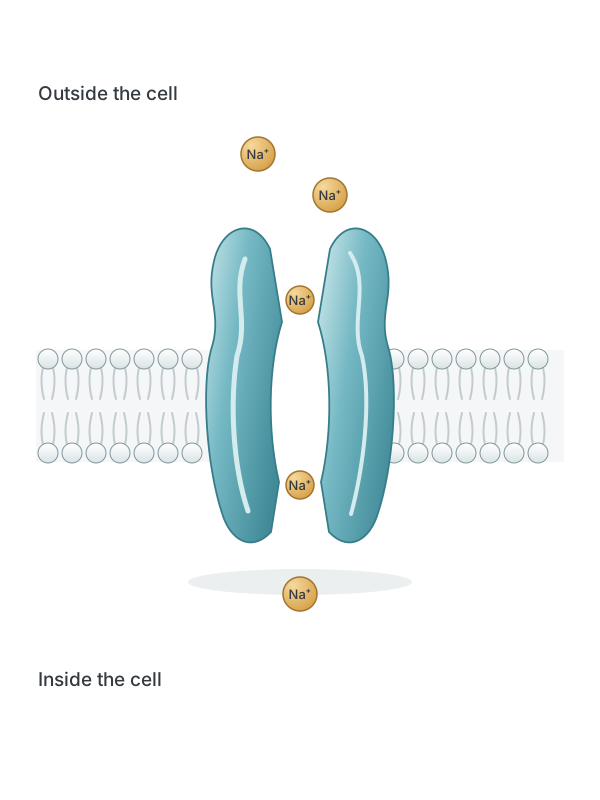
Optional motion shows inward ion movement in this example. Counts and timing are illustrative.
- Sodium · Na+
Sodium can enter through an available open channel.
- Voltage-sensitive sodium channel
Closed, open and inactivated are distinct channel states.
- Open channel
The arrow shows a qualitative direction, not an ion count or measured rate.
Simplified teaching model. Protein shapes, sizes, particle counts and arrows are illustrative, not measurements or experimental structures.
Voltage-sensitive sodium channels help nerve cells generate electrical signals. This panel shows an illustrative open channel and inward sodium movement.
About this illustration
Nerve-cell signal; Molecular action; Network activity. A cell’s electrical activity is only one part of a connected brain network.
This is a simplified illustration. It does not show exactly how a medicine fits into a protein or predict a dose or response to treatment.
How the Medication Changes Signalling
Oxcarbazepine and MHD can block voltage-sensitive sodium channels in laboratory experiments. This makes unusually rapid, repeated activity harder to sustain and may help limit the spread of seizure-related signals. MHD is an active metabolite, meaning a substance made when the body chemically changes a medicine that still has an effect of its own. This conversion is a central part of how oxcarbazepine works in the body.
What is known: MHD provides much of oxcarbazepine’s activity in the body.
What remains uncertain: The relative importance of the different actions in preventing seizures is uncertain.
The active metabolite MHD
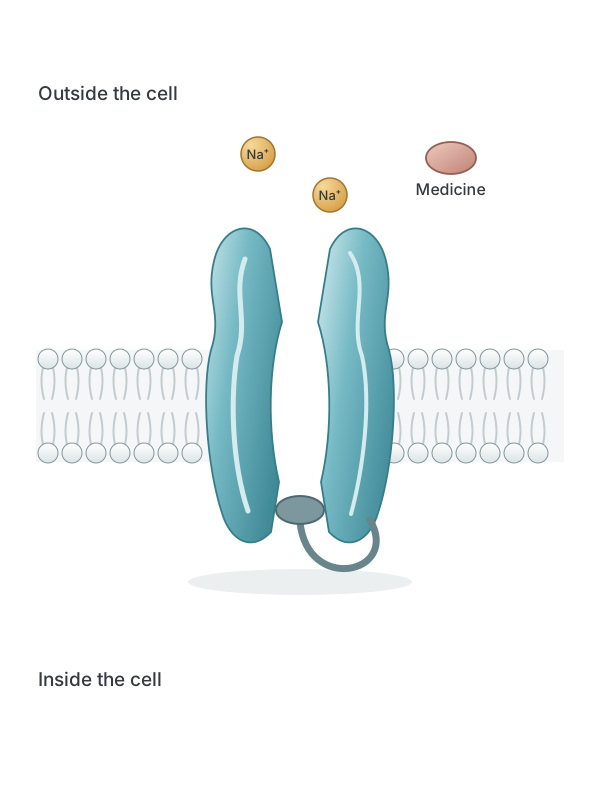
- Ion
Sodium (Na+)
- Target
Voltage-sensitive sodium channel
- Medicine-related action
MHD is the active metabolite; this is a laboratory effect, not a verified binding pose or bipolar mechanism.
Simplified teaching model. Protein shapes, sizes, particle counts and arrows are illustrative, not measurements or experimental structures.
The active MHD metabolite of oxcarbazepine blocks voltage-sensitive sodium channels in laboratory studies. The full therapeutic mechanism remains uncertain.
About this illustration
Medicine; Molecular actions; Clinical effects. The relative importance of the different actions in preventing seizures is uncertain.
This is a simplified illustration. It does not show exactly how a medicine fits into a protein or predict a dose or response to treatment.
How does it affect my body?
Dizziness, sleepiness and double vision may impair driving or other activities requiring alertness.
How does my body process it?
Reduction produces MHD, followed by conjugation and renal elimination. Kidney impairment can require a lower starting dose.
How do treatment options differ?
Structural similarity to carbamazepine does not establish identical licences, doses or allergy tolerance. A supervised change is necessary.
A closer look at the science
Oxcarbazepine is rapidly converted to the active monohydroxy derivative, often abbreviated MHD.
Oxcarbazepine is a dibenzazepine carboxamide related to carbamazepine, with a ketone group.
Chemical formula: C15H12N2O2
The image and formula show oxcarbazepine, not its active monohydroxy metabolite MHD. Molecular identity does not specify a medicine’s release system.

Parent connectivity only; active MHD and release technology are not shown.
How was this medicine developed?
This tablet record was revised in July 2025.
Sources and References
- Trileptal 150 mg, 300 mg and 600 mg tablets — UK SmPC
Product information published on the electronic Medicines Compendium (emc); supplied by pharmaceutical companies.
Scope: United Kingdom product information.
- Trileptal tablets — UK patient leaflet
Product information published on the electronic Medicines Compendium (emc); supplied by pharmaceutical companies.
Scope: United Kingdom product information.
- Trileptal 60 mg/mL oral suspension — UK SmPC
Product information published on the electronic Medicines Compendium (emc); supplied by pharmaceutical companies.
Scope: United Kingdom product information.
- Trileptal 60 mg/mL oral suspension — UK patient leaflet
Product information published on the electronic Medicines Compendium (emc); supplied by pharmaceutical companies.
Scope: United Kingdom product information.
- Oxcarbazepine: current prescribing information — mechanism explanation
Scope: Mechanism explanation only. Source sections checked: 12.1 Mechanism of Action; 12.3 Pharmacokinetics..
Shared scientific background. US product pharmacology and international chemical records support molecular explanations only; UK product details and prescribing information are verified separately.
Article Information
- Edition
- United Kingdom
- Content updated
- 2026-10-24
- Source check dates
- Listed with each reference above; retained dates for shared scientific content.
- Scope
- exact products checked
Source and coverage limits
- No UK psychiatric dosing recommendation is asserted from an epilepsy licence.
- Trileptal tablets and 60 mg/mL suspension are checked; Oxtellar XR instructions and other manufacturers are not transferred.