
About this medicine
Its bipolar benefit is preventive; the UK licence does not cover treating an acute manic or depressive episode.
What is this medicine used for?
The psychiatric licence is for adults with bipolar I disorder dominated by depressive episodes. NICE also discusses off-labelOff-labelUse of a licensed medicine outside the terms of its UK marketing authorisation.Read the full definition of Off-label treatment of bipolar depression. Epilepsy indications have different age limits.
Which warning signs need help?
Seek urgent medical assessment for a new rash, blistering, peeling skin, fever or mouth sores. Breathing difficulty or collapse is an emergency. Use local emergency services outside the UK.
Fever with swollen glands or organ symptoms can signal a serious immune reaction even before a rash appears. Severe headache with neck stiffness, new neurological symptoms, or suicidal thinking also requires urgent assessment.
How do I take it safely?
Without valproate or enzyme-inducing medicines, the adult bipolar schedule progresses from 25 mg/day for two weeks to 50 mg/day for two weeks, then 100 mg/day in week five and usually 200 mg/day in week six. Other combinations require different schedules. This describes the label, not instructions to change treatment.
Standard tablets are swallowed whole. Dispersible tablets may be dispersed, but do not take only part of the resulting mixture. Product form does not remove the need for slow escalation.
What side effects should I know about?
Common problems include headache, nausea, dizziness, tiredness and rash. A rash should not be dismissed as an ordinary nuisance.
Who needs extra care with this medicine?
Previous allergy, liver or kidney disease and heart conditions, including Brugada syndrome, need assessment.
Can it affect my other medicines?
Valproate, carbamazepine, rifampicin and hormonal contraception can affect treatment. Starting or stopping the combined pill needs a medication review.
Valproate slows lamotrigine clearance and increases rash risk if the wrong escalation schedule is used. Oestrogen-containing contraception can lower lamotrigine levels; levels may rise during a pill-free week or after stopping contraception. Discuss breakthrough bleeding and contraception changes promptly.
What check-ups will I need?
Before you start lamotrigine for bipolar disorder, NICE recommends blood tests to check your blood cells, kidneys, body salts and liver. Your care team will also ask about mood changes, rashes and other medicines.
What about pregnancy, breastfeeding and age?
Pregnancy planning needs specialist discussion. MHRA pregnancy evidence is comparatively reassuring for lamotrigine, but does not mean zero risk. Breastfed babies may need observation for rash, sleepiness or poor growth. Bipolar use below 18 is not recommended in the checked licence.
The SmPC recommends specialist pregnancy planning, folic acid supplementation, and concentration checks before, during and after pregnancy. Levels can fall during pregnancy and rise rapidly after birth; dose review protects against loss of seizure control or toxicity. Epilepsy use includes specified indications from age two, not a psychiatric licence at that age.
What if I miss a dose or want to stop?
Do not double a missed dose. After an interruption, seek advice about restarting slowly; returning directly to the former dose can increase rash risk.
How does it work?
Lamotrigine affects the channels that help nerve cellsNeuronA nerve cell that receives and sends information. Neurons work in connected groups, rather than carrying a whole thought on their own.Read the full definition of Neuron produce electrical signals. Laboratory studies suggest that it can limit repeated firing, meaning the sending of electrical signals, and influence the release of chemical messengers. These findings help explain some of its actions, although scientists have not established exactly how they produce its benefits in bipolar disorder.
How Brain Cells Communicate
A nerve cell, or neuron, carries a brief electrical signal along its long connecting branch, called an axon. The signal depends on charged particles called ions moving through channels in the cell’s outer membrane. When it reaches a nerve ending, it can trigger the release of a neurotransmitter: a chemical messenger that travels across a tiny gap to another cell.
What is known: Electrical signals and chemical messengers are linked stages of communication between nerve cells.
What remains uncertain: A single electrical signal does not explain a person’s mood or a seizure.
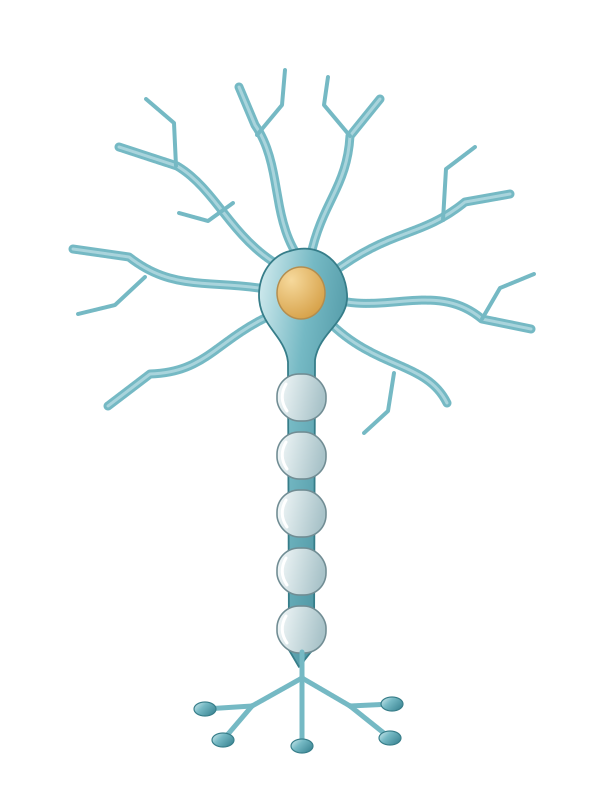
- Receiving branches
Dendrites connect with signals arriving from other cells.
- Cell body
The cell body joins the receiving branches to the axon.
- Axon
Changing voltage propagates along its membrane; no particle travels along the arrow.
- Nerve terminals
The signal can trigger release of chemical messengers.
- Myelin
Insulating coverings wrap sections of many axons; the gaps are called nodes of Ranvier.
Simplified teaching model. Protein shapes, sizes, particle counts and arrows are illustrative, not measurements or experimental structures.
About this illustration
Receiving branches lead to a cell body and a long axon ending at a nerve terminal. A single electrical signal does not explain a person’s mood or a seizure.
How the Medication Changes Signaling
Sodium channels are proteins that allow sodium ions to enter a cell briefly; they then become temporarily unavailable and recover before helping produce another signal. In laboratory studies, lamotrigine interferes with these voltage-sensitive channels, meaning channels that respond to changes in electrical charge. Its effect depends partly on the channel’s current state, an action called state-dependent inhibition. This can make rapid, repeated firing harder to sustain and change the release of glutamate, a messenger that usually increases the receiving cell’s activity.
What is known: Experiments show effects on voltage-sensitive sodium channels and release of messengers that increase cell activity.
What remains uncertain: The importance of each cellular effect in humans has not been fully established.
Without medicine: ready
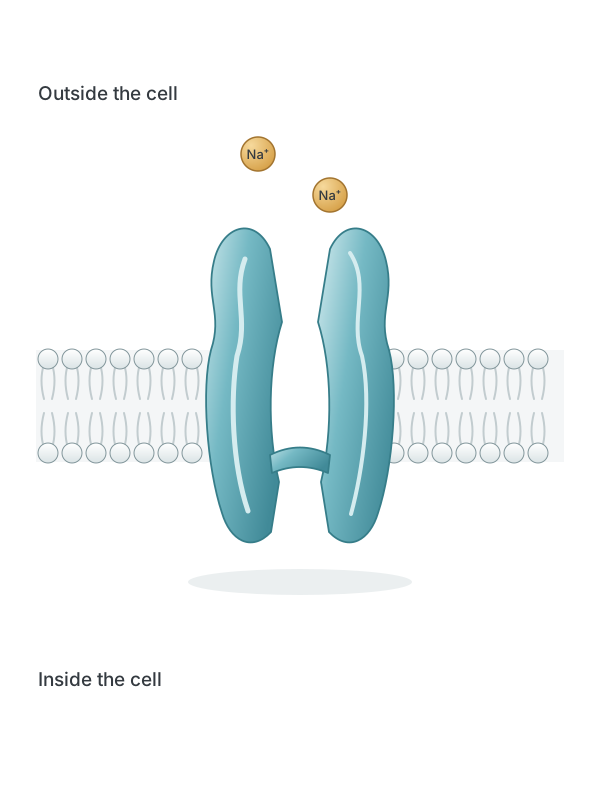
- Sodium · Na+
Sodium can enter through an available open channel.
- Voltage-sensitive sodium channel
Closed, open and inactivated are distinct channel states.
- Closed and ready
No flow arrow is shown through the closed pore.
Simplified teaching model. Protein shapes, sizes, particle counts and arrows are illustrative, not measurements or experimental structures.
Without medicine: open
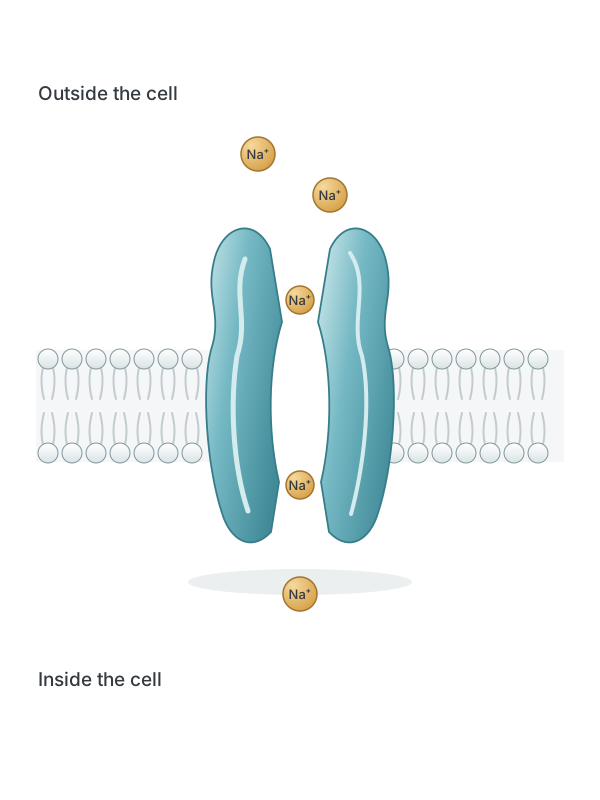
Optional motion shows inward ion movement in this example. Counts and timing are illustrative.
- Sodium · Na+
Sodium can enter through an available open channel.
- Voltage-sensitive sodium channel
Closed, open and inactivated are distinct channel states.
- Open channel
The arrow shows a qualitative direction, not an ion count or measured rate.
Simplified teaching model. Protein shapes, sizes, particle counts and arrows are illustrative, not measurements or experimental structures.
Without medicine: inactivated
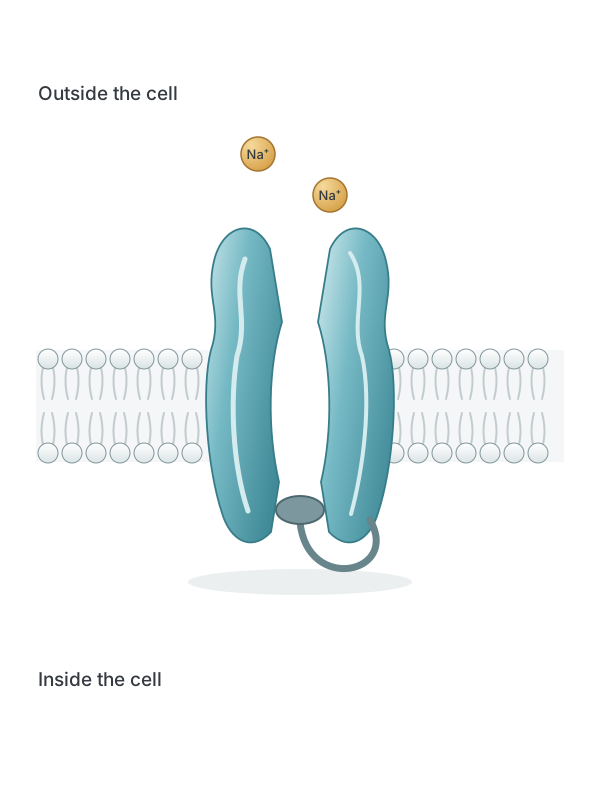
- Sodium · Na+
Sodium can enter through an available open channel.
- Voltage-sensitive sodium channel
Closed, open and inactivated are distinct channel states.
- Temporarily unavailable
The inactivation mark differs from the closed, available gate.
Simplified teaching model. Protein shapes, sizes, particle counts and arrows are illustrative, not measurements or experimental structures.
With lamotrigine: laboratory effect
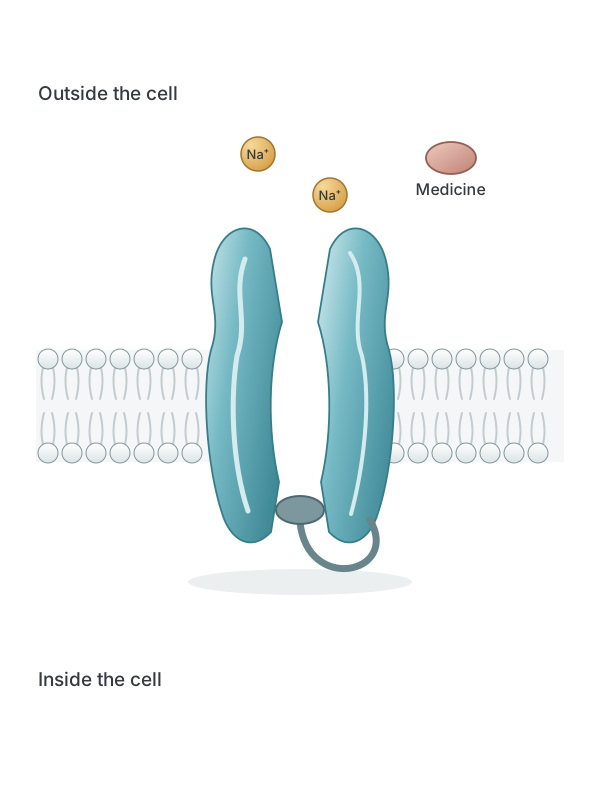
- Sodium · Na+
Sodium can enter through an available open channel.
- Voltage-sensitive sodium channel
Closed, open and inactivated are distinct channel states.
- Lamotrigine: current reduced
The medicine symbol labels an action, not an experimentally determined binding position.
Simplified teaching model. Protein shapes, sizes, particle counts and arrows are illustrative, not measurements or experimental structures.
About this illustration
Three channel states: closed and ready, open with inward sodium flow, and inactivated. The importance of each cellular effect in humans has not been fully established.
How does it affect my body?
Dizziness or sleepiness can affect driving. Headaches, nausea and sleep changes may occur.
How does my body process it?
Your liver uses a process called glucuronidation to change lamotrigine into substances your body can remove, mainly in urine. Other medicines can speed up or slow down this process, which can change lamotrigine levels.
How do treatment options differ?
It has a different role from treatments for acute mania: NICE advises against using it to treat mania.
A closer look at the science
Lamotrigine blocks voltage-gated sodium channels in an activity-dependent way and reduces glutamateGlutamateAn important excitatory chemical messenger used by nerve cells.Read the full definition of Glutamate release. These actions do not establish a complete explanation of its mood effects.
The drawing represents neutral lamotrigine, the active molecule, using the atom connections and two-dimensional coordinates in PubChem CID 3878. It is not a salt, tablet formulation or protein-bound model.
Chemical formula: C9H7Cl2N5
This means 9 carbon atoms, 7 hydrogen atoms, 2 chlorine atoms and 5 nitrogen atoms. Lines show bonds; double lines show double bonds. All atoms are labeled in this teaching drawing.

How was this medicine developed?
The checked Lamictal record lists initial UK tablet authorisations in 1991.
Sources and References
- Lamictal tablets and chewable/dispersible tablets — UK SmPC
Product covered: Lamictal tablets and chewable/dispersible tablets. Marketing authorisation holder: The Wellcome Foundation Ltd, trading as GlaxoSmithKline UK. Label text revised 2025-11-05; source record updated 2025-11-19. Product identity and links checked 2026-10-19; this does not change the article’s clinical check date.
Company-supplied UK Patient Information Leaflet hosted by emc — patient text revised 2026-06. The opened PIL is for conventional tablets; do not silently apply it to chewable/dispersible products.
Product information published on the electronic Medicines Compendium (emc); supplied by pharmaceutical companies.
Scope: United Kingdom product information.
- Lamictal tablets and chewable/dispersible tablets — Company-supplied UK Patient Information Leaflet hosted by emc
- Lamotrigine
Scope: NHS website medicines information (England); not a guarantee of identical services across UK nations.
- Lamictal tablets — patient leaflet
Product information published on the electronic Medicines Compendium (emc); supplied by pharmaceutical companies.
Scope: United Kingdom product information.
- Bipolar disorder: assessment and management (CG185), recommendations
Scope: NICE guidance for England; application in other UK nations determined separately.
- Antiepileptic drugs in pregnancy: updated advice following comprehensive safety review
Scope: United Kingdom.
- Lamictal in-use labeling and patient guide — mechanism explanation
Scope: Mechanism explanation only. Source sections checked: 12.1 Mechanism of Action..
- Interaction of the antiepileptic drug lamotrigine with recombinant rat brain type IIA Na+ channels and with native Na+ channels in rat hippocampal neurones — mechanism explanation
Scope: Mechanism explanation only. Source sections checked: Abstract: voltage-, use- and state-dependent inhibition in cell experiments..
Shared scientific background. Some references are US product pharmacology or international chemical records; UK product details and prescribing information are verified separately.
Article Information
- Edition
- United Kingdom
- Content updated
- 2026-10-24
- Source check dates
- Listed with each reference above; retained dates for shared scientific content.
- Scope
- exact products checked
Source and coverage limits
- This concise educational record does not audit every UK manufacturer, pack or local formulary. Product strengths are not a personal dosing schedule.
- NICE recommendations were checked in indexed official-source text; direct NICE page retrieval returned HTTP 403. No full local NHS pathway audit.