
What should I know first?
An action potentialAction potentialA brief electrical change that can travel along a nerve cell. It involves coordinated changes in ion flow across the cell membrane.Read the full definition of Action potential is a brief change in electrical voltage that can travel along a nerve cell. It is part of ordinary nervous-system communication, not an electrical spark. This page explains the basic process without treating a diagram as a measurement of your brain activity.
A charged boundary
The cell membraneCell membraneThe thin boundary of a cell. It separates the inside from the surroundings and contains proteins that control transport and signaling.Read the full definition of Cell membrane is the thin boundary between a cell and its surroundings. IonsIonAn atom or group of atoms with an electrical charge. Movement of ions such as sodium and potassium helps produce nerve-cell electrical signals.Read the full definition of Ion are electrically charged particles. Sodium and potassium ions are distributed differently inside and outside a nerve cell, and the voltage across the boundary depends on this distribution and which routes are open.
Cellular pumps use energy to help maintain these differences. The important point is the separation across a boundary: simply having sodium somewhere in the body is not the same as producing a nerve signal. This is not advice to change dietary salt.
A traveling change
An ion channelIon channelA protein passage through a cell membrane that allows particular charged particles to move through. Some channels open in response to voltage changes.Read the full definition of Ion channel is a protein passage through the membrane. Some channels respond to voltage changes. In a typical nerve impulse, sodium channels briefly open and sodium enters locally. The resulting electrical change helps activate channels farther along the axonAxonA nerve-cell extension along which electrical signals can travel toward other cells. Its endings can communicate at synapses.Read the full definition of Axon, the cell’s signal-carrying extension.
The signal travels as a changing pattern of activity along the membrane. Potassium channels and other proteins help shape the response and the return toward the resting state. One drawing cannot represent every kind of neuron or every channel involved.
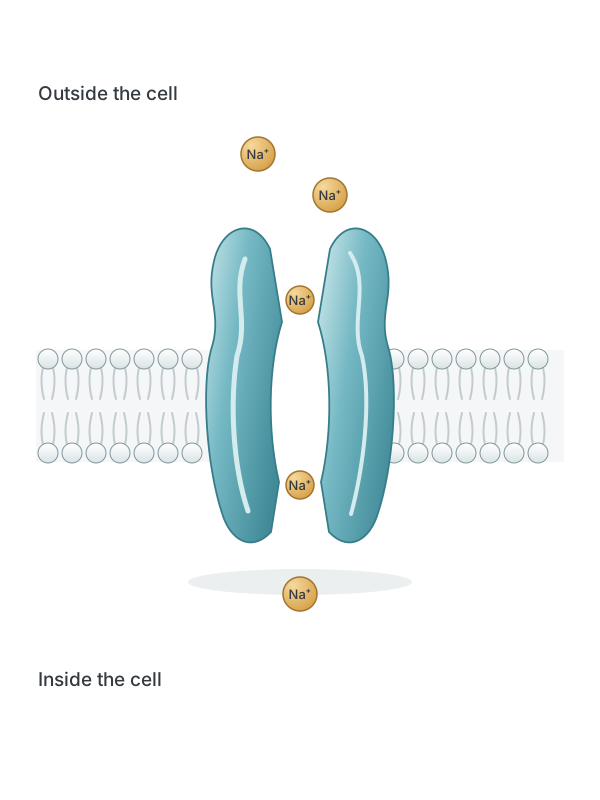
Optional motion shows inward ion movement in this example. Counts and timing are illustrative.
- Sodium · Na+
Sodium can enter through an available open channel.
- Voltage-sensitive sodium channel
Closed, open and inactivated are distinct channel states.
- Open channel
The arrow shows a qualitative direction, not an ion count or measured rate.
Simplified teaching model. Protein shapes, sizes, particle counts and arrows are illustrative, not measurements or experimental structures.
Insulation and connections
MyelinMyelinAn insulating covering around many nerve-cell axons. It helps electrical signals travel efficiently; not every axon has this covering.Read the full definition of Myelin is an insulating covering around many axons. It helps signals travel efficiently. Axons are not all identical: their structure and covering matter, so an illustrated signal should not be mistaken for a universal speed or timing measurement.
At a chemical synapseSynapseA communication junction between cells. At a chemical synapse, a released messenger crosses a narrow gap; electrical synapses allow more direct electrical communication.Read the full definition of Synapse—a junction between communicating cells—electrical activity can lead to release of a chemical messenger. This is where the electrical story connects with the receptorReceptorA protein that recognizes a signal and helps a cell respond. Different receptor types can produce different responses to the same messenger.Read the full definition of Receptor and transporterTransporterA protein that moves a substance across a cell membrane. Some transporters help remove released chemical messengers from the space around nerve cells.Read the full definition of Transporter story.
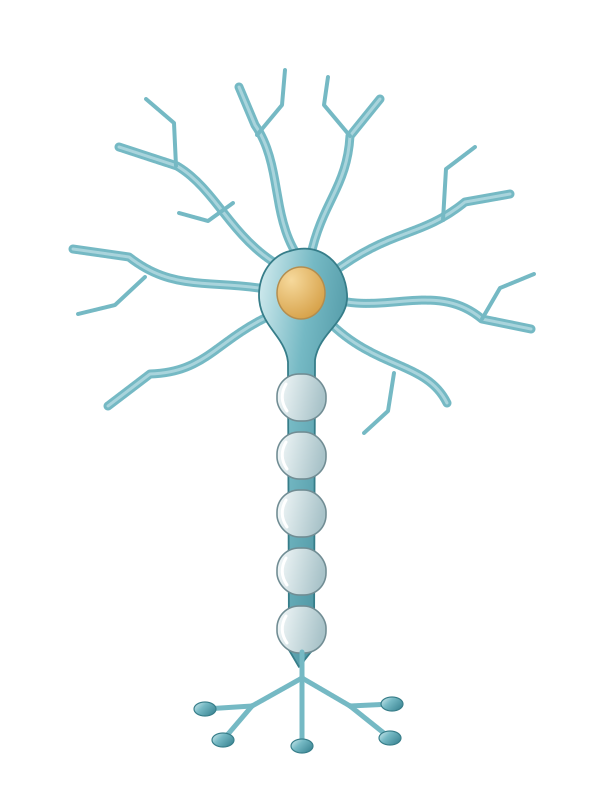
- Receiving branches
Dendrites connect with signals arriving from other cells.
- Cell body
The cell body joins the receiving branches to the axon.
- Axon
Changing voltage propagates along its membrane; no particle travels along the arrow.
- Nerve terminals
The signal can trigger release of chemical messengers.
- Myelin
Insulating coverings wrap sections of many axons; the gaps are called nodes of Ranvier.
Simplified teaching model. Protein shapes, sizes, particle counts and arrows are illustrative, not measurements or experimental structures.
From a signal to a medication lesson
The lamotrigine mechanism lesson explores a particular medicine’s effects on signaling, with a separate explanation of the evidence and its limits. A change in a channel in a laboratory experiment does not by itself explain a whole clinical benefit. Keep the cellular finding and the treatment outcome as separate questions when reading that lesson.
Sources and References
Article Information
- Edition
- United Kingdom
- Content updated
- 2026-10-16
- Sources checked
- Listed with each reference above; retained dates for shared scientific content.
- Publication status
- Published