
What should I know first?
At a chemical synapseSynapseA communication junction between cells. At a chemical synapse, a released messenger crosses a narrow gap; electrical synapses allow more direct electrical communication.Read the full definition of Synapse, a communication junction between cells, a released messenger can interact with different cellular tools. A receptorReceptorA protein that recognizes a signal and helps a cell respond. Different receptor types can produce different responses to the same messenger.Read the full definition of Receptor helps a cell respond to a signal. A transporterTransporterA protein that moves a substance across a cell membrane. Some transporters help remove released chemical messengers from the space around nerve cells.Read the full definition of Transporter moves a substance across the cell membraneCell membraneThe thin boundary of a cell. It separates the inside from the surroundings and contains proteins that control transport and signaling.Read the full definition of Cell membrane, the cell’s thin boundary. Both are proteins, folded molecules that carry out work in cells, but their jobs differ.
Receiving a message
A receptor recognizes a messenger and helps produce a cellular response. Different receptor types can respond differently to the same messenger. For serotoninSerotoninA chemical messenger involved in several functions, including sleep, mood and digestion. It acts through different receptors, with effects that depend on the cell.Read the full definition of Serotonin, for example, the effect depends on both the receptor and its cellular setting.
“Receptor” is therefore a broad name, not a promise that every receiving cell will become more active. When reading a mechanism explanation, look for the receptor’s identity and the kind of cell studied before drawing a conclusion about the effect.
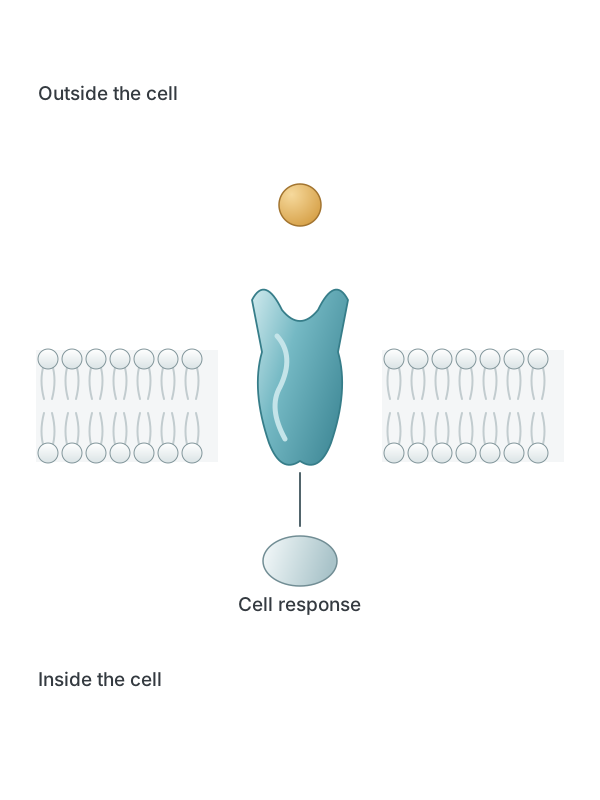
- Chemical messenger
A messenger can change signaling through its receptor.
- Receptor
This receptor symbol identifies a function, not a molecular structure.
- Cell response
The arrow represents a signaling response, not movement through a pore.
Simplified teaching model. Protein shapes, sizes, particle counts and arrows are illustrative, not measurements or experimental structures.
Moving a messenger
A neurotransmitterNeurotransmitterA chemical messenger released by a nerve cell. Its effect depends on the receiving cell and the receptor that detects it.Read the full definition of Neurotransmitter is a chemical messenger released by a nerve cellNeuronA nerve cell that receives and sends information. Neurons work in connected groups, rather than carrying a whole thought on their own.Read the full definition of Neuron. Some transporters remove these messengers from the space around cells. ReuptakeReuptakeThe return of a released chemical messenger into a cell through a transporter. It is one way to limit a signal; chemical breakdown is another.Read the full definition of Reuptake means taking a released messenger back into a cell; this helps limit how long it can signal nearby.
Transport is not the same event as recognizing a message. A useful comparison is a sensor that responds to a visitor and a doorway that moves the visitor across a boundary. This is only an analogy: actual transporters are moving proteins, not hollow doors left permanently open.
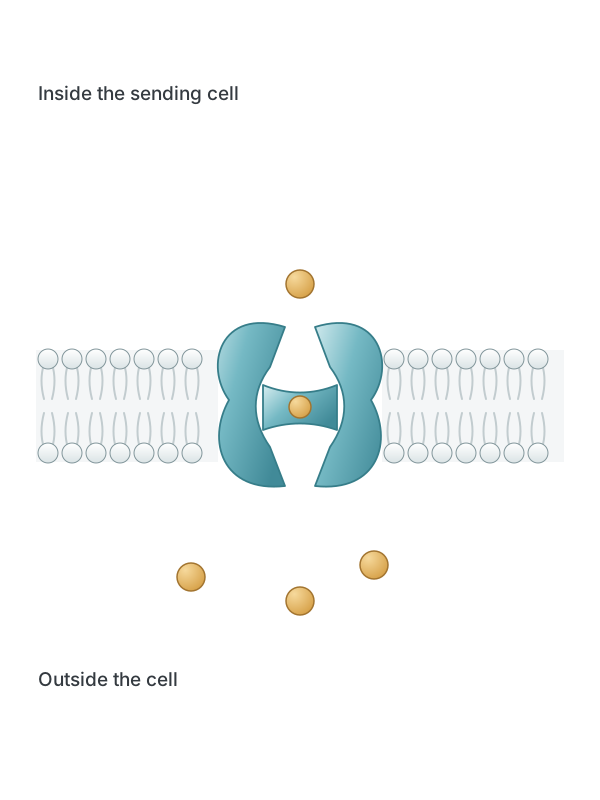
- Serotonin
The messenger is shown outside the sending cell.
- SERT
SERT returns serotonin from outside into the sending cell. Other transporters handle different messengers.
- Return into the cell
The arrow shows transport direction, without a measured rate.
Simplified teaching model. Protein shapes, sizes, particle counts and arrows are illustrative, not measurements or experimental structures.
Ending and interpreting a signal
Reuptake is one route for managing a message. Chemical breakdown can also help end signaling. The balance between release, reception and removal matters; the amount of one messenger alone does not describe the whole communication process.
These distinctions become useful when reading medication names. Inhibiting reuptake describes an effect on movement of a messenger. Changing a receptor response describes a different action. Neither phrase, on its own, tells us whether a medicine will be appropriate or helpful for an individual.
Follow the SSRI example
Start with the nerve-cell page if the synapse is unfamiliar, then explore How SSRIs Work. That lesson uses sertraline to connect reuptake with a real medicine and provides official patient information for further reading. The detailed lesson keeps the drug-specific evidence and uncertainty together, while this introduction supplies the basic vocabulary.
Sources and References
Article Information
- Edition
- United Kingdom
- Content updated
- 2026-10-16
- Sources checked
- Listed with each reference above; retained dates for shared scientific content.
- Publication status
- Published