
About this medicine
Doxazosin is primarily a cardiovascular and urinary medicine. Being included in a psychiatric reference does not mean it is licensed or routinely recommended for a psychiatric condition.
What is this medicine used for?
Cardura's licensed uses are hypertension and symptoms of benign prostate enlargement. The checked record does not include PTSD or nightmares; no UK psychiatric dosing schedule is inferred from US content.
Cardura XL and SyriMed suspension also list hypertension and benign prostatic hyperplasia, not PTSD or nightmares. Neither a slower release system nor a liquid concentration adds a psychiatric authorisation.
Which warning signs need help?
Severe allergy, chest pain with collapse, stroke symptoms or a persistent painful erection requires urgent medical help. An overdose may cause dangerous low blood pressure. Use emergency services for your actual location.
Fainting is especially relevant after starting or increasing treatment. Sit or lie down if suddenly dizzy and obtain advice. A prolonged painful erection needs urgent medical attention; tell the eye surgeon about current or previous use before cataract surgery.
How do I take it safely?
For checked standard Cardura, clinicians generally start at 1 mg daily and increase at one- to two-week intervals. Licensed maximums differ: 16 mg for hypertension and 8 mg for prostate symptoms. These are not psychiatric treatment instructions.
Cardura XL comes in 4 and 8 mg prolonged-release tablets. Its reference begins at 4 mg once daily and allows an increase to 8 mg after assessing response, which may take four weeks. Swallow whole with liquid; do not crush, chew or divide. An empty shell can appear in stools.
SyriMed suspension is 0.4 mg/mL, not a prolonged-release liquid. Its reference begins at 1 mg once daily for either licensed indication. Shake for at least 30 seconds before measuring; use the supplied 10 mL syringe for volumes up to 10 mL and 20 mL syringe for larger volumes. Discard 30 days after opening.
A formulation change needs a prescribing plan and blood-pressure review. NHS SPS describes several clinician-selected strategies, not one universal milligram conversion. Do not replace tablets with a matching-looking volume or change from XL on your own.
What side effects should I know about?
Headache, dizziness, ankle swelling and stomach upset can occur. Tell a pharmacist or doctor if symptoms persist; do not assume a faint feeling is simply anxiety.
Who needs extra care with this medicine?
A history of postural hypotensionOrthostatic hypotensionOrthostatic hypotension, also called postural hypotension, is a drop in blood pressure when you stand up from sitting or lying down. It can cause lightheadedness, dizziness, blurred vision or fainting.Medicines and dehydration are among the possible causes. If you feel faint, sit or lie down to reduce the risk of a fall, and tell your clinician about repeated episodes. and certain bladder-outflow conditions are exclusions. Tell the eye surgeon about current or previous alpha-blocker use before cataract surgery.
Cardura XL has additional restrictions for previous gastrointestinal or oesophageal obstruction or narrowing, because of its non-deformable release system. This is not a reason to apply the same physical-tablet restriction to the suspension.
Can it affect my other medicines?
Sildenafil and similar medicines, other blood-pressure treatments and strong enzyme inhibitors can increase low-blood-pressure risk. Alcohol can worsen dizziness; check non-prescription products too.
Medicines for erectile difficulties can add to blood-pressure lowering. Do not manage this by guessing a dose interval; the clinician should assess stability, doses and symptoms.
What check-ups will I need?
Review blood pressure, postural symptoms and falls when starting, changing dose or changing formulation. For prostate symptoms, assessment should exclude other causes such as malignancy.
After switching from XL to standard tablets, monitor for either a blood-pressure rise or an excessive fall; the new regimen may need adjustment. NHS SPS guidance concerns clinician-managed switching, not a self-treatment schedule.
What about pregnancy, breastfeeding and age?
Safety and efficacy in children are not established for the checked XL and suspension products. Their pregnancy and breastfeeding wording requires the prescriber to judge benefit against risk; low reported milk transfer does not establish absence of infant risk.
Liver impairment requires particular caution. The suspension contains parabens, which can cause delayed allergic reactions, as well as propylene glycol and benzoic acid. Excipients and ability to swallow matter when choosing a formulation.
What if I miss a dose or want to stop?
Do not double a missed dose or stop a regular prescription without advice. Follow the leaflet for your exact product, because immediate- and modified-release instructions differ.
How does it work?
Doxazosin helps certain muscles relax, including muscle in blood-vessel walls and around the bladder outlet. This can lower blood pressure and make it easier for urine to flow. It does this by blocking part of the body’s response to norepinephrine, a chemical messenger also called noradrenaline.
How Brain Cells Communicate
Norepinephrine carries messages between nerve cells and helps control how organs respond to activity and stress. Receptors are proteins that receive these messages. One type, called alpha-1, helps control smooth muscle: muscle that works without conscious effort in places such as blood-vessel walls. The term adrenergic refers to this family of chemical signals and receptors.
What is known: Alpha-1 signals can make smooth muscle tighten.
What remains uncertain: These signals alone cannot explain why a particular person has nightmares.
Norepinephrine: Alpha-1 adrenergic receptor
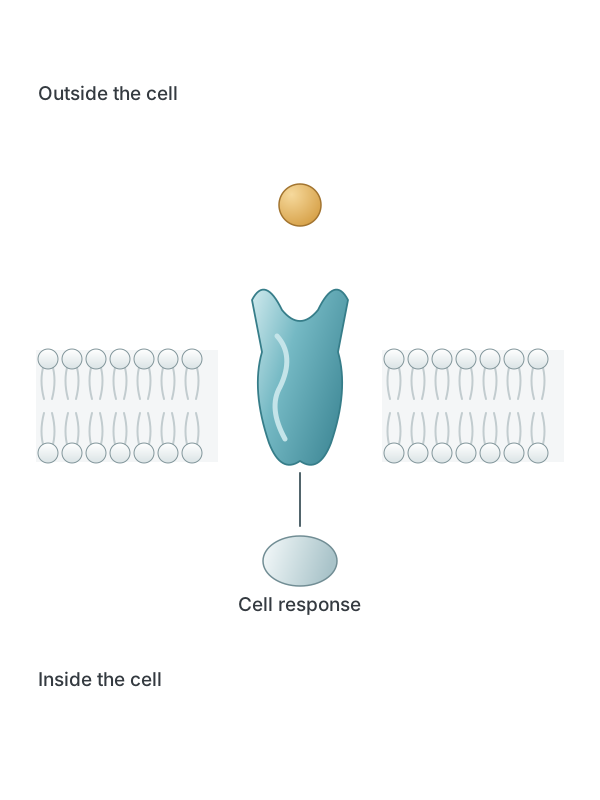
- Messenger
Norepinephrine
- Target
Alpha-1 adrenergic receptor
- Cell context
smooth-muscle cell; simplified membrane, not a binding structure.
Simplified teaching model. Protein shapes, sizes, particle counts and arrows are illustrative, not measurements or experimental structures.
Norepinephrine can activate alpha-1 adrenergic receptor and change signaling in the cell. This is a smooth-muscle cell example, not a complete nervous-system pathway.
About this illustration
Norepinephrine; Alpha-1 receptor; Muscle tone. These signals alone cannot explain why a particular person has nightmares.
This is a simplified illustration. It does not show exactly how a medicine fits into a protein or predict a dose or response to treatment.
How the Medication Changes Signaling
Doxazosin blocks alpha-1 receptors, reducing the tightening signal. This blocking action is called antagonism. Less muscle tone, or tension in the muscle, means the vessels can relax and blood flows with less resistance.
Relaxation around the bladder outlet and prostate can also help urine pass. The prostate is a gland around the tube that carries urine out of the bladder; doxazosin’s effect on this muscle does not mean it shrinks the gland. These are peripheral effects, meaning effects outside the brain and spinal cord.
What is known: Alpha-1 blockade helps explain the effects on blood pressure and urine flow.
What remains uncertain: Those effects do not establish whether it will help with nightmares after trauma.
Doxazosin: Alpha-1 adrenergic receptor
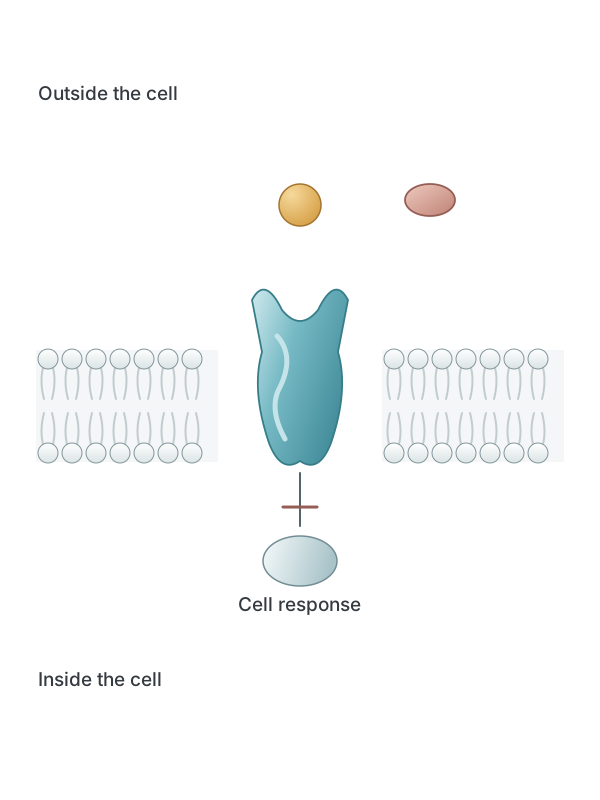
- Messenger
Norepinephrine
- Target
Alpha-1 adrenergic receptor
- Doxazosin: receptor activation opposed
The medicine symbol and crossbar indicate antagonist action in a smooth-muscle cell; receptor action does not predict an individual clinical response.
Simplified teaching model. Protein shapes, sizes, particle counts and arrows are illustrative, not measurements or experimental structures.
Doxazosin blocks alpha-1 adrenergic receptors. This smooth-muscle example explains a peripheral action; it does not establish nightmare-treatment benefit.
About this illustration
Doxazosin; Alpha-1 blockade; Less constriction. Those effects do not establish whether it will help with nightmares after trauma.
This is a simplified illustration. It does not show exactly how a medicine fits into a protein or predict a dose or response to treatment.
How does it affect my body?
Blood pressure may fall on standing, especially when starting treatment. Dizziness can cause falls; sit or lie down if faint and avoid hazardous activity while affected.
How does my body process it?
The liver extensively metabolises doxazosin, with CYP3A4 a major pathway. Its approximately 22-hour half-lifeThe time for a measured drug level to fall by halfThe time it takes for the concentration of a medicine in a body fluid, usually blood, to decrease by half during elimination.Read the full definition of Half-life supports once-daily dosing; liver impairment can increase exposure.
Cardura XL releases the medicine gradually, producing a later, lower peak than standard tablets. Both can be prescribed once daily, but the shared elimination half-life does not make their starting doses identical.
How do treatment options differ?
Cardura and prolonged-release doxazosin are not automatically interchangeable schedules. A shared alpha-blocking mechanism with prazosin is not proof of identical evidence, duration or dosing.
NHS England policy, explained by NHS SPS, does not support routine XL prescribing in primary care and favours standard tablets when appropriate. This is a prescribing-policy distinction, not withdrawalWithdrawalSymptoms that may occur after reducing or stopping a medicine or substance to which the body has adapted.Read the full definition of Withdrawal of the XL licence, nor a claim that every UK nation uses the same formulary policy.
A closer look at the science
Selective blockade of post-junctional alpha-1 adrenoceptors reduces the response to adrenergic signalling. This mechanism alone cannot establish efficacy for trauma-related symptoms.
The medicine contains doxazosin mesylate, a salt of the active doxazosin molecule. The neutral parent belongs to the quinazoline family and is not a benzodiazepine.
Chemical formula: C23H25N5O5 · CH4O3S
The portion before the dot is doxazosin: 23 carbon, 25 hydrogen, 5 nitrogen and 5 oxygen atoms. The dot separates the methanesulfonic-acid component in the label’s salt formula. Tablet strengths are expressed as equivalent doxazosin, not the total salt weight.

This verified PubChem neutral-parent drawing omits the mesylate component. It does not show a receptor-bound pose, establish brain exposure, or distinguish the tablet release systems.
How was this medicine developed?
The current Cardura information retains established cardiovascular and urinary indications. A medicine's later off-labelOff-labelUse of a licensed medicine outside the terms of its UK marketing authorisation.Read the full definition of Off-label discussion does not rewrite the history or scope of its marketing authorisation.
Sources and References
- Cardura 1 mg tablets: UK SmPC
Product information published on the electronic Medicines Compendium (emc); supplied by pharmaceutical companies.
Scope: United Kingdom.
- Cardura 1 mg and 2 mg tablets: patient leaflet
Product information published on the electronic Medicines Compendium (emc); supplied by pharmaceutical companies.
Scope: United Kingdom.
- Doxazosin
Scope: UK patient information.
- Cardura XL 4 mg prolonged-release tablets: UK SmPC
Product information published on the electronic Medicines Compendium (emc); supplied by pharmaceutical companies.
Scope: United Kingdom.
- Cardura XL 8 mg prolonged-release tablets: UK SmPC
Product information published on the electronic Medicines Compendium (emc); supplied by pharmaceutical companies.
Scope: United Kingdom.
- Doxazosin 0.4 mg/mL oral suspension: UK SmPC
Product information published on the electronic Medicines Compendium (emc); supplied by pharmaceutical companies.
Scope: United Kingdom.
- Switching doxazosin XL tablets to doxazosin standard tablets
Scope: England: NHS England prescribing-policy context; professional formulation guidance.
- Doxazosin tablets: prescribing information — mechanism explanation
Scope: Mechanism explanation only. Source sections checked: 12.1 Mechanism of Action..
- Doxazosin: patient information — mechanism explanation
Scope: Mechanism explanation only. Source sections checked: Why is this medication prescribed?..
- Low blood pressure: MedlinePlus Medical Encyclopedia
Shared scientific background. US product pharmacology and international chemical references do not establish UK licences, doses, formulations or NHS recommendations.
Article Information
- Edition
- United Kingdom
- Content updated
- 2026-10-24
- Source check dates
- Listed with each reference above; retained dates for shared scientific content.
- Scope
- Representative standard and prolonged-release doxazosin tablets and licensed 0.4 mg/mL oral suspension; exact product and England prescribing-policy distinctions.
Source and coverage limits
- Not an exhaustive manufacturer/strength, stock or funding catalogue.
- No UK psychiatric efficacy recommendation or PTSD/nightmare dosing is asserted; the checked product licences do not establish those uses.
- NHS England routine-prescribing policy is not represented as four-nation policy.