
About this medicine
Propranolol can reduce a racing heart and shaking associated with anxiety. It is also used for several conditions outside mental health.
The aim in anxiety is relief of bodily symptoms such as tremor and a pounding heart, not erasing difficult thoughts or treating every cause of anxiety. NHS information describes an effect beginning within hours; cardiovascular or migraine benefits may follow a different timescale. A quick physical effect does not establish that a psychiatric disorder has resolved.
What is this medicine used for?
Inderal’s UK indication includes relief of situational and generalised anxiety symptoms, particularly bodily symptoms. This product licence does not establish that it is the preferred treatment for every anxiety disorder.
Which warning signs need help?
Any suspected overdose needs urgent medical advice. Breathing difficulty, collapse, seizures or chest pain require emergency help: call 999 in the UK, or local emergency services elsewhere. Do not drive yourself.
How do I take it safely?
The NHS describes an adult anxiety regimen beginning at 40 mg once daily, potentially increased to 40 mg three times daily. The prescriber determines suitability. Standard and slow-release preparations have different administration schedules.
Inderal 40 mg has a score line that the checked SmPC says is not intended for breaking the tablet. Tablet appearance is therefore not enough to decide whether a dose can be divided. Other standard tablets, oral liquid and slow-release capsules exist, but a change in formulation requires the pharmacist to check the exact strength and instructions. Measure liquid with a medicine syringe or spoon, not a kitchen teaspoon.
What side effects should I know about?
Tiredness, dizziness, cold hands or feet, nausea, diarrhoea, sleep disturbance and nightmares can occur. Persistent problems warrant review.
Who needs extra care with this medicine?
The checked Inderal product is contraindicated with a history of asthma or bronchospasm. Slow pulse, hypotension, worsening heart failure, diabetes and impaired liver or kidney function require careful assessment.
Propranolol can hide the fast heartbeat that otherwise warns of low blood glucose and can prolong an insulin-related low. Fasting, poor intake and diabetes therefore matter. Important exclusions include significant heart-conduction block, uncontrolled heart failure and a marked slow pulse or low blood pressure. Asthma risk is relevant even when the dose is being used for anxiety rather than heart disease.
Can it affect my other medicines?
Verapamil or diltiazem can dangerously increase cardiac effects. Insulin-related low glucose may be harder to recognise. Clonidine combinations require a planned withdrawalWithdrawalSymptoms that may occur after reducing or stopping a medicine or substance to which the body has adapted.Read the full definition of Withdrawal sequence.
Tell the anaesthetist about propranolol before an operation: anaesthetic medicines can add to its blood-pressure effects. Do not stop it independently for surgery. Its effects on the heart and lungs also make a medication review important before adding another cardiovascular medicine or changing inhalers.
What check-ups will I need?
Longer-term use for migraine or anxiety needs blood-pressure review. Review symptom relief, dizziness and whether continuing treatment is useful.
Review the target symptom as well as pulse, blood pressure and adverse effects. An improvement in shaking should be weighed against dizziness, tiredness or reduced activity. Longer-term anxiety treatment needs a continuing-benefit review, and the licence advises reassessment after 6–12 months; this does not require waiting that long if problems arise.
What about pregnancy, breastfeeding and age?
Propranolol may be used during pregnancy after review, sometimes with additional foetal-growth monitoring. Breastfeeding can be compatible when the baby is healthy; seek individual advice. Children need indication-specific prescribing.
What if I miss a dose or want to stop?
Do not double a missed dose. Stopping suddenly can worsen the treated condition; the prescriber usually reduces treatment gradually.
The Inderal label describes gradual withdrawal over 7–14 days with observation, especially in people with ischaemic heart disease. This is a product reference, not a universal personal taper. Rebound symptoms after stopping can include a faster heartbeat and worsening of the original condition; a forgotten dose should not be replaced by extra tablets.
How does it work?
Propranolol reduces some of the body’s responses to adrenaline and noradrenaline, chemical messengers involved in activity and stress. It can slow the heartbeat and reduce how strongly the heart contracts. This can ease some physical signs of stress, but a calmer heartbeat does not necessarily mean that anxious thoughts or the wider anxiety problem have improved.
How Brain Cells Communicate
Stress signals travel through nerves and through the blood. A hormone is a chemical messenger that travels in the blood to reach other parts of the body. Adrenaline is also called epinephrine, and noradrenaline is also called norepinephrine.
They can activate beta receptors, proteins that receive these signals. This is called adrenergic signaling. Beta-1 receptors help control the heart’s response, while beta-2 receptors have roles in other tissues, including the airways.
What is known: Beta receptors help translate chemical messages into physical responses.
What remains uncertain: A fast heartbeat can have several causes and does not, on its own, identify an anxiety disorder.
Norepinephrine / epinephrine: Beta-1 adrenergic receptor
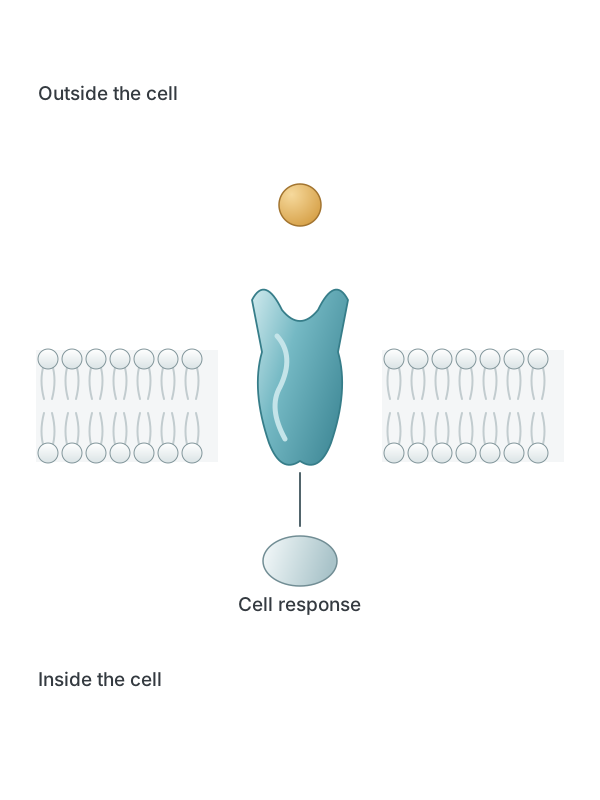
- Messenger
Norepinephrine / epinephrine
- Target
Beta-1 adrenergic receptor
- Cell context
peripheral tissue cell; simplified membrane, not a binding structure.
Simplified teaching model. Protein shapes, sizes, particle counts and arrows are illustrative, not measurements or experimental structures.
Norepinephrine / epinephrine can activate beta-1 adrenergic receptor and change signaling in the cell. This is a peripheral tissue cell example, not a complete nervous-system pathway.
Norepinephrine / epinephrine: Beta-2 adrenergic receptor
- Messenger
Norepinephrine / epinephrine
- Target
Beta-2 adrenergic receptor
- Cell context
peripheral tissue cell; simplified membrane, not a binding structure.
Simplified teaching model. Protein shapes, sizes, particle counts and arrows are illustrative, not measurements or experimental structures.
Norepinephrine / epinephrine can activate beta-2 adrenergic receptor and change signaling in the cell. This is a peripheral tissue cell example, not a complete nervous-system pathway.
About this illustration
Adrenergic signals; Beta receptors; Body responses. A fast heartbeat can have several causes and does not, on its own, identify an anxiety disorder.
This is a simplified illustration. It does not show exactly how a medicine fits into a protein or predict a dose or response to treatment.
How the Medication Changes Signaling
Propranolol competes with the usual messengers for beta receptors and reduces their activation. This is called competitive blockade. It acts on both beta-1 and beta-2 receptors, which is why it is described as nonselective.
Blocking beta-1 signals reduces the heart’s response to stimulation. Blocking beta-2 signals can affect the airways. These peripheral effects, meaning effects outside the brain and spinal cord, help explain why breathing conditions matter.
What is known: Propranolol blocks beta-1 and beta-2 receptors.
What remains uncertain: The extent of its effect on physical symptoms does not predict benefit for every anxiety symptom.
Propranolol: Beta-1 adrenergic receptor
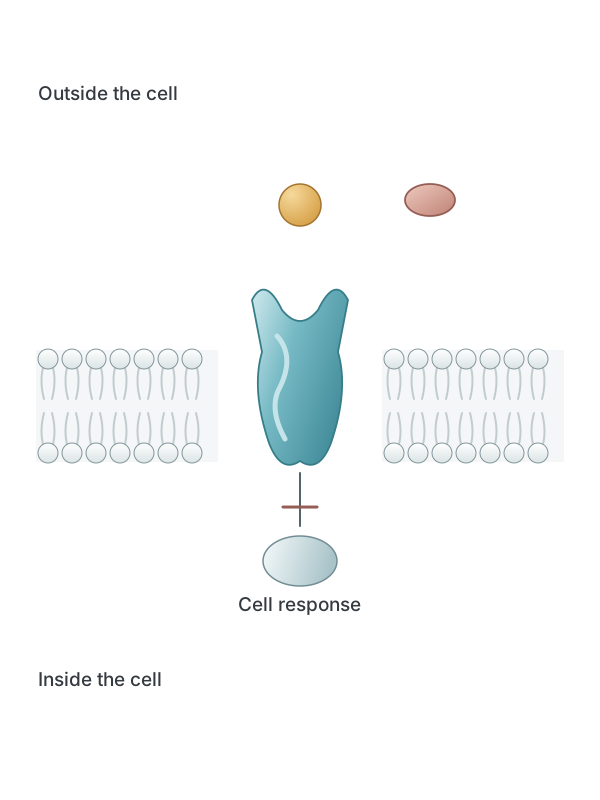
- Messenger
Norepinephrine / epinephrine
- Target
Beta-1 adrenergic receptor
- Propranolol: receptor activation opposed
The medicine symbol and crossbar indicate antagonist action in a peripheral tissue cell; receptor action does not predict an individual clinical response.
Simplified teaching model. Protein shapes, sizes, particle counts and arrows are illustrative, not measurements or experimental structures.
Propranolol competes with adrenergic signals at beta-1 receptors. The heart is one relevant tissue; this is not a complete psychiatric treatment mechanism.
Propranolol: Beta-2 adrenergic receptor
- Messenger
Norepinephrine / epinephrine
- Target
Beta-2 adrenergic receptor
- Propranolol: receptor activation opposed
The medicine symbol and crossbar indicate antagonist action in a peripheral tissue cell; receptor action does not predict an individual clinical response.
Simplified teaching model. Protein shapes, sizes, particle counts and arrows are illustrative, not measurements or experimental structures.
Propranolol also blocks beta-2 receptors in tissues including the airways. Beta-1 and beta-2 are distinct receptor types.
About this illustration
Propranolol; Beta-1 and beta-2; Reduced responses. The extent of its effect on physical symptoms does not predict benefit for every anxiety symptom.
This is a simplified illustration. It does not show exactly how a medicine fits into a protein or predict a dose or response to treatment.
How does it affect my body?
Heart rate can slow and blood pressure can fall. Dizziness matters for driving and falls, particularly when starting treatment or changing the dose.
How does my body process it?
The liver removes much of an oral dose before it reaches the circulation. The usual oral elimination half-lifeThe time for a measured drug level to fall by halfThe time it takes for the concentration of a medicine in a body fluid, usually blood, to decrease by half during elimination.Read the full definition of Half-life is approximately 3–6 hours.
How do treatment options differ?
For anxiety, propranolol mainly addresses physical symptoms. Psychological therapies may address additional difficulties, and treatment choice should reflect the actual anxiety condition.
A closer look at the science
Propranolol competitively blocks beta-1 and beta-2 adrenergic receptorsReceptorA protein that recognizes a signal and helps a cell respond. Different receptor types can produce different responses to the same messenger.Read the full definition of Receptor. Its non-selective action includes effects on the heart and airways.
Propranolol hydrochloride is a salt of propranolol. The neutral parent has formula C16H21NO2; adding HCl describes the salt. Propranolol has two mirror-image forms, and the S form has greater beta-blocking activity. The drawing represents chemical connectivity and does not specify the composition, dose or formulation of a particular product.
Chemical formula: C16H21NO2 · HCl
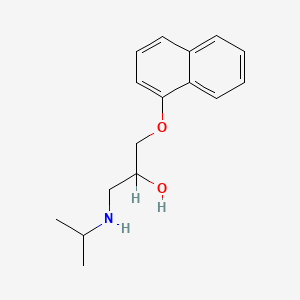
Neutral parent only; hydrochloride separately specified.
How was this medicine developed?
The checked Inderal 40 mg product lists first authorisation in May 1975. Product history does not imply unchanged guidance or present-day stock.
Sources and References
- Inderal 40 mg film-coated tablets: SmPC, sections 1–5 and 9
Product information published on the electronic Medicines Compendium (emc); supplied by pharmaceutical companies.
Scope: United Kingdom product information.
- Common questions about propranolol
Scope: NHS website for England — general medicine education, not a four-nation service pathway.
- How and when to take propranolol
Scope: NHS website for England — general medicine education, not a four-nation service pathway.
- Side effects of propranolol
Scope: NHS website for England — general medicine education, not a four-nation service pathway.
- Who can and cannot take propranolol
Scope: NHS website for England — general medicine education, not a four-nation service pathway.
- Propranolol: pregnancy and breastfeeding
Scope: NHS website for England — general medicine education, not a four-nation service pathway.
- Propranolol hydrochloride tablets: prescribing information — mechanism explanation
Scope: Mechanism explanation only. Source sections checked: Clinical Pharmacology; Pharmacokinetics..
- Propranolol: patient information — mechanism explanation
Scope: Mechanism explanation only. Source sections checked: Why is this medication prescribed?..
- About propranolol — mechanism explanation
Scope: Mechanism explanation only. Source sections checked: How propranolol helps physical symptoms..
Shared scientific background. Some references are US product pharmacology or international chemical records; UK product details and prescribing information are verified separately.
Article Information
- Edition
- United Kingdom
- Content updated
- 2026-10-24
- Source check dates
- Listed with each reference above; retained dates for shared scientific content.
- Scope
- exact products checked
Source and coverage limits
- Product-level strength verification in this batch covers Inderal 40 mg only.
- Other aliases are recognised by NHS information but do not establish interchangeable formulations, licensed uses or stock.
- No claim of first-line status for a specific anxiety disorder is made.