
What should I know first?
A neuron is a nerve cell that receives information and sends signals. Reading a sentence involves many connected cells; no single cell contains the meaning of the whole page. This introduction follows one common kind of communication, a chemical synapse, to make part of that larger process easier to understand.
Receiving and sending
DendritesDendriteA branching extension of a nerve cell that commonly receives signals from other cells. A neuron can receive many inputs across its branches.Read the full definition of Dendrite are branching parts of many neurons that receive signals. The cell body keeps the cell functioning, while an axonAxonA nerve-cell extension along which electrical signals can travel toward other cells. Its endings can communicate at synapses.Read the full definition of Axon is an extension that carries electrical signals toward other cells. These names describe parts of a cell, not separate steps in conscious thought.
Signals reaching a cell can encourage, reduce or adjust further signaling. A useful question is therefore not only “Did a message arrive?” but also “What else was happening in this cell and its connections?”
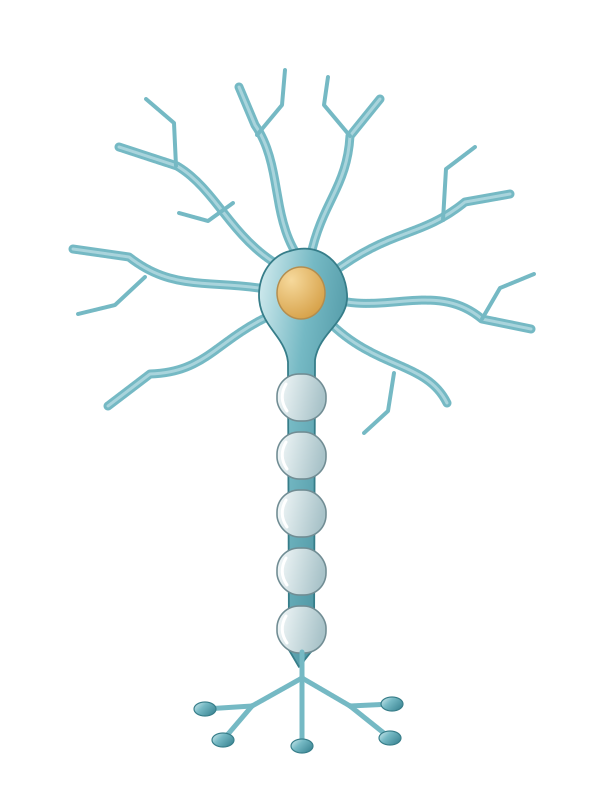
- Receiving branches
Dendrites connect with signals arriving from other cells.
- Cell body
The cell body joins the receiving branches to the axon.
- Axon
Changing voltage propagates along its membrane; no particle travels along the arrow.
- Nerve terminals
The signal can trigger release of chemical messengers.
- Myelin
Insulating coverings wrap sections of many axons; the gaps are called nodes of Ranvier.
Simplified teaching model. Protein shapes, sizes, particle counts and arrows are illustrative, not measurements or experimental structures.
Across a chemical synapse
A synapse is a junction where cells communicate. In a chemical synapse, a neurotransmitterNeurotransmitterA chemical messenger released by a nerve cell. Its effect depends on the receiving cell and the receptor that detects it.Read the full definition of Neurotransmitter—a chemical messenger—is released from small pouches called vesiclesVesicleA tiny membrane-bound pouch inside a cell. At many nerve endings, vesicles hold chemical messengers until they are released.Read the full definition of Vesicle near a nerve ending. It crosses a narrow gap and reaches a receptorReceptorA protein that recognizes a signal and helps a cell respond. Different receptor types can produce different responses to the same messenger.Read the full definition of Receptor, a protein that helps the receiving cell respond.
Afterward, the messenger can be taken back into cells or broken down. This helps separate one signal from the next. Some synapses instead transmit electrical activity more directly, so this chemical example does not describe every connection.
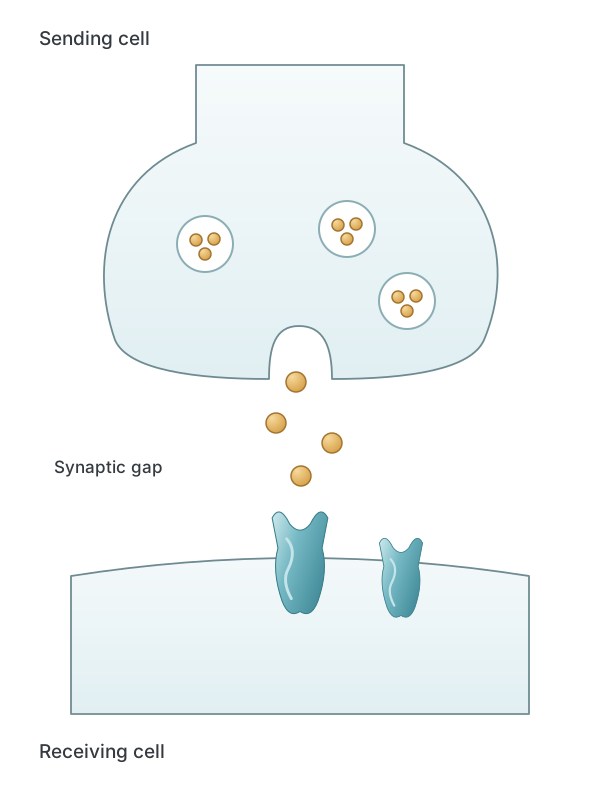
- Sending cell
Vesicles hold chemical messengers before release.
- Chemical messengers
A few illustrated particles identify the messengers; their number and spacing are illustrative.
- Synaptic gap
A chemical message crosses the space between the cells.
- Receiving receptor
A receptor responds to an appropriate messenger.
Simplified teaching model. Protein shapes, sizes, particle counts and arrows are illustrative, not measurements or experimental structures.
More than a chain of messages
GliaGliaNervous-system cells with roles that support neurons. Some glial cells make myelin, the insulating covering around many axons.Read the full definition of Glia are another broad group of nervous-system cells. Some make myelinMyelinAn insulating covering around many nerve-cell axons. It helps electrical signals travel efficiently; not every axon has this covering.Read the full definition of Myelin, an insulating covering around many axons. The brain includes these supporting cells as well as neurons.
A brain networkBrain networkConnected brain areas that contribute to an activity together. A network explanation asks how areas interact, as well as what each area does.Read the full definition of Brain network is a set of connected regions working together. Research on behavior examines connections among several regions, rather than treating one region as a complete explanation. The journey drawn here is a teaching model, not a test that can reveal the cause of someone’s symptoms.
Follow the next connection
Read about electrical signals to explore what travels along an axon. The receptor and transporterTransporterA protein that moves a substance across a cell membrane. Some transporters help remove released chemical messengers from the space around nerve cells.Read the full definition of Transporter introduction explains what happens when a chemical message arrives or is taken back up. From there, the SSRI lesson uses sertraline as a specific medication example. That lesson is education about a mechanism, not advice to choose a medicine.
Sources and References
Article Information
- Edition
- United Kingdom
- Content updated
- 2026-10-16
- Sources checked
- Listed with each reference above; retained dates for shared scientific content.
- Publication status
- Published