
About this medicine
Lorazepam can bring relatively rapid relief of anxiety but can also impair alertness. Its short-term role should be agreed with a prescriber alongside a plan for the underlying problem.
What is this medicine used for?
The Genus tablets are licensed for severe adult anxiety for 2–4 weeks, including anxiety-related insomnia, and for procedural premedication from age five. The Aristo dissolving product has different age and dose instructions.
Aristo’s paediatric exception is procedural premedication from age six, not routine anxiety treatment. Its under-six contraindicationA medical reason a medicine should not be usedA medical reason a medicine should not be used in a particular situation because it may be harmful.Read the full definition of Contraindication differs from Genus’s age-five procedural indication. Lorazepam is not primary treatment for depression or psychosisPsychosisPsychosis describes symptoms that affect a person’s ability to tell what is real. These can include hallucinations, delusions and disorganised thinking or speech.Psychosis can occur with different mental or physical health conditions, some medicines or substance use. It does not automatically mean schizophrenia. New symptoms need prompt professional assessment. and should not be used alone for depression-associated anxiety.
The oral solution covers short-term severe anxiety and procedural premedication but is not recommended for children. Macure injection has separate procedural and acute-anxiety/excitement/mania indications, and is also used for status epilepticus.
Which warning signs need help?
Dependence can develop during treatment. Combining lorazepam with opioids or alcohol can cause profound sedation and breathing failure. If someone is difficult to wake or breathing abnormally, obtain emergency help immediately: 999 in the UK, or local emergency services elsewhere.
How do I take it safely?
The Genus adult anxiety schedule is 1–4 mg daily in divided doses; anxiety-related insomnia uses 1–2 mg before bed. The Aristo dissolving product gives a usual 0.5–2.5 mg daily range for anxiety-related problems. Product-specific instructions matter; these are educational label examples, not doses to select yourself.
The Aristo 1 mg tablet is scored into equal doses and dissolves on the tongue; swallowing with water is optional. The short-term plan should include an end-of-treatment review from the outset.
The checked oral liquid is 1 mg/ml and comes with an oral syringe. It requires refrigeration at 2–8°C and protection from light; after opening, its 60 ml bottle expires after 30 days and 150 ml bottle after 90 days. Follow the dispensed pack’s instructions.
Macure 4 mg/ml injection is administered intravenously or intramuscularly; intravenous use is preferred in its label. Intramuscular absorption is slower and need not act faster than oral lorazepam. It is not for chronic treatment.
What side effects should I know about?
Sleepiness, dizziness, unsteadiness and muscle weakness are recognised effects. New agitation, unusual behaviour, confusion or memory difficulties should be discussed promptly with the prescriber.
Who needs extra care with this medicine?
Severe breathing or liver problems, sleep apnoea and myasthenia gravis can rule out treatment. Older people are more vulnerable to falls and often need lower doses.
The Aristo product additionally contraindicates acute intoxication with alcohol or other central depressants and a history of alcohol or drug dependence. These product-specific restrictions require prescriber assessment, not judgement or abrupt withdrawalWithdrawalSymptoms that may occur after reducing or stopping a medicine or substance to which the body has adapted.Read the full definition of Withdrawal of established treatment.
Can it affect my other medicines?
Tell the prescriber about other sedating medicines, including opioid pain medicines and sedating antihistamines. Valproate can increase lorazepam exposure; clozapine combinations need particular caution. Avoid alcohol.
What check-ups will I need?
Review benefit, sleepiness, falls, mood and the continuing need for treatment. Tell the clinician if the same dose seems less effective or taking more becomes difficult to resist. These concerns need support.
If repeated courses are clinically necessary, the SmPC recommends periodic blood counts and liver-function assessment. Kidney or liver impairment requires closer supervision and potentially lower dosing. For bedtime use, allow adequate uninterrupted sleep because memory and next-day functioning can be impaired.
Macure requires facilities to support breathing and observation for at least eight hours, preferably overnight; an outpatient must leave accompanied. Its benzyl alcohol and propylene glycol add particular neonatal/young-child and organ-impairment cautions. Preparation and seizure-treatment protocols belong to trained clinical teams.
What about pregnancy, breastfeeding and age?
Pregnancy and breastfeeding need a specific risk–benefit discussion. Exposure near birth can affect the baby’s breathing, feeding or adaptation. Childhood procedural use does not authorise routine treatment of childhood anxiety.
Macure is not recommended below twelve for premedication or acute anxiety, but its status-epilepticus section includes paediatric use. These are not the oral products’ age limits.
What if I miss a dose or want to stop?
Do not abruptly stop regular lorazepam: withdrawal may include seizures. The dose is reduced according to an agreed plan. Do not double a missed dose; the leaflet gives different timing advice for anxiety and bedtime use.
How does it work?
Lorazepam helps nerve cellsNeuronA nerve cell that receives and sends information. Neurons work in connected groups, rather than carrying a whole thought on their own.Read the full definition of Neuron respond more strongly to GABA, a chemical messenger that usually quiets their activity. This can ease anxiety, but the same effect can make a person sleepy or less coordinated. It belongs to the benzodiazepine family of medicines.
How Brain Cells Communicate
Brain cells communicate by releasing chemical messengers across small gaps called synapses. A messenger reaches the next cell by attaching to a receptor, a protein that receives its signal. GABA acts at several kinds of receptor; the GABA-A receptor is a channel through which electrically charged particles can move. In many adult brain cells, opening this channel makes it harder for the cell to send another electrical signal.
What is known: GABA-A receptors help restrain activity in connected groups of nerve cells.
What remains uncertain: These connections also participate in memory, movement and alertness.
GABA-A signaling
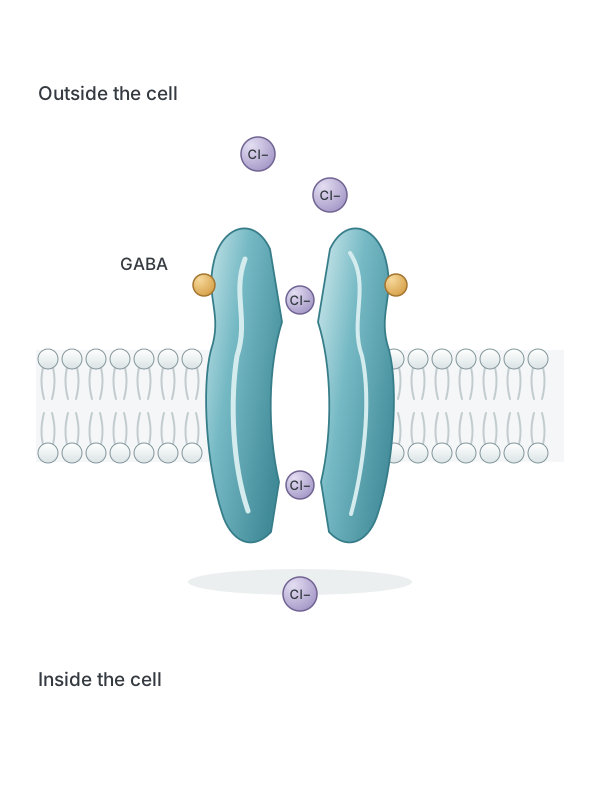
Optional motion shows inward ion movement in this example. Counts and timing are illustrative.
- Chloride · Cl−
Inward movement is a typical mature-cell example; ion gradients can differ.
- GABA-A receptor / channel
GABA activates this ion channel.
- Open channel
The arrow shows a qualitative direction, not an ion count or measured rate.
Simplified teaching model. Protein shapes, sizes, particle counts and arrows are illustrative, not measurements or experimental structures.
GABA acts at GABA-A receptor channels. Inward chloride movement is a typical mature-cell example; the effect depends on the cell and ion gradients.
About this illustration
GABA: inhibitory messenger. These connections also participate in memory, movement and alertness.
Conceptual pathway · not to scale · arrows show relationships, not measured rates
How the Medication Changes Signaling
Lorazepam attaches to a particular part of the GABA-A receptor called the benzodiazepine site. This site is separate from the place where GABA attaches, so lorazepam strengthens the response to GABA already present. The resulting increase in inhibition, meaning reduced nerve-cell activity, helps explain both calming and sedating effects.
What is known: Its action depends on enhancing an existing GABA signal.
What remains uncertain: Receptor activity cannot tell us how much anxiety relief one person will feel.
Lorazepam and GABA-A
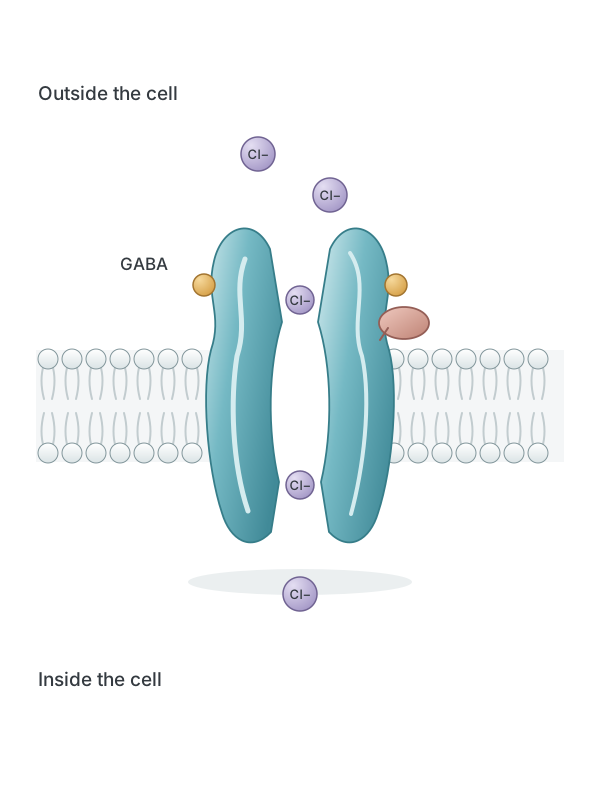
- Chloride · Cl−
Inward movement is a typical mature-cell example; ion gradients can differ.
- GABA-A receptor / channel
GABA activates this ion channel.
- Lorazepam: GABA response enhanced
The medicine symbol labels an action, not an experimentally determined binding position.
Simplified teaching model. Protein shapes, sizes, particle counts and arrows are illustrative, not measurements or experimental structures.
Lorazepam enhances GABA-mediated signaling through GABA-A receptor complexes. The medicine does not replace GABA or block the pore.
About this illustration
Lorazepam: benzodiazepine site. Receptor activity cannot tell us how much anxiety relief one person will feel.
Conceptual pathway · not to scale · arrows show relationships, not measured rates
How does it affect my body?
Calming and sleepiness may appear within roughly half an hour after oral treatment. Concentration and coordination can remain impaired, so feeling calmer does not establish fitness to drive.
How does my body process it?
Lorazepam is converted mainly to an inactive glucuronide rather than major active metabolites. The Genus label reports an elimination half-lifeThe time for a measured drug level to fall by halfThe time it takes for the concentration of a medicine in a body fluid, usually blood, to decrease by half during elimination.Read the full definition of Half-life of about 12 hours.
How do treatment options differ?
NICE restricts benzodiazepines for generalised anxiety to brief crisis use. Longer-term care may involve psychological therapy or other medicines. Benzodiazepine doses are not interchangeable milligram for milligram.
A closer look at the science
It belongs to the 1,4-benzodiazepines. Binding at benzodiazepine sites functionally linked to GABA receptorsReceptorA protein that recognizes a signal and helps a cell respond. Different receptor types can produce different responses to the same messenger.Read the full definition of Receptor enhances GABA-mediated inhibition; it does not replace GABA.
The image shows the verified lorazepam molecular identity used in the article. It does not depict inactive ingredients or a receptor-bound conformation.
Chemical formula: C15H10Cl2N2O2
C, H, N, O and Cl stand for carbon, hydrogen, nitrogen, oxygen and chlorine where present. Subscripts count atoms. The formula identifies composition, not clinical potency or a dose.
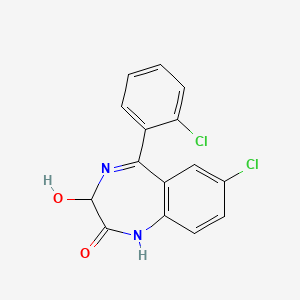
A 2D structure does not show the full range of conformations or predict treatment response.
How was this medicine developed?
Ativan is a recognised search name for lorazepam. The products verified here are generic Genus tablets and an Aristo dissolving tablet; an alias does not establish a particular brand’s current supply.
Ativan oral tablets received US approval in September 1977. This is an international development milestone, not the authorisation date or current supply status of a UK product.
Sources and References
- NHS: common questions about lorazepam
Scope: NHS website medicines information (England); not a guarantee of identical services across UK nations.
- Lorazepam 1 mg tablets — SmPC, sections 4.1–4.9, 5.1–5.2 and 7–10
Product information published on the electronic Medicines Compendium (emc); supplied by pharmaceutical companies.
Scope: United Kingdom product information.
- Lorazepam Aristo 1 mg orodispersible tablets — SmPC, sections 4.1–4.9, 5.1–5.2 and 7–10
Product information published on the electronic Medicines Compendium (emc); supplied by pharmaceutical companies.
Scope: United Kingdom product information.
- Lorazepam 1 mg and 2.5 mg tablets — patient leaflet, sections 1–4 and 6
Product information published on the electronic Medicines Compendium (emc); supplied by pharmaceutical companies.
Scope: United Kingdom product information.
- Strengthened information on dependence, addiction, withdrawal and tolerance — benzodiazepines, Z-drugs and gabapentinoids
Scope: United Kingdom.
- NICE CG113: generalised anxiety and panic disorder — drug-treatment recommendations on benzodiazepines
Scope: NICE guidance for England; application in other UK nations determined separately.
- Oral benzodiazepines and choosing equivalent doses — differences and licensed indications
Scope: NHS Specialist Pharmacy Service (England), professional medicines advice.
- Lorazepam: original product approval and regulatory history
Scope: United States; historical approval only.
- Lorazepam Macure 4 mg/ml solution for injection — SmPC
Product information published on the electronic Medicines Compendium (emc); supplied by pharmaceutical companies.
Scope: United Kingdom; named product information.
- Lorazepam 1 mg/ml oral solution — SmPC
Product information published on the electronic Medicines Compendium (emc); supplied by pharmaceutical companies.
Scope: United Kingdom; named product information.
- Loreev XR prescribing information — receptor mechanism and formulation distinction
Scope: Shared scientific explanation; source remains US, not UK prescribing authority.
- Lorazepam: current product prescribing information
Scope: Shared scientific explanation; source remains US, not UK prescribing authority.
- NIMH: Understanding psychosis
Shared scientific background. US product pharmacology and chemical references do not establish UK licences, doses, formulations or NHS recommendations.
Article Information
- Edition
- United Kingdom
- Content updated
- 2026-10-24
- Source check dates
- Listed with each reference above; retained dates for shared scientific content.
- Scope
- exact products checked
Source and coverage limits
- Product information establishes the checked product and label, not current pharmacy stock or local NHS funding.
- This is a selected-product educational record, not an exhaustive inventory of UK brands, presentations or specialist protocols.
- Ativan is retained as an NHS-recognised and cross-edition alias, not asserted as a stocked UK brand.
- NICE CG113 recommendations were read in official indexed text; direct NICE page retrieval returned HTTP 403.
- No general benzodiazepine conversion or personal withdrawal schedule is supplied.