
What should I know first?
Lamotrigine can inhibit voltage-sensitive sodium currents in experimental systems. The UK Lamictal information describes this action while acknowledging that its mechanism in bipolar disorder remains unestablished.
Read the UK lamotrigine medicine article for product-specific indications and important precautions, including serious rash and restarting treatment. Sodium-channel research is not a reason to change a prescription.
This is a mechanism lesson, not a complete medicine guide. A diagram cannot choose treatment, predict your response, or tell you how to change a prescription.
How Brain Cells Communicate
A neuronNeuronA nerve cell that receives and sends information. Neurons work in connected groups, rather than carrying a whole thought on their own.Read the full definition of Neuron is a nerve cell. Its membraneCell membraneThe thin boundary of a cell. It separates the inside from the surroundings and contains proteins that control transport and signaling.Read the full definition of Cell membrane separates the inside from the outside. Charged particles, called ionsIonAn atom or group of atoms with an electrical charge. Movement of ions such as sodium and potassium helps produce nerve-cell electrical signals.Read the full definition of Ion, move through selected channels in that membrane. Their movement helps produce a brief electrical signal along the axonAxonA nerve-cell extension along which electrical signals can travel toward other cells. Its endings can communicate at synapses.Read the full definition of Axon, the cell’s long communicating branch.
At a chemical synapseSynapseA communication junction between cells. At a chemical synapse, a released messenger crosses a narrow gap; electrical synapses allow more direct electrical communication.Read the full definition of Synapse, an electrical signal can trigger release of a neurotransmitterNeurotransmitterA chemical messenger released by a nerve cell. Its effect depends on the receiving cell and the receptor that detects it.Read the full definition of Neurotransmitter, a chemical messenger that acts on a nearby cell. The electrical signal and the messenger crossing the gap are different steps.
Known action: Electrical and chemical signalling are linked parts of communication between many neurons.
What remains uncertain: This simplified drawing omits many channels, supporting cells and network effects. It does not represent a whole brain or an individual illness.
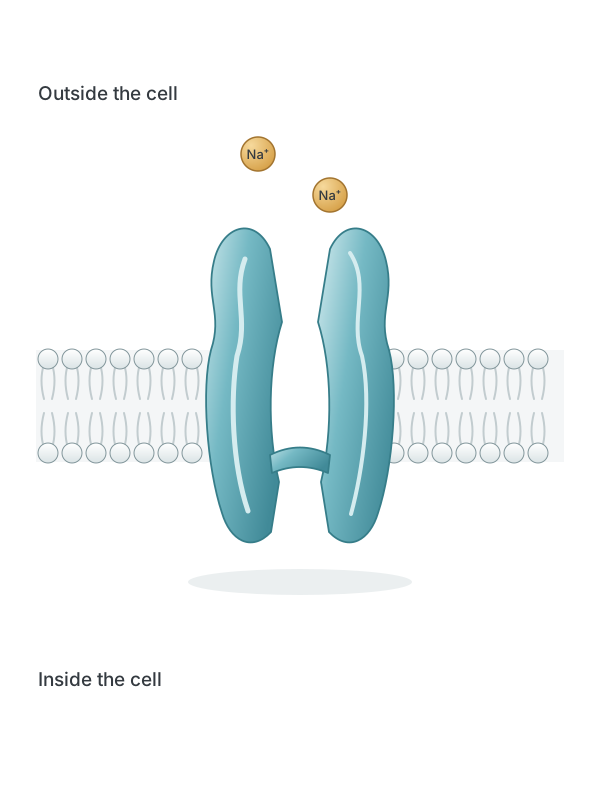
- Sodium · Na+
Sodium can enter through an available open channel.
- Voltage-sensitive sodium channel
Closed, open and inactivated are distinct channel states.
- Closed and ready
No flow arrow is shown through the closed pore.
Simplified teaching model. Protein shapes, sizes, particle counts and arrows are illustrative, not measurements or experimental structures.
About this illustration
A closed but available sodium channel can open when the membrane voltage changes. The bar indicates no sodium flow through this closed channel.
How the Medication Changes Signalling
Voltage-sensitive sodium channels change state as the membrane voltage changes. A channel can be closed but ready, open briefly, or temporarily inactivated before becoming available again. Sodium entry during opening helps the electrical signal rise.
Experiments show that lamotrigine can inhibit sodium currents in a way that depends on channel state and repeated activity. This can limit repetitive firing under the experimental conditions. It does not permanently close every channel.
Known action: State-dependent sodium-current inhibition has been observed in cell experiments.
What remains uncertain: Different preparations and conditions affect the findings. This qualitative schematic cannot predict firing or treatment effects in a person.
A Closer Look at the Molecular Level
A target is a biological component a medicine can affect. Here the relevant targets are voltage-sensitive sodium channels, which are proteins in cell membranes. Patch-clamp experiments measure electrical currents through cell membranes.
The cited Kuo and Lu study examined rat hippocampal nerve cells. This is a useful experimental system, but it does not establish an exact human protein-bound pose or how bipolar maintenance benefit arises.
Known action: reduced sodium currents and effects dependent on membrane voltage and channel state are experimentally supported in the stated system.
What remains uncertain: the mechanism of therapeutic action in bipolar disorder remains unestablished. No verified protein structure or docking position is asserted here.
Sources and References
- Lamictal tablets: UK SmPC
Product information published on the electronic Medicines Compendium (emc); supplied by pharmaceutical companies.
Scope: United Kingdom.
- What Is a Neurotransmitter?
Scope: International scientific education; not UK regulatory evidence.
- Sodium-channel states in rat nerve-cell experiments by Kuo and Lu
Scope: International laboratory research.
Article Information
- Edition
- United Kingdom
- Content updated
- 2026-10-17
- Sources checked
- Listed with each reference above; retained dates for shared scientific content.
- Publication status
- Published
- Scope
- How this medicine works, with UK product information.
Source and coverage limits
- A mechanism lesson is not a complete medicine profile, dosing schedule or individual treatment recommendation.
- Original qualitative SVG diagrams explain direction and target type; they do not measure biological rates, binding geometry or clinical response.