
About this medicine
Topiramate changes nerve-cell excitability. Its use for epilepsy or migraine does not establish a licensed role for bipolar disorder, eating disorders or substance-use problems.
What is this medicine used for?
The checked licence includes monotherapy for specified seizures above age 6 and adjunctive epilepsy treatment from age 2. Migraine prevention is for adults after considering alternatives, not relief of an attack already under way.
Psychiatric context needs more than the label 'off-label'. NICE CG185 specifically advises against offering topiramate for bipolar disorder; it should not be presented as an interchangeable mood stabiliser.
For binge-eating disorder, NICE NG69 prioritises eating-disorder-focused psychological care and advises that medicine should not be the sole treatment. A reduction in appetite or weight while taking topiramate is not, by itself, evidence of an appropriate treatment for an eating disorder or antipsychotic-associated weight gain.
The current UK alcohol-treatment guidance lists topiramate among drugs used elsewhere for relapse prevention but says these are not routinely used in the UK because of the evidence limitations. This is distinct from both a UK marketing authorisation and an individual specialist's off-label decision.
Which warning signs need help?
Painful or suddenly blurred vision, severe skin reaction, marked confusion or breathing changes need urgent assessment. Pregnancy restrictions are essential: for suspected pregnancy, migraine users should stop and contact their GP; epilepsy users should not abruptly stop and need urgent specialist advice.
Reduced sweating and overheating can occur, particularly in children. Unexplained worsening confusion or unusual lethargy warrants assessment for metabolic problems, including hyperammonaemia. Painful eye symptoms must not wait for the next routine review.
New thoughts of self-harm or a marked deterioration in mood need urgent clinical help. The pregnancy-prevention requirements also apply when a clinician uses topiramate off-label; changing the reason for prescribing does not remove fetal risk.
How do I take it safely?
Treatment starts low and increases gradually. For adult migraine prevention the reference begins at 25 mg nightly, usually increasing weekly towards 100 mg daily in two doses. Epilepsy regimens differ; this is not an off-label psychiatric schedule.
Topamax 15 mg sprinkle capsules provide a different way to take the medicine: the entire contents can be put onto a small spoonful of soft food and swallowed immediately without chewing or storing the mixture. Rosemont 20 mg/mL is a suspension, not an injection; shake thoroughly and use the supplied oral measuring device.
Epilepsy treatment depends on seizure type and whether topiramate is used alone or added to another antiseizure medicine. Children's regimens are weight-based and adjusted by the specialist; migraine doses must not be transferred to childhood epilepsy or a psychiatric indication. Renal impairment changes the time taken to reach stable levels and may require smaller doses and slower adjustment.
What side effects should I know about?
Nausea, dizziness, fatigue, diarrhoea and tingling can occur. Depression or other mood changes deserve review. Do not drive when thinking, vision or alertness is impaired.
Who needs extra care with this medicine?
Kidney stones, glaucoma, metabolic-acidosis risk and kidney or liver disease need assessment. Adequate hydration is important, particularly in hot weather or with activity.
Can it affect my other medicines?
Hormonal contraception and other antiseizure medicines need specific interaction review. Alcohol can worsen impairment. Valproate combinations can cause hyperammonaemia or hypothermia, requiring clinical assessment of concerning symptoms.
Tell the team about all psychiatric medicines as well as epilepsy treatment. The product record includes interactions involving lithium, risperidone and other medicines; the clinical significance depends on the combination and dose. The presence of an interaction entry does not mean either medicine should be stopped without a plan.
What check-ups will I need?
Review effectiveness, weight, cognition, mood and adverse effects; assess bicarbonate and renal concerns as indicated. Pregnancy-prevention review is at least annual, with contraception continuing for four weeks after stopping.
For children, review growth, nutrition, school functioning and heat tolerance as well as seizure control. Persistent cognitive problems or metabolic symptoms may require treatment adjustment. For an off-label prescription, the target problem, expected benefit and stopping/review criteria should be explicit rather than judged only by a change on the scales.
What about pregnancy, breastfeeding and age?
Do not use for migraine in pregnancy. For epilepsy in pregnancy, use is restricted to situations without a suitable alternative. Anyone who could become pregnant must meet the Pregnancy Prevention Programme, including effective contraception and documented risk discussion.
The programme includes excluding pregnancy before treatment, highly effective contraception and annual documented reassessment. Contraceptive interactions need specific advice; absence of breakthrough bleeding does not prove protection. Discuss breastfeeding with the treating team rather than assuming pregnancy rules answer that separate question.
The Pregnancy Prevention Programme applies to all indications, not just migraine or epilepsy. At initiation and annual review the prescriber and patient complete the Risk Awareness Form. Girls approaching reproductive potential need timely review; low doses or absence of sexual activity should not be assumed to remove the programme requirements.
Breastfeeding is a separate decision. The Topamax SmPC describes substantial passage into milk and reports diarrhoea, drowsiness, irritability and inadequate infant weight gain. It calls for weighing breastfeeding benefits against the mother's need for treatment when deciding whether to suspend feeding or change treatment. An infant with these symptoms needs assessment; the pregnancy programme is not breastfeeding advice.
For girls taking topiramate, the product information asks parents or carers to contact the specialist when periods first begin. The young person and family need an age-appropriate discussion of pregnancy risks and highly effective contraception when relevant. This review is necessary even when treatment started before puberty.
What if I miss a dose or want to stop?
Routine stopping is gradual to reduce seizure risk, even without a previous seizure history. A missed dose must not be doubled. The urgent pregnancy instructions above are indication-specific exceptions requiring clinician contact.
How does it work?
Topiramate affects several systems that control electrical and chemical activity in nerve cellsNeuronA nerve cell that receives and sends information. Neurons work in connected groups, rather than carrying a whole thought on their own.Read the full definition of Neuron. Laboratory studies show that it can influence sodium channels, strengthen quieting messages carried by GABA and reduce some activating messages carried by glutamateGlutamateAn important excitatory chemical messenger used by nerve cells.Read the full definition of Glutamate. The combination of actions may contribute to its effects, although the exact contribution of each is uncertain.
How Brain Cells Communicate
Brain cells communicate using electrical impulses and chemical messengers. GABA usually makes a receiving cell less likely to fire, while glutamate often makes firing more likely. The effect depends on the receptor, the protein that receives the chemical message. Sodium channels have a different role: they help the cell generate the electrical impulse itself.
What is known: Electrical channels and chemical receptors both influence nerve-cell activity.
What remains uncertain: A person’s symptoms cannot be explained by simply measuring one messenger.
Chemical communication between cells
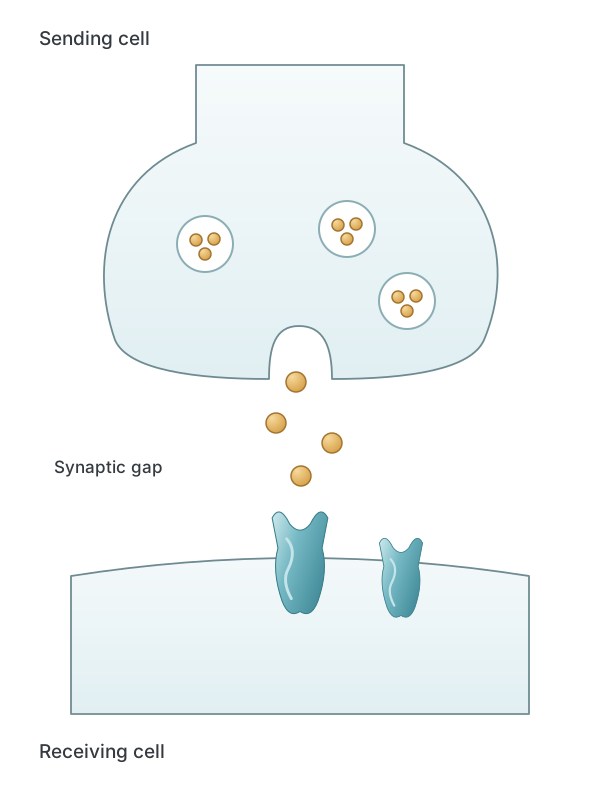
- Sending cell
Vesicles hold chemical messengers before release.
- Chemical messengers
A few illustrated particles identify the messengers; their number and spacing are illustrative.
- Synaptic gap
A chemical message crosses the space between the cells.
- Receiving receptor
A receptor responds to an appropriate messenger.
Simplified teaching model. Protein shapes, sizes, particle counts and arrows are illustrative, not measurements or experimental structures.
Brain cells use electrical activity and chemical messengers. This chemical synapse illustrates one part of that communication, not the complete mechanism of topiramate.
About this illustration
Electrical activity; Chemical messages; Network signaling. A person’s symptoms cannot be explained by simply measuring one messenger.
This is a simplified illustration. It does not show exactly how a medicine fits into a protein or predict a dose or response to treatment.
How the Medication Changes Signaling
Topiramate can reduce activity in voltage-dependent sodium channels, which respond to changes in electrical charge. It also increases responses at some GABA-A receptors and opposes responses at AMPA and kainate receptors, two kinds of glutamate receptor. These actions can reduce excessive signaling in experimental systems. They are several separate effects, rather than evidence that the medicine acts on one universal cause of seizures or migraine.
What is known: Laboratory evidence identifies sodium-channel, GABA-A and AMPA/kainate effects.
What remains uncertain: The exact combination responsible for seizure or migraine benefit is unknown.
One laboratory target: sodium channels
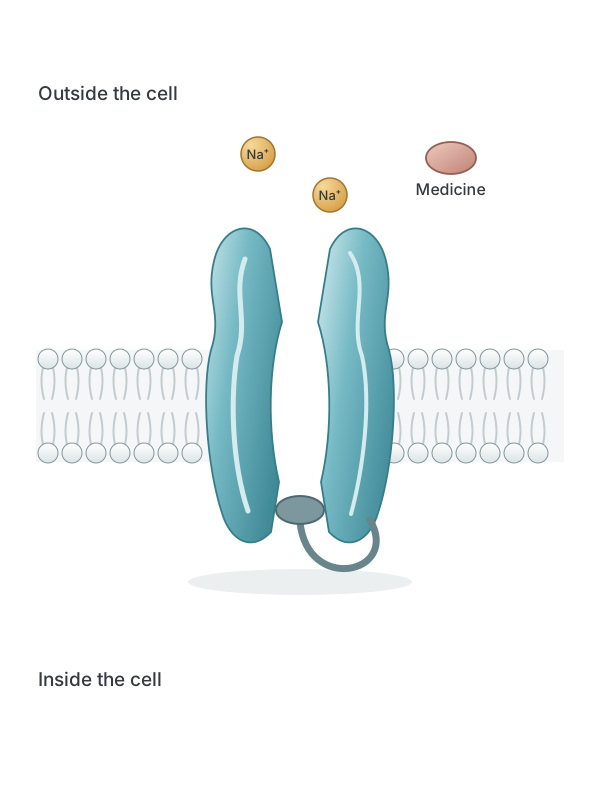
- Ion
Sodium (Na+)
- Target
Voltage-dependent sodium channel
- Scope
One laboratory target; not a complete clinical mechanism or a lamotrigine binding model.
Simplified teaching model. Protein shapes, sizes, particle counts and arrows are illustrative, not measurements or experimental structures.
Topiramate can reduce voltage-dependent sodium-channel activity in laboratory studies. Other GABA, AMPA/kainate and enzyme effects remain described in the article.
About this illustration
Sodium channels; GABA and glutamate; Altered signaling. The exact combination responsible for seizure or migraine benefit is unknown.
This is a simplified illustration. It does not show exactly how a medicine fits into a protein or predict a dose or response to treatment.
How does it affect my body?
Appetite and weight can fall, while attention, memory or word finding may become difficult. These effects matter for work and learning and should not be mistaken automatically for the underlying psychiatric condition.
Weight loss can be unwanted, especially where nutrition or growth is already vulnerable. Monitoring should include function: trouble finding words, slowed thinking or attention changes can affect studying, employment and everyday decisions even when seizures or migraines improve.
How does my body process it?
Elimination is predominantly renal. Kidney impairment can slow clearance and titrationTitrationAdjusting a medicine dose in planned stages, guided by the intended benefit and unwanted effects.Read the full definition of Titration may need adjustment; interacting antiseizure medicines can also alter exposure.
How do treatment options differ?
An antiseizure class label does not make topiramate interchangeable with a medicine licensed for bipolar disorder. Each indication requires its own evidence and safety assessment.
A closer look at the science
Actions include voltage-dependent sodium-channel inhibition, enhancement of GABA effects, antagonism at AMPA/kainate glutamate receptorsReceptorA protein that recognizes a signal and helps a cell respond. Different receptor types can produce different responses to the same messenger.Read the full definition of Receptor and carbonic-anhydrase inhibition. The last action helps explain metabolic adverse effects.
Topiramate is a sulfamate-substituted monosaccharide, a chemically modified sugar-based molecule. That chemical ancestry does not make it a dietary sugar or predict its clinical effects.
Chemical formula: C12H21NO8S
One molecule contains 12 carbon,21 hydrogen,1 nitrogen,8 oxygen and 1 sulfur atom. The verified PubChem drawing shows the specific three-dimensional stereochemical relationships using a two-dimensional convention; it is not a receptor-binding pose.
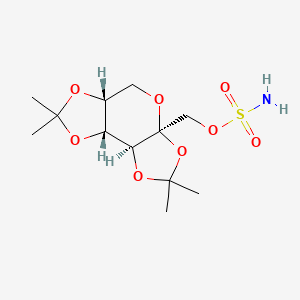
This drawing identifies topiramate, not the composition or release rate of a finished capsule.
How was this medicine developed?
MHRA introduced the Pregnancy Prevention Programme in June 2024 after reviewing fetal and developmental harm. The black triangle denotes additional UK safety monitoring, not a US boxed-warning designation.
Sources and References
- Topiramate Milpharm 25 mg tablets: UK SmPC
Product information published on the electronic Medicines Compendium (emc); supplied by pharmaceutical companies.
Scope: United Kingdom.
- Topamax 25 mg tablets: UK SmPC
Product information published on the electronic Medicines Compendium (emc); supplied by pharmaceutical companies.
Scope: United Kingdom.
- Topiramate
Scope: UK patient information.
- Topiramate: Pregnancy Prevention Programme and new safety measures
Scope: United Kingdom.
- Bipolar disorder: assessment and management (CG185), recommendations
Scope: NICE guidance; implementation and services vary by UK nation.
- Eating disorders: recognition and treatment (NG69), recommendations
Scope: NICE guidance; implementation varies by UK nation.
- Clinical guidelines for alcohol treatment, chapter 10: pharmacological interventions
Scope: UK alcohol-treatment guidance; national/local implementation must be distinguished.
- Topamax 15 mg Sprinkle Hard Capsules: UK SmPC
Product information published on the electronic Medicines Compendium (emc); supplied by pharmaceutical companies.
Scope: United Kingdom.
- Topiramate Rosemont 20 mg/mL oral suspension: UK SmPC
Product information published on the electronic Medicines Compendium (emc); supplied by pharmaceutical companies.
Scope: United Kingdom.
- Topamax tablets and sprinkle capsules: US prescribing information, March 2026
Scope: Shared science only; original source jurisdiction retained in title/publisher.
Shared scientific background. US product pharmacology and international chemical references do not establish UK licences, doses, formulations or NHS recommendations.
Article Information
- Edition
- United Kingdom
- Content updated
- 2026-10-30
- Source check dates
- Listed with each reference above; retained dates for shared scientific content.
- Scope
- UK educational profile covering licensed epilepsy/migraine uses, representative tablets/sprinkle/liquid formulations, psychiatric off-label boundaries, major safety and Pregnancy Prevention Programme requirements.
Source and coverage limits
- Representative named products are verified; every manufacturer, stock position, local funding decision and specialist prescribing scenario is not claimed.
- UK clinical guidance, exact-product marketing authorisations and local NHS service protocols are kept distinct.
- Existing shared mechanism and molecular modules remain required and unchanged; no US prescribing fields were imported.
- Direct NICE retrieval was unavailable; official indexed recommendation text was checked.