
About this medicine
Naltrexone is used alongside recovery support rather than as a stand-alone cure for addiction. The purpose and product licence should be clear before treatment begins.
What is this medicine used for?
Adepend licenses alcohol relapse prevention, supporting abstinence and reducing craving. The separate AOP generic 50 mg product licenses adjunctive care after opioid detoxification. These indications must not be assumed identical just because the active ingredient matches.
Which warning signs need help?
Naltrexone can precipitate dangerous opioid withdrawalWithdrawalSymptoms that may occur after reducing or stopping a medicine or substance to which the body has adapted.Read the full definition of Withdrawal. Taking large opioid doses to defeat the blockade, or restarting previous doses after tolerance falls, can cause fatal overdose. Severe withdrawal, slow breathing or collapse needs emergency care: 999 in the UK, local emergency services elsewhere.
How do I take it safely?
Adepend’s adult alcohol-treatment dose is 50 mg daily. The AOP opioid-treatment label starts at 25 mg then usually 50 mg daily. In alcohol care, UK guidance also describes an initial 25 mg dose, explicitly identifying it as off-labelOff-labelUse of a licensed medicine outside the terms of its UK marketing authorisation.Read the full definition of Off-label. Initiation requires confirmed opioid clearance.
For alcohol relapse prevention, national guidance commonly uses six months, extending when beneficial; the Adepend label recommends at least three months. Duration is reviewed with psychosocial support rather than determined by a single tablet course.
What side effects should I know about?
Nausea, abdominal discomfort, headache, disturbed sleep, restlessness and weakness are reported. Jaundice or significant new mood symptoms need urgent assessment.
Who needs extra care with this medicine?
Current opioid use, positive opioid screening or an unsuccessful supervised challenge can prevent initiation. Acute hepatitis, liver failure and severe kidney disease are important exclusions; other impairment needs careful monitoring.
A negative urine screen alone may not settle uncertain opioid exposure. A supervised naloxone challenge may be necessary; neither the test nor naltrexone initiation belongs in a home detoxification plan.
Can it affect my other medicines?
Opioids may be present in prescribed pain medicines and some cough or diarrhoea medicines. Methadone and other opioid treatments are incompatible with routine naltrexone initiation. Check all products with the treatment team.
What check-ups will I need?
Assess liver and kidney function and opioid exposure before treatment. Product information calls for liver monitoring during therapy. Review mood, adherence, benefit and the wider recovery plan regularly.
UK alcohol guidance distinguishes baseline liver/kidney tests from repeat tests tailored to age, coexisting illness and results. Adepend’s SmPC calls for liver tests during treatment; the clinician reconciles these within an individual monitoring plan. Continued drinking without benefit after four to six weeks warrants review of treatment.
What about pregnancy, breastfeeding and age?
The checked products are not recommended below 18 years. Pregnancy needs an individual assessment; the AOP leaflet does not recommend breastfeeding. Seek advice rather than interrupting addiction care without a plan.
What if I miss a dose or want to stop?
Follow the product’s missed-dose instructions without doubling. Stopping requires a relapse and overdose-prevention plan because opioid sensitivity may increase. Contact the treatment team before restarting after a gap.
How does it work?
Naltrexone blocks opioid receptorsReceptorA protein that recognizes a signal and helps a cell respond. Different receptor types can produce different responses to the same messenger.Read the full definition of Receptor, receiving sites used by the body’s own opioid signals and by medicines and drugs such as morphine and heroin. It occupies these sites without producing the usual opioid effect. Blocking the body’s own opioid signals is also thought to contribute to its benefit in alcohol treatment, but the exact explanation is not fully understood.
How Brain Cells Communicate
Opioid receptors are proteins involved in how nerve cells respond to pain and other signals. They receive messages from opioid chemicals made within the body as well as from opioid medicines and drugs. A substance that activates a receptor is called an agonist; one that occupies it and blocks activation is an antagonist. These words describe what happens at the receiving site, rather than how an entire person will feel.
What is known: Activating and blocking an opioid receptor produce different effects.
What remains uncertain: A single receptor pathway cannot explain all aspects of craving or recovery.
Opioid agonist: Mu-opioid receptor
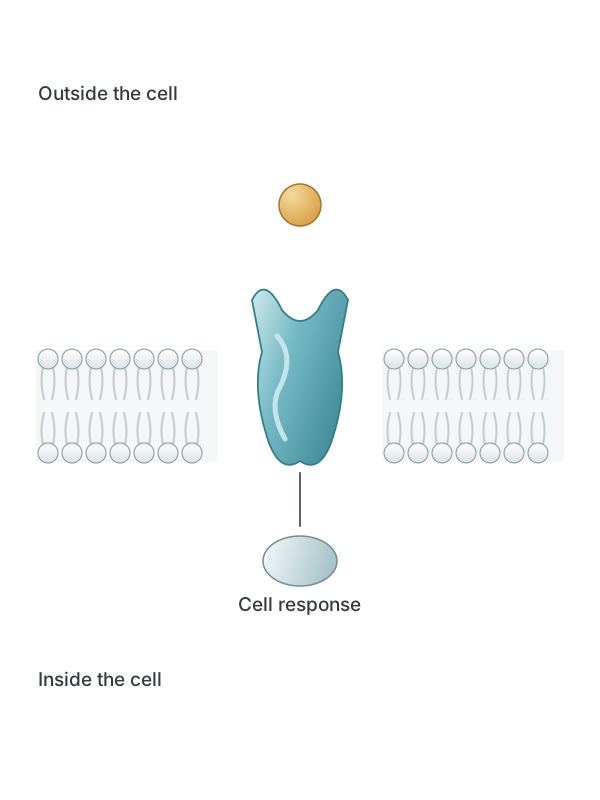
- Opioid agonist
A messenger can change signaling through its receptor.
- Mu-opioid receptor
This receptor symbol identifies a function, not a molecular structure.
- Cell response
The arrow represents a signaling response, not movement through a pore.
Simplified teaching model. Protein shapes, sizes, particle counts and arrows are illustrative, not measurements or experimental structures.
Opioid agonist can activate mu-opioid receptor and change signaling in the cell.
About this illustration
Opioid agonist → Opioid receptor → Receptor activation. A single receptor pathway cannot explain all aspects of craving or recovery.
An agonist can activate an opioid receptor; the diagram is not an exact binding model.
Qualitative model · no scale, rate, dose or binding pose
How the Medication Changes Signaling
Naltrexone is an antagonist with particularly strong attachment, or affinity, for the mu type of opioid receptor. By competing for access to these receptors, it can prevent another opioid from producing its expected effect. Withdrawal means physical and emotional symptoms that can occur when an opioid’s effects decrease after the body has adapted to it. Naltrexone can cause this abruptly, which is called precipitated withdrawal.
What is known: Naltrexone has little or no opioid-activating action of its own.
What remains uncertain: Receptor blockade does not provide absolute protection against an opioid overdose.
Naltrexone: Mu-opioid receptor
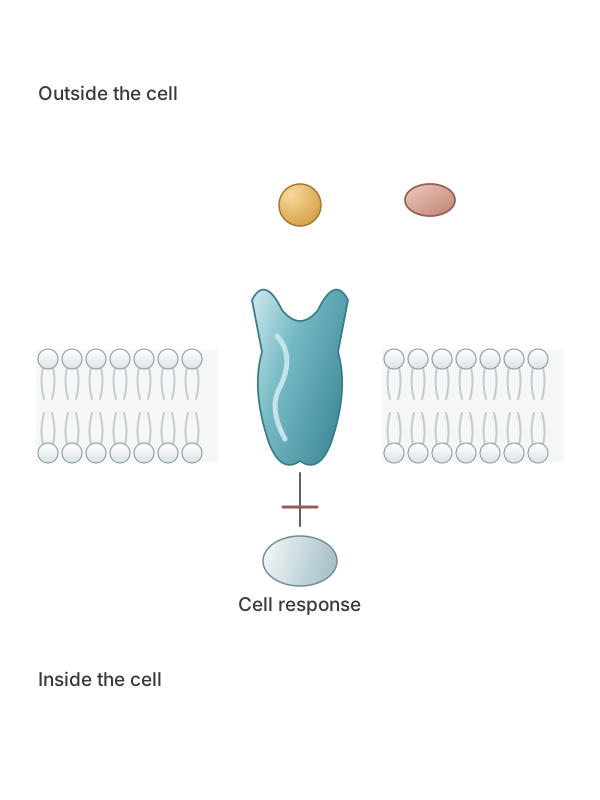
- Opioid agonist
A messenger can change signaling through its receptor.
- Mu-opioid receptor
This receptor symbol identifies a function, not a molecular structure.
- Naltrexone: activation opposed
The crossbar marks opposition to receptor activation, not permanent closure.
Simplified teaching model. Protein shapes, sizes, particle counts and arrows are illustrative, not measurements or experimental structures.
Naltrexone competes at opioid receptors, with greatest affinity at mu receptors and little or no agonist activity. Its full alcohol-treatment mechanism is not established by this image.
About this illustration
Naltrexone binds → Opioid action blocked → Withdrawal risk if dependent. Receptor blockade does not provide absolute protection against an opioid overdose.
Antagonism blocks opioid effects; a qualitative diagram cannot establish an opioid-free start date.
Qualitative model · no scale, rate, dose or binding pose
How does it affect my body?
Opioid pain relief may not work normally during treatment. Healthcare teams must know about naltrexone before emergency care, anaesthesia or surgery. Do not try to overcome the blockade yourself.
How does my body process it?
The liver produces active 6-beta-naltrexol and other metabolites, which are mainly eliminated through the kidneys. Approximate half-lives are four hours for naltrexone and 13 hours for 6-beta-naltrexol.
How do treatment options differ?
NICE describes acamprosate or oral naltrexone with psychological treatment after successful alcohol withdrawal. Choice also depends on health, opioid exposure and patient preference; this is not a personal treatment recommendation.
Naltrexone is not emergency naloxone and is not a substitute for medically supported withdrawal. An opioid-free interval is assessed by the treatment team, including prescribed and intermittently used opioids.
A closer look at the science
Naltrexone competes for opioid receptor binding. Its active metabolite, 6-beta-naltrexol, also contributes to the medicine’s pharmacology. It is an antagonist rather than opioid substitution treatment.
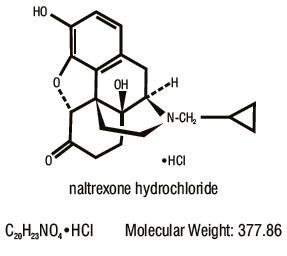
Oral tablets contain naltrexone hydrochloride. The retained drawing identifies that salt, not a drug-delivery system.
Chemical formula: C20H23NO4 · HCl
C, H, N, O and Cl denote carbon, hydrogen, nitrogen, oxygen and chlorine. Chemical composition is not a dosing or equivalence rule.
How was this medicine developed?
Adepend’s product record lists first authorisation in 2011. Revia and injectable Vivitrol remain US search aliases; this batch verifies UK oral products and does not establish a UK injection licence.
Sources and References
- NHS: alcohol-use disorder
Scope: NHS website medicines information (England); not a guarantee of identical services across UK nations.
- Adepend 50 mg filmcoated tablets — SmPC, sections 4.1–4.9, 5.1–5.2 and 7–10
Product information published on the electronic Medicines Compendium (emc); supplied by pharmaceutical companies.
Scope: United Kingdom product information.
- Naltrexone hydrochloride 50 mg film-coated tablets — SmPC, sections 4.1–4.9, 5.1–5.2 and 7–10
Product information published on the electronic Medicines Compendium (emc); supplied by pharmaceutical companies.
Scope: United Kingdom product information.
- UK clinical guidelines for alcohol treatment — chapter 10, pharmacological interventions
Scope: United Kingdom: England, Scotland, Wales and Northern Ireland.
- Naltrexone hydrochloride 50 mg tablets — patient leaflet, sections 1–4 and 6
Product information published on the electronic Medicines Compendium (emc); supplied by pharmaceutical companies.
Scope: United Kingdom product information.
- NICE CG115: alcohol-use disorders — pharmacological interventions, section 1.3.6
Scope: NICE guidance for England; application in other UK nations determined separately.
- Adepend 50 mg film-coated tablets — patient leaflet, sections 1–4 and 6
Product information published on the electronic Medicines Compendium (emc); supplied by pharmaceutical companies.
Scope: United Kingdom product information.
- Oral naltrexone hydrochloride: current generic prescribing information
Scope: Shared scientific explanation; source remains US, not UK prescribing authority.
- Vivitrol: current prescribing information — mechanism explanation
Scope: Mechanism explanation only. Source sections checked: 11 Description; 12.1 Mechanism of Action; 12.2 Pharmacodynamics; 12.3 Pharmacokinetics; 5.1 Vulnerability to Opioid Overdose; 5.3 Precipitation of Opioid Withdrawal..
Shared scientific background. US product pharmacology and chemical references do not establish UK licences, doses, formulations or NHS recommendations.
Article Information
- Edition
- United Kingdom
- Content updated
- 2026-10-24
- Source check dates
- Listed with each reference above; retained dates for shared scientific content.
- Scope
- exact products checked
Source and coverage limits
- Product information establishes the checked product and label, not current pharmacy stock or local NHS funding.
- This is a selected-product educational record, not an exhaustive inventory of UK brands, presentations or specialist protocols.
- Vivitrol injection and Revia are existing US aliases, not current UK availability claims.
- NICE CG115 was read through official indexed text; direct page retrieval returned 403.
- Opioid-free intervals, testing and emergency analgesia require specialist assessment; no self-directed initiation procedure is provided.