
About this medicine
Invega releases paliperidone gradually from an oral tablet. Kidney function is important when choosing the dose.
Treatment aims include reducing psychotic symptoms and preventing their return. Day-to-day benefit should be considered alongside alertness, mobility, physical health and the person’s own priorities; sedation alone is not a measure of recovery.
What is this medicine used for?
Schizophrenia is licensed from age 15; the schizoaffective indication is adult-only. These licences concern the checked oral product.
Xeplion, Trevicta and Byannli have adult schizophrenia maintenance indications. They do not inherit Invega’s adolescent or schizoaffective licences. Xeplion generally follows established paliperidone or risperidone treatment, with a defined option for selected previously responsive patients. The longer-interval injections require prior stabilisation; they are not first-dose substitutes for an oral antipsychotic.
Which warning signs need help?
Get urgent help for fever with rigidity or impaired awareness, stroke-like weakness, severe allergy, chest pain with breathlessness, or a painful prolonged erection.
Antipsychotic treatment in older people with dementia is associated with increased stroke and mortality concerns. This is a UK clinical warning, not a transplanted FDA regulatory designation. The checked oral indications do not include dementia-related behaviour.
Rare severe injection allergies can occur despite earlier tolerance of tablets. Seek emergency help for throat swelling or breathing difficulty. Byannli also has particularly long persistence: pregnancy planning and breastfeeding need product-specific discussion before treatment, not only when the next injection is due.
How do I take it safely?
For oral Invega, the usual labelled adult dose is 6 mg each morning. Adolescent schizophrenia starts at 3 mg, with weight-dependent limits. Tablet shells may appear in stools.
The oral adult schizophrenia label allows 3–12 mg daily and the oral adult schizoaffective label 6–12 mg daily, with reassessment before increases. These are total daily amounts, not a list of marketed tablet strengths. The permitted adolescent maximum depends on body weight.
For oral Invega, kidney function changes both dose and frequency: some impairment requires every-other-day initiation, and use is not recommended with creatinine clearance below 10 mL/min. Such decisions require the prescriber’s renal assessment, not a self-calculated dose from this article.
Xeplion is monthly treatment. Its UK SmPC describes initial 150 mg and 100 mg injections one week apart into the upper-arm muscle, followed by monthly maintenance injections into the arm or buttock. Renal impairment changes this initiation. The current leaflet lists 50–150 mg presentations; an older SmPC reference to 25 mg does not establish a currently marketed 25 mg product here.
Trevicta is given every three months after adequate stabilisation on monthly paliperidone palmitate, preferably for at least four months. Its 175, 263, 350 and 525 mg strengths have a product-specific conversion from monthly treatment. It is injected into the upper arm or buttock by a healthcare professional.
Byannli is given every six months, only into the buttock. Its 700 and 1000 mg presentations follow specified stable monthly or three-monthly treatment; it is not started directly from tablets. The team checks the preceding product, dose and dates rather than estimating a six-month supply.
UK injection strengths above are paliperidone-equivalent amounts: for example, 150 mg Xeplion contains 234 mg of paliperidone palmitate. An American label may display the salt amount differently. Never copy US depot numbers or convert an oral daily dose by simple multiplication.
What side effects should I know about?
Commonly reported problems include insomnia, headache, sleepiness, restlessness and parkinsonian movement symptoms.
Restlessness may feel like an inability to sit still; movement effects can include tremor, stiffness or slowed movement. Report persistent involuntary mouth or tongue movements promptly. Menstrual changes, breast discharge or sexual difficulties are also worth discussing rather than accepting as an unavoidable cost of treatment.
Who needs extra care with this medicine?
Kidney disease, heart-rhythm risks and narrowing of the digestive tract require particular assessment for this non-deformable tablet.
A previous allergy to risperidone also matters. Tell the team about Parkinson’s disease, previous low white-cell counts, seizures, dehydration, swallowing difficulty and planned cataract surgery. These can change the assessment or monitoring required.
All three checked injections are not recommended when creatinine clearance is below 50 mL/min. Mild renal impairment requires product-specific selection and prior stabilisation; Byannli 1000 mg is not recommended in that group. The more permissive renal range in the oral label must not be transferred to an injection.
Can it affect my other medicines?
With oral Invega, valproate can increase exposure. Combining paliperidone with risperidone is not recommended; review QT-prolonging medicines, sedatives and treatments for Parkinson’s disease. Interaction findings for oral Invega do not automatically apply to depot delivery.
Alcohol and sedating medicines can add impairment; blood-pressure treatments can add dizziness or fainting. Medicines affecting heart rhythm or gut transit also need review. A similar chemical name is not a safe reason to combine paliperidone and risperidone.
What check-ups will I need?
Assess symptoms, movement effects, prolactin-related symptoms, weight, blood pressure and metabolic measures alongside renal function.
Regular weight and glucose review helps detect changes that may not be immediately felt. Existing low white-cell counts can justify additional blood tests; prolactin-related symptoms and abnormal movements need active questioning. In schizoaffective disorder, follow changes between high and low mood as well as psychosisPsychosisPsychosis describes symptoms that affect a person’s ability to tell what is real. These can include hallucinations, delusions and disorganised thinking or speech.Psychosis can occur with different mental or physical health conditions, some medicines or substance use. It does not automatically mean schizophrenia. New symptoms need prompt professional assessment..
Review injection-site reactions as well as movement, metabolic and prolactin effects. A three- or six-month dosing interval does not mean concerns should wait until the next injection. Exposure and dose-adjustment effects can persist for months, making planned follow-up particularly important.
What about pregnancy, breastfeeding and age?
For oral Invega, discuss pregnancy and possible newborn effects; its leaflet advises against breastfeeding. Older people may need reduced doses because of kidney function. The injection-specific precautions below must be considered separately.
Byannli’s current leaflet says a dose may remain in the body for up to four years. It advises against breastfeeding during use or within four years after use and limits use when planning pregnancy to situations where clearly necessary. This is a specific long-acting-product precaution, not a four-year rule for oral Invega. The depot products are not for people under 18.
What if I miss a dose or want to stop?
For oral Invega, after one missed dose take the next dose the following day; never double. Contact the doctor after two or more missed doses.
Stopping can allow symptoms to return. Discuss a change with the treating team and agree how symptoms and physical health will be followed. Oral missed-dose advice must never be used for a long-acting injection.
For an overdue injection, contact the clinic promptly. Restart requirements depend on the actual product and elapsed time; a long delay may require a shorter-interval formulation first. Do not supplement with tablets or use another depot’s loading schedule without a specialist plan.
How does it work?
Paliperidone changes how brain cells respond to dopamineDopamineA chemical messenger involved in movement, learning and emotion. Its name does not describe one feeling or one role throughout the brain.Read the full definition of Dopamine and serotoninSerotoninA chemical messenger involved in several functions, including sleep, mood and digestion. It acts through different receptors, with effects that depend on the cell.Read the full definition of Serotonin, two chemical messengers. It blocks selected receptorsReceptorA protein that recognizes a signal and helps a cell respond. Different receptor types can produce different responses to the same messenger.Read the full definition of Receptor, the proteins that receive these messages. These actions are thought to contribute to benefit, but researchers do not fully understand how they produce improvement in symptoms.
How Brain Cells Communicate
Chemical messengers called neurotransmitters carry signals between brain cells. A receiving cell responds through receptors, and different receptor types can produce different responses to the same messenger. Dopamine and serotonin each take part in many connected networks, so changing their action at one receiving site is only one part of the medicine’s overall effect.
What is known: The type and location of a receiving site influence a chemical message’s effects.
What remains uncertain: A drawing of communication between cells cannot represent an individual’s whole illness.
Dopamine: D2 receptor
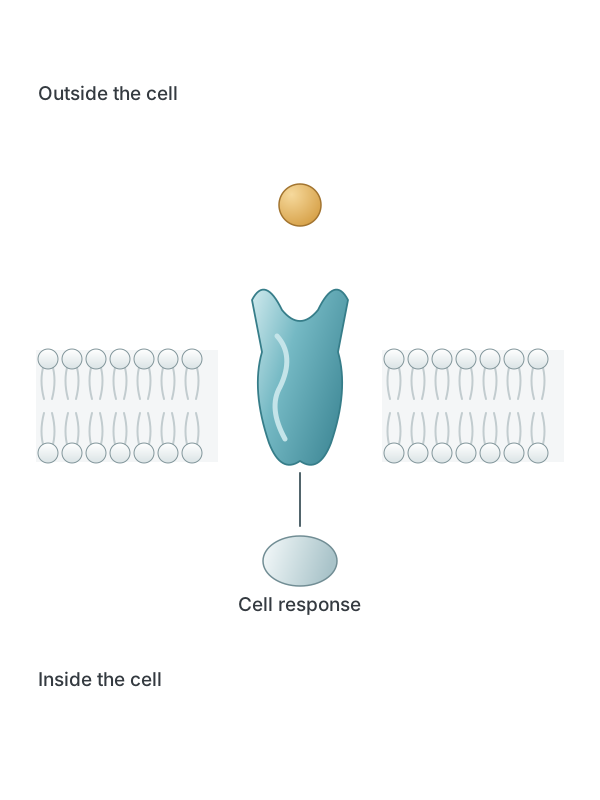
- Dopamine
A messenger can change signaling through its receptor.
- D2 receptor
This receptor symbol identifies a function, not a molecular structure.
- Cell response
The arrow represents a signaling response, not movement through a pore.
Simplified teaching model. Protein shapes, sizes, particle counts and arrows are illustrative, not measurements or experimental structures.
Dopamine can activate d2 receptor and change signaling in the cell.
Serotonin: 5-HT2A receptor
- Serotonin
A messenger can change signaling through its receptor.
- 5-HT2A receptor
This receptor symbol identifies a function, not a molecular structure.
- Cell response
The arrow represents a signaling response, not movement through a pore.
Simplified teaching model. Protein shapes, sizes, particle counts and arrows are illustrative, not measurements or experimental structures.
Serotonin can activate 5-ht2a receptor and change signaling in the cell.
About this illustration
Nerve-cell signal; Receptor action; Network activity. A drawing of communication between cells cannot represent an individual’s whole illness.
This is a simplified illustration. It does not show exactly how a medicine fits into a protein or predict a dose or response to treatment.
How the Medication Changes Signalling
Paliperidone blocks dopamine D2 and serotonin 5-HT2A receptors; these labels identify receiving-site types, and 5-HT is another name for serotonin. Blocking activation is called antagonism. Paliperidone is also 9-hydroxyrisperidone, the active metabolite, or active breakdown product, made when the body processes risperidone. It acts at other receptors as well, including histamine receptors involved in wakefulness and adrenergic receptors responding to adrenaline and norepinephrine.
What is known: Paliperidone blocks selected receiving sites and is chemically related to risperidone.
What remains uncertain: That relationship does not make the medicines interchangeable dose for dose.
Paliperidone: D2 receptor
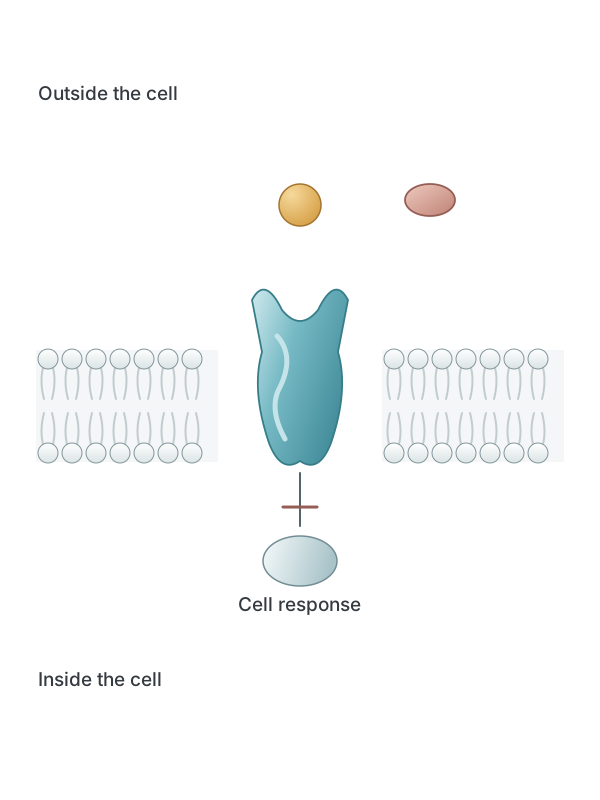
- Dopamine
A messenger can change signaling through its receptor.
- D2 receptor
This receptor symbol identifies a function, not a molecular structure.
- Paliperidone: activation opposed
The crossbar marks opposition to receptor activation, not permanent closure.
Simplified teaching model. Protein shapes, sizes, particle counts and arrows are illustrative, not measurements or experimental structures.
Paliperidone antagonizes dopamine D2 receptors. This is one example from a broader receptor profile, not a complete explanation of clinical response.
Paliperidone: 5-HT2A receptor
- Serotonin
A messenger can change signaling through its receptor.
- 5-HT2A receptor
This receptor symbol identifies a function, not a molecular structure.
- Paliperidone: activation opposed
The crossbar marks opposition to receptor activation, not permanent closure.
Simplified teaching model. Protein shapes, sizes, particle counts and arrows are illustrative, not measurements or experimental structures.
Paliperidone also opposes serotonin 5-HT2A receptor activation. The serotonin target is separate from the dopamine receptor.
About this illustration
Medicine; Molecular actions; Clinical effects. That relationship does not make the medicines interchangeable dose for dose.
This is a simplified illustration. It does not show exactly how a medicine fits into a protein or predict a dose or response to treatment.
How does it affect my body?
Prolactin can rise, sometimes causing menstrual, breast or sexual symptoms. Weight and blood-sugar changes are also possible.
How does my body process it?
Much of a dose leaves through the kidneys unchanged. Renal impairment can therefore require substantial dose adjustment.
The depot formulations release paliperidone over a much longer period than tablets. Persistence after an injection is governed by the named formulation as well as kidney clearance; the oral elimination profile cannot predict when an injection has left the body.
How do treatment options differ?
Milligram doses cannot be assumed equivalent to risperidone or injection regimens.
A closer look at the science
Paliperidone is 9-hydroxyrisperidone, an active metabolite of risperidone. Alpha-adrenergic and histamine effects also occur.
Paliperidone is a benzisoxazole derivative and the active 9-hydroxy metabolite of risperidone. Injectable products use its palmitate ester.
Chemical formula: C23H27FN4O3
The formula and verified image show neutral paliperidone, not the larger palmitate ester. They do not describe depot release or establish dose equivalence.
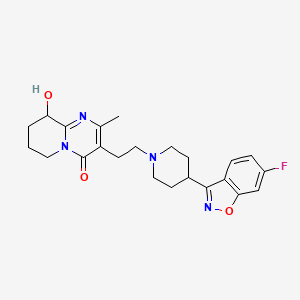
The image shows the paliperidone parent; it is not a drawing of the palmitate ester or injection particles.
How was this medicine developed?
The product record gives first authorisation in June 2007 and a June 2025 SmPC revision.
Sources and References
- Invega 6 mg prolonged-release tablets — UK SmPC
Product information published on the electronic Medicines Compendium (emc); supplied by pharmaceutical companies.
Scope: United Kingdom product information.
- Invega 3 mg, 6 mg and 9 mg tablets — UK patient leaflet
Product information published on the electronic Medicines Compendium (emc); supplied by pharmaceutical companies.
Scope: United Kingdom product information.
- Psychosis and schizophrenia in adults: recommendations
Scope: England guidance; applicability or adoption in other UK nations requires separate consideration.
- Xeplion 150 mg — UK SmPC
Product information published on the electronic Medicines Compendium (emc); supplied by pharmaceutical companies.
Scope: United Kingdom product information.
- Xeplion 50, 75, 100 and 150 mg — UK patient leaflet
Product information published on the electronic Medicines Compendium (emc); supplied by pharmaceutical companies.
Scope: United Kingdom product information.
- Trevicta 525 mg — UK SmPC
Product information published on the electronic Medicines Compendium (emc); supplied by pharmaceutical companies.
Scope: United Kingdom product information.
- Trevicta 175, 263, 350 and 525 mg — UK patient leaflet
Product information published on the electronic Medicines Compendium (emc); supplied by pharmaceutical companies.
Scope: United Kingdom product information.
- Byannli 700 mg — UK SmPC
Product information published on the electronic Medicines Compendium (emc); supplied by pharmaceutical companies.
Scope: United Kingdom product information.
- Byannli 700 and 1000 mg — UK patient leaflet
Product information published on the electronic Medicines Compendium (emc); supplied by pharmaceutical companies.
Scope: United Kingdom product information.
- Invega (paliperidone) extended-release tablets: prescribing information — mechanism explanation
Scope: Mechanism explanation only. Source sections checked: 11 Description; 12.1 Mechanism of Action; 12.2 Pharmacodynamics; 12.3 Pharmacokinetics..
- Invega Sustenna (paliperidone palmitate): prescribing information — mechanism explanation
Scope: Mechanism explanation only. Source sections checked: 12.1 Mechanism of Action; 12.3 Pharmacokinetics..
- NIMH: Understanding psychosis
Shared scientific background. US product pharmacology and international chemical records support molecular explanations only; UK product details and prescribing information are verified separately.
Article Information
- Edition
- United Kingdom
- Content updated
- 2026-10-24
- Source check dates
- Listed with each reference above; retained dates for shared scientific content.
- Scope
- exact products checked
Source and coverage limits
- NICE recommendation text was checked through official indexed results; direct retrieval returned HTTP 403.
- Major checked UK depot families are included; stock, local funding and every manufacturer's presentation are not inferred.
- The current Xeplion PIL lists 50/75/100/150 mg; the older SmPC's 25 mg dose reference is not promoted as proof of a marketed 25 mg presentation.
- Injection strengths are UK paliperidone-equivalent amounts. US palmitate-salt dose numbers are not imported.