
About this medicine
Benefits and adverse effects need regular review. The reason for treatment determines both the dose and how long it should continue.
An effective treatment plan follows symptoms and daily functioning, not sedation alone. Tablets, liquid and long-acting injections have different administration rules; an injection is not a larger oral dose taken less often.
What is this medicine used for?
Checked UK oral products cover schizophrenia and bipolar mania. They also allow up to six weeks for persistent aggression in moderate/severe Alzheimer’s disease after non-drug measures fail and harm is a risk. A separate six-week conduct-disorder indication from age five has specific intellectual-functioning criteria and requires comprehensive specialist care. Autism alone is not that licensed indication.
Risperdal Consta is licensed for schizophrenia maintenance after stabilisation with an oral antipsychotic. Okedi treats adult schizophrenia after oral risperidone tolerability and effectiveness have been established. Neither checked injection inherits the oral mania or short-term aggression indication.
Which warning signs need help?
Dementia treatment needs a careful benefit–risk decision because stroke and death risks increase. Sudden facial weakness, speech problems, severe fever with stiffness, collapse or breathing difficulty needs emergency help. Use services for your actual country. A limited aggression licence does not justify general sedation of people with dementia.
A painful prolonged erection, a swollen painful leg with possible chest pain or breathlessness, severe allergy, or fever with marked muscle stiffness needs urgent assessment. Injections can rarely cause an allergic reaction despite earlier tolerance of oral risperidone; prior tablet tolerance does not exclude every injection reaction.
How do I take it safely?
For oral risperidone, typical adult schizophrenia treatment starts at 2 mg/day, often rising to 4 mg on day two; many respond to 4–6 mg/day. Mania commonly starts at 2 mg/day, within a 1–6 mg/day range. Older people and kidney/liver impairment need lower or slower schedules. Oral aggression regimens are different and much lower. These label examples are not individual instructions.
Oral treatment can be taken with or without food. Measure the 1 mg/mL solution with its supplied device; the checked liquid is incompatible with most teas, including black tea. Oral doses used for aggression are much smaller than typical adult schizophrenia doses and depend on the indication and, in children, weight.
Risperdal Consta is a two-weekly muscle injection. Its delayed initial release requires adequate oral antipsychotic treatment for the first three weeks. The usual maintenance dose is 25 mg, with 37.5 or 50 mg used when appropriate; increases are not made more often than every four weeks and their effect is delayed. This is not a patient-led conversion rule.
Okedi is given every 28 days at 75 or 100 mg. Oral response and tolerance are confirmed beforehand; the label recommends neither a loading dose nor supplemental oral risperidone after starting it. That differs importantly from Consta. Kidney or liver disease may affect suitability; Okedi is not recommended below creatinine clearance 60 mL/min.
What side effects should I know about?
Sleepiness, headache, shaking or stiffness and increased appetite can occur. Report involuntary movements or troubling hormonal symptoms.
Who needs extra care with this medicine?
Cardiovascular disease, Parkinson’s disease, low blood pressure and kidney/liver impairment need assessment. Allergy to the medicine or its ingredients is a contraindicationA medical reason a medicine should not be usedA medical reason a medicine should not be used in a particular situation because it may be harmful.Read the full definition of Contraindication.
Can it affect my other medicines?
Carbamazepine, rifampicin, sedatives, blood-pressure medicines, levodopa and diuretics can interact. A pharmacist should check the full list, including St John’s wort and ginkgo.
Fluoxetine and paroxetine can raise risperidone exposure, while enzyme-inducing medicines can lower it. Starting or stopping an interacting medicine can matter as much as the first prescription. Changes involving stimulants also deserve review because movement symptoms may emerge. Injection treatment does not remove these interaction concerns.
What check-ups will I need?
Review response, weight, blood pressure, metabolic health, movement effects and prolactin-related symptoms. Short-term aggression treatment needs repeated reassessment of continuing need.
Continue checking movement effects, weight and metabolic health with either route. Ask about breast changes, menstrual changes and sexual difficulties because raised prolactin may otherwise go unreported. The injection interval is not the only time help can be sought; new adverse effects deserve review between appointments.
When used for severe aggression in conduct disorder, agree a target behaviour and measure both benefit and unwanted effects. NICE recommends review at 3–4 weeks and stopping by six weeks if there is no clinically important response. The limited UK conduct-disorder licence does not authorise routine treatment of childhood distress.
What about pregnancy, breastfeeding and age?
Pregnancy and breastfeeding need an individual treatment review. Observe a breastfed baby for poor feeding, excessive sleepiness or unusual movements. The checked products do not recommend schizophrenia or mania treatment below 18. The checked depot products are adult treatments, not paediatric alternatives.
The limited conduct-disorder licence is not a general authority to medicate distress or challenging behaviour. Assessment should consider pain, social circumstances and inappropriate environmental demands. When prescribed to a child, monitoring includes growth, weight, puberty, prolactin-related symptoms and the effect of sedation on learning.
What if I miss a dose or want to stop?
For oral risperidone, do not double a missed dose; after two or more missed doses, contact the prescriber. Planned stopping normally involves gradual dose reduction.
The missed-tablet advice does not apply to injection appointments. Contact the treatment team promptly if an injection is delayed; the product and time since the previous dose determine the next step. Do not use spare tablets to invent replacement cover.
How does it work?
Risperidone changes how brain cells receive messages carried by dopamineDopamineA chemical messenger involved in movement, learning and emotion. Its name does not describe one feeling or one role throughout the brain.Read the full definition of Dopamine and serotoninSerotoninA chemical messenger involved in several functions, including sleep, mood and digestion. It acts through different receptors, with effects that depend on the cell.Read the full definition of Serotonin. It blocks selected receptorsReceptorA protein that recognizes a signal and helps a cell respond. Different receptor types can produce different responses to the same messenger.Read the full definition of Receptor, the proteins that respond to those messengers. These actions are thought to contribute to its benefits, although researchers do not fully understand how they lead to improvement in symptoms.
How Brain Cells Communicate
A brain cell releases chemical messengers, or neurotransmitters, that can reach receptors on other cells. Dopamine and serotonin are two examples, and each has several types of receiving site. A receptor’s response depends on its type and where it sits within a network of connected cells; a single chemical does not have just one effect throughout the brain.
What is known: Chemical messages influence cells through particular receiving sites.
What remains uncertain: A signaling diagram cannot show the cause or severity of someone’s symptoms.
Dopamine: D2 receptor
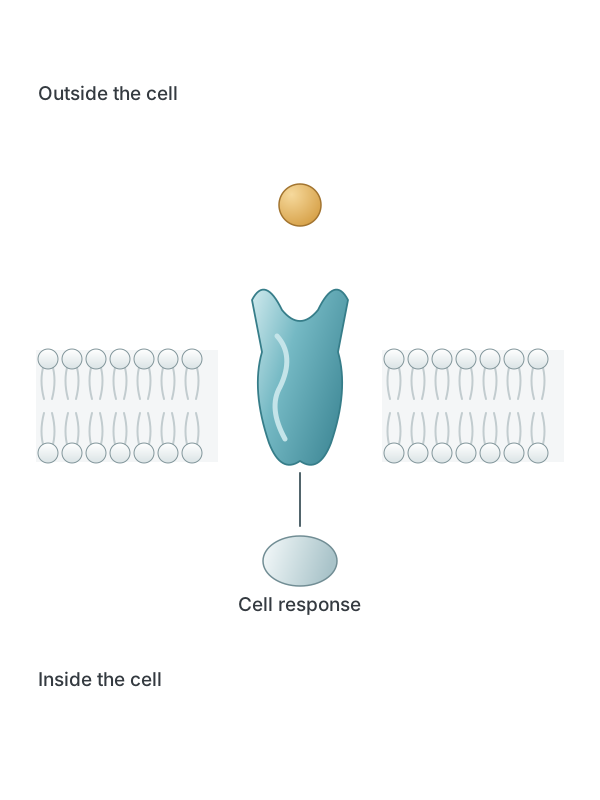
- Dopamine
A messenger can change signaling through its receptor.
- D2 receptor
This receptor symbol identifies a function, not a molecular structure.
- Cell response
The arrow represents a signaling response, not movement through a pore.
Simplified teaching model. Protein shapes, sizes, particle counts and arrows are illustrative, not measurements or experimental structures.
Dopamine can activate d2 receptor and change signaling in the cell.
Serotonin: 5-HT2 receptor
- Serotonin
A messenger can change signaling through its receptor.
- 5-HT2 receptor
This receptor symbol identifies a function, not a molecular structure.
- Cell response
The arrow represents a signaling response, not movement through a pore.
Simplified teaching model. Protein shapes, sizes, particle counts and arrows are illustrative, not measurements or experimental structures.
Serotonin can activate 5-ht2a receptor and change signaling in the cell.
About this illustration
Chemical communication. A signaling diagram cannot show the cause or severity of someone’s symptoms.
A signaling diagram cannot diagnose schizophrenia or measure symptom severity.
Qualitative teaching model
How the Medication Changes Signaling
Risperidone acts as an antagonist at dopamine D2 and serotonin 5-HT2 receptors. An antagonist occupies a receiving site and reduces its activation by the usual messenger; D2 and 5-HT2 name the receptor types, and 5-HT is another name for serotonin. Risperidone also acts at other receptors, including those responding to histamine, a messenger involved in wakefulness. Its overall effects therefore involve more than one type of message.
What is known: Blocking selected receiving sites changes how cells respond to dopamine and serotonin.
What remains uncertain: Knowing which sites are blocked does not predict every benefit or unwanted effect.
Risperidone: D2 receptor
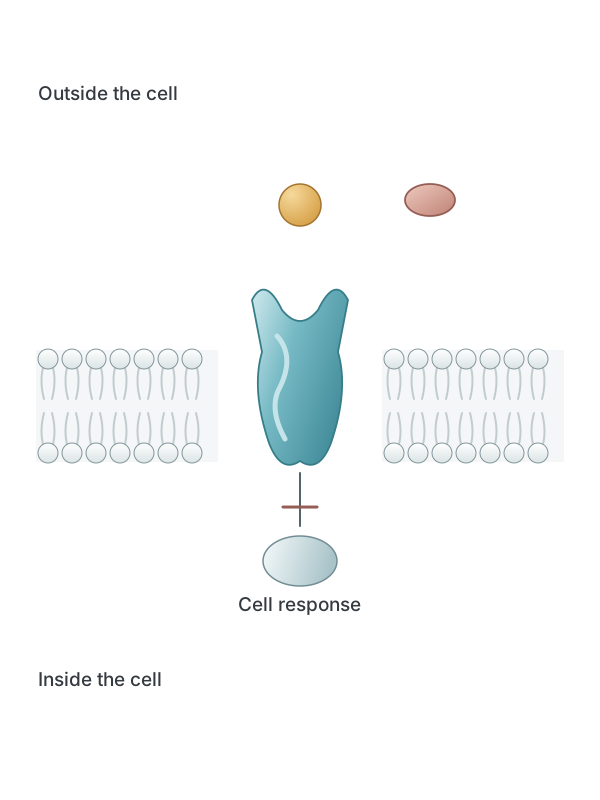
- Dopamine
A messenger can change signaling through its receptor.
- D2 receptor
This receptor symbol identifies a function, not a molecular structure.
- Risperidone: activation opposed
The crossbar marks opposition to receptor activation, not permanent closure.
Simplified teaching model. Protein shapes, sizes, particle counts and arrows are illustrative, not measurements or experimental structures.
Risperidone antagonizes dopamine D2 receptors. This is one example from a broader receptor profile, not a complete explanation of clinical response.
Risperidone: 5-HT2 receptor
- Serotonin
A messenger can change signaling through its receptor.
- 5-HT2 receptor
This receptor symbol identifies a function, not a molecular structure.
- Risperidone: activation opposed
The crossbar marks opposition to receptor activation, not permanent closure.
Simplified teaching model. Protein shapes, sizes, particle counts and arrows are illustrative, not measurements or experimental structures.
Risperidone also opposes serotonin 5-HT2 receptor activation. The serotonin target is separate from the dopamine receptor.
About this illustration
Risperidone receptor actions. Knowing which sites are blocked does not predict every benefit or unwanted effect.
Blocking a target does not predict who will benefit or which adverse effects will occur.
Qualitative teaching model
How does it affect my body?
It may cause sleepiness, movement symptoms and weight gain. Raised prolactin can affect menstrual periods, sexual function and breast symptoms.
How does my body process it?
CYP2D6 converts risperidone to active 9-hydroxyrisperidone. Reduced kidney function can reduce clearance of the active antipsychotic fraction.
How do treatment options differ?
Oral and depot products have different uses and schedules. Consta’s initial oral-cover period must not be copied to Okedi, and Okedi’s lack of supplemental oral treatment must not be copied to Consta. A switch requires the named product, last dose and treatment history to be checked.
A closer look at the science
Risperidone antagonises dopamine D2 and serotonin 5-HT2 receptors, with additional alpha-adrenergic and histamine receptor binding.
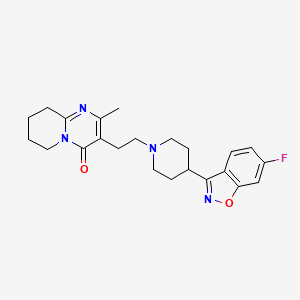
Risperidone is a small organic molecule. This verified two-dimensional depiction shows chemical connectivity rather than its shape bound to a receptor.
Chemical formula: C23H27FN4O2
The formula counts atoms in one parent molecule: C is carbon, H hydrogen, N nitrogen, O oxygen, Cl chlorine, F fluorine and S sulfur where present. Atom counts do not specify a clinical dose or predict treatment response.
How was this medicine developed?
The checked Dexcel 0.5 mg tablet authorisation dates to October 2007. This is a product milestone, not the date risperidone was discovered.
Sources and References
- Risperidone 0.5 mg film-coated tablets — UK SmPC
Product information published on the electronic Medicines Compendium (emc); supplied by pharmaceutical companies.
Scope: United Kingdom product information.
- Risperidone 1 mg/mL oral solution — UK SmPC
Product information published on the electronic Medicines Compendium (emc); supplied by pharmaceutical companies.
Scope: United Kingdom product information.
- About risperidone
Scope: NHS website for England — general medicine education, not a four-nation service pathway.
- Taking risperidone
Scope: NHS website for England — general medicine education, not a four-nation service pathway.
- Risperidone side effects
Scope: NHS website for England — general medicine education, not a four-nation service pathway.
- Risperidone in pregnancy and breastfeeding
Scope: NHS website for England — general medicine education, not a four-nation service pathway.
- Risperidone interactions
Scope: NHS website for England — general medicine education, not a four-nation service pathway.
- Bipolar disorder: assessment and management (CG185), recommendations
Scope: England guidance; applicability or adoption in other UK nations requires separate consideration.
- Risperdal Consta 50 mg — UK SmPC
Product information published on the electronic Medicines Compendium (emc); supplied by pharmaceutical companies.
Scope: United Kingdom product information.
- Risperdal Consta 25, 37.5 and 50 mg — UK patient leaflet
Product information published on the electronic Medicines Compendium (emc); supplied by pharmaceutical companies.
Scope: United Kingdom product information.
- Okedi 75 mg — UK SmPC
Product information published on the electronic Medicines Compendium (emc); supplied by pharmaceutical companies.
Scope: United Kingdom product information.
- Okedi 100 mg — UK patient leaflet
Product information published on the electronic Medicines Compendium (emc); supplied by pharmaceutical companies.
Scope: United Kingdom product information.
- Risperdal: current US prescribing information (5/2026)
- Antisocial behaviour and conduct disorders in children and young people — recommendations
Scope: United Kingdom; NICE recommendations require attention to national implementation and local pathways.
Shared scientific background. Some references are US product pharmacology or international chemical records; UK product details and prescribing information are verified separately.
Article Information
- Edition
- United Kingdom
- Content updated
- 2026-10-30
- Source check dates
- Listed with each reference above; retained dates for shared scientific content.
- Scope
- exact products checked
Source and coverage limits
- Selected UK oral products and the major Consta and Okedi injection families were separately checked; this is not every manufacturer, pack or local formulary.
- Current oral Risperdal brand availability was not established. Risperdal Consta is a separately verified injection, not proof of oral brand availability.
- Depot schizophrenia indications and initiation rules must not be substituted with the oral-product indications or doses.