
About this medicine
The dose and duration depend on the indication, age and vulnerability to adverse effects. The oral solution is not a depot injection.
What is this medicine used for?
Selected indications also include severe tics and narrowly defined aggression or psychosisPsychosisPsychosis describes symptoms that affect a person’s ability to tell what is real. These can include hallucinations, delusions and disorganised thinking or speech.Psychosis can occur with different mental or physical health conditions, some medicines or substance use. It does not automatically mean schizophrenia. New symptoms need prompt professional assessment.. Paediatric licences have separate age thresholds and prior-treatment requirements.
Paediatric product indications are schizophrenia at 13–17, severe persistent aggression with autism or pervasive developmental disorders at 6–17, and severely impairing tics at 10–17; each requires failure or intolerance of the prior treatments specified in the SmPC. These are not broad licences for childhood behavioural difficulties.
Which warning signs need help?
Fainting or palpitations can signal an abnormal heart rhythm. Fever with rigidity or confusion needs urgent help. New swallowing difficulty requires assessment. Antipsychotic treatment increases mortality risk in older people with dementia.
Both injection types retain serious cardiac and movement risks. The depot contains sesame oil and benzyl alcohol: check allergies and the exact preparation before administration. Once injected, a depot cannot simply be stopped or removed if adverse effects develop.
How do I take it safely?
The adult schizophrenia label describes 2–10 mg daily in one or two doses, with individual adjustment. Older people often require much less. Measure liquid accurately; only dilute as the leaflet directs.
For adult schizophrenia, the maximum is 20 mg/day; doses above 10 mg/day often add movement toxicity without extra benefit. Mania has a different 15 mg/day ceiling. These limits do not apply to frail older people or children. Dilute this solution only with water.
Short-acting haloperidol injection is 5 mg/ml and is given into a muscle by a healthcare professional. Adult uses include rapid control of severe agitation associated with psychosisPsychosisPsychosis describes symptoms that affect a person’s ability to tell what is real. These can include hallucinations, delusions and disorganised thinking or speech.Psychosis can occur with different mental or physical health conditions, some medicines or substance use. It does not automatically mean schizophrenia. New symptoms need prompt professional assessment. or bipolar I mania when oral treatment is unsuitable. It is not a depot. Its SmPC recommends intramuscular administration; oral doses are not injection instructions.
Haldol Decanoate contains the equivalent of 50 or 100 mg haloperidol per ml. It is a deep buttock-muscle injection, usually four-weekly, for adult schizophrenia or schizoaffective disorder after stability on oral haloperidol. It is not for immediate symptom control. Conversion and any oral supplementation require the prescribing team.
A checked Teva 5 mg tablet supplies another oral option. Tablet strength does not dictate the starting dose, and a suitable lower-strength or liquid presentation may be needed for small doses. The tablet is not the 5 mg/ml injection; matching numbers do not make the routes interchangeable.
What side effects should I know about?
Restlessness, tremor, stiffness, involuntary movements, sleepiness and dizziness can occur. Report troublesome movements early.
Who needs extra care with this medicine?
ContraindicationsA medical reason a medicine should not be usedA medical reason a medicine should not be used in a particular situation because it may be harmful.Read the full definition of Contraindication include Parkinson’s disease, Lewy body dementia and certain heart-rhythm disorders. Correct low potassium or magnesium before treatment.
Can it affect my other medicines?
Other QT-prolonging medicines may be contraindicated. Review all prescribed and non-prescription drugs; alcohol can worsen drowsiness.
Fluoxetine can increase haloperidol exposure; carbamazepine can reduce it. Lithium combinations require vigilance for neurological toxicity. Haloperidol can oppose levodopa’s effects.
What check-ups will I need?
For elderly delirium, MHRA advises baseline ECG and electrolyte correction, repeated assessment, gradual dose changes and the lowest dose for the shortest duration. Monitor movement, swallowing and blood pressure.
The SmPC recommends a baseline ECG for all patients, not only elderly delirium, plus baseline and periodic electrolytes. Follow-up ECG need is assessed individually. Monitor persistent involuntary facial or tongue movements, which can represent tardive dyskinesiaTardive dyskinesiaTardive dyskinesia is a movement disorder that can develop after exposure to certain medicines, particularly antipsychotics. It causes repeated movements that the person does not intend, such as lip-smacking, chewing motions or tongue movements; other body areas can be affected.The movements may persist after the medicine is stopped. Report new involuntary movements to your prescriber; medication changes should be planned with them..
What about pregnancy, breastfeeding and age?
Pregnancy and breastfeeding require individual assessment. Newborns exposed late in pregnancy may need monitoring. Childhood indications must not be extrapolated from adult treatment.
Teva’s oral tablet label includes restricted paediatric uses after other approaches fail: schizophrenia at 13–17, severe persistent aggression with autism or pervasive developmental disorders at 6–17, and severely impairing tics at 10–17. These do not establish paediatric indications for the acute injection or depot.
What if I miss a dose or want to stop?
Skip a missed dose and take the next as scheduled, without doubling. Planned withdrawalWithdrawalSymptoms that may occur after reducing or stopping a medicine or substance to which the body has adapted.Read the full definition of Withdrawal should follow the prescriber’s advice.
How does it work?
Haloperidol changes how brain cells respond to dopamineDopamineA chemical messenger involved in movement, learning and emotion. Its name does not describe one feeling or one role throughout the brain.Read the full definition of Dopamine, a chemical messenger involved in several brain functions. Its main known action is to block dopamine D2 receptorsReceptorA protein that recognizes a signal and helps a cell respond. Different receptor types can produce different responses to the same messenger.Read the full definition of Receptor, proteins that receive that particular signal. This is thought to contribute to treatment benefit, although the complete mechanism is not established.
How Brain Cells Communicate
Brain cells release chemical messengers called neurotransmitters, which influence other cells through receptors. Dopamine participates in networks involved in movement, motivation and the interpretation of experiences. Its effects depend on where a message is received, so reducing one kind of dopamine response can affect several functions rather than just one symptom.
What is known: Dopamine messages have different roles in different networks of cells.
What remains uncertain: A single dopamine pathway cannot explain everything a person is experiencing.
Dopamine: D2 receptor
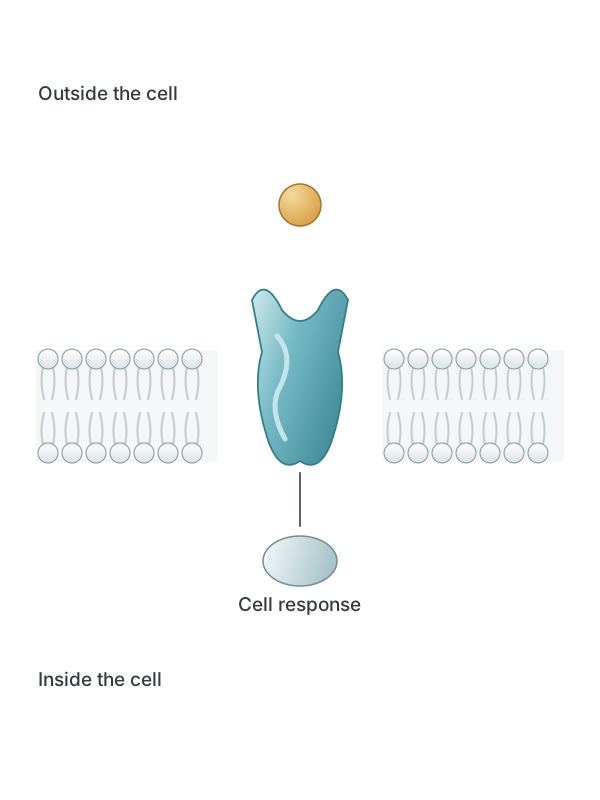
- Dopamine
A messenger can change signaling through its receptor.
- D2 receptor
This receptor symbol identifies a function, not a molecular structure.
- Cell response
The arrow represents a signaling response, not movement through a pore.
Simplified teaching model. Protein shapes, sizes, particle counts and arrows are illustrative, not measurements or experimental structures.
Dopamine can activate d2 receptor and change signaling in the cell.
About this illustration
Nerve-cell signal; Receptor action; Network activity. A single dopamine pathway cannot explain everything a person is experiencing.
This is a simplified illustration. It does not show exactly how a medicine fits into a protein or predict a dose or response to treatment.
How the Medication Changes Signaling
Haloperidol acts as an antagonist at D2 receptors: it occupies these receiving sites and reduces their activation by dopamine. D2 identifies one member of the dopamine receptor family. Blocking this action can also affect movement and increase prolactin, a hormone, or chemical message carried in the blood, that helps control milk production. These effects illustrate why the same receptor action can contribute to both wanted and unwanted changes.
What is known: Haloperidol reduces activation of dopamine D2 receiving sites.
What remains uncertain: The amount of receptor blocking does not provide an exact forecast of benefit or side effects.
Haloperidol: D2 receptor
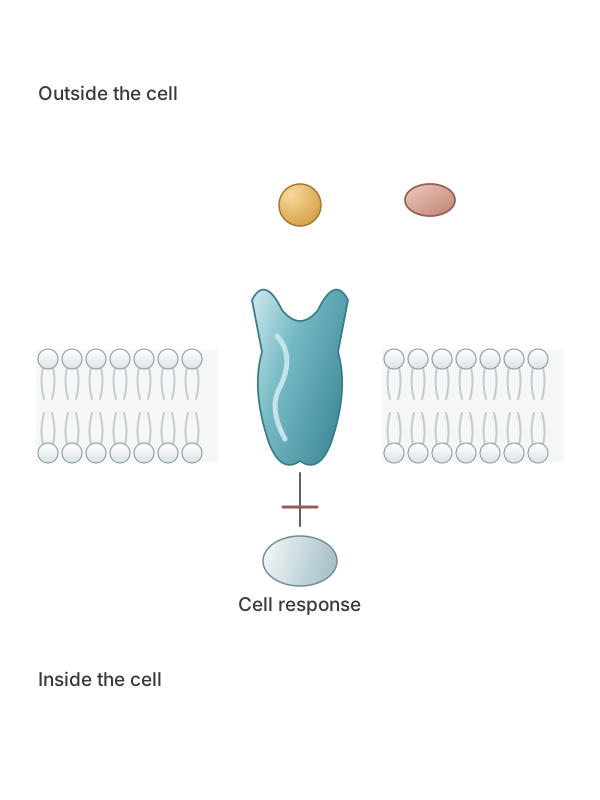
- Dopamine
A messenger can change signaling through its receptor.
- D2 receptor
This receptor symbol identifies a function, not a molecular structure.
- Haloperidol: activation opposed
The crossbar marks opposition to receptor activation, not permanent closure.
Simplified teaching model. Protein shapes, sizes, particle counts and arrows are illustrative, not measurements or experimental structures.
Haloperidol antagonizes dopamine D2 receptors. This may contribute to antipsychotic effects, but the complete therapeutic mechanism is not established.
About this illustration
Medicine; Molecular actions; Clinical effects. The amount of receptor blocking does not provide an exact forecast of benefit or side effects.
This is a simplified illustration. It does not show exactly how a medicine fits into a protein or predict a dose or response to treatment.
How does it affect my body?
Movement effects can impair swallowing. In frail older people this can increase aspiration risk, while postural blood-pressure falls can contribute to falls.
How does my body process it?
The liver metabolises haloperidol, including through CYP3A4 and CYP2D6. Age and interacting medicines can alter exposure.
How do treatment options differ?
Oral liquid allows measured doses but does not eliminate cardiac or movement risks. Injection and tablet products need separate prescribing checks.
A closer look at the science
It is a butyrophenone antipsychotic. Dopamine blockade also contributes to movement problems and raised prolactin.
Haloperidol is a butyrophenone derivative. Lactate is a salt; decanoate is a long-chain ester used for depot delivery.
Chemical formula: C21H23ClFNO2
The formula and image depict neutral haloperidol, not the lactate salt or decanoate ester. Formulation changes release, not merely the printed name.
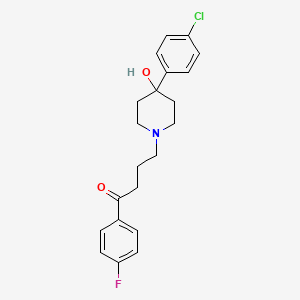
Parent connectivity only; salt and ester modifications are not shown.
How was this medicine developed?
This oral-solution record dates its first authorisation to June 1989. MHRA reiterated elderly-delirium precautions in December 2021.
Sources and References
- Haldol 2 mg/ml oral solution — UK SmPC
Product information published on the electronic Medicines Compendium (emc); supplied by pharmaceutical companies.
Scope: United Kingdom product information.
- Haldol 2 mg/ml oral solution — UK patient leaflet
Product information published on the electronic Medicines Compendium (emc); supplied by pharmaceutical companies.
Scope: United Kingdom product information.
- Haloperidol: risks in elderly patients treated for acute delirium
Scope: United Kingdom.
- Haldol Decanoate 50 mg/ml and 100 mg/ml solution for injection — UK SmPC
Product information published on the electronic Medicines Compendium (emc); supplied by pharmaceutical companies.
Scope: United Kingdom product information.
- Haloperidol 5 mg/ml solution for injection — UK SmPC
Product information published on the electronic Medicines Compendium (emc); supplied by pharmaceutical companies.
Scope: United Kingdom product information.
- Haloperidol 5 mg tablets — Teva UK SmPC
Scope: United Kingdom; named product information.
- Haloperidol tablets: prescribing information — mechanism explanation
Scope: Mechanism explanation only. Source sections checked: Clinical Pharmacology..
- Haldol Decanoate (haloperidol decanoate): prescribing information — mechanism explanation
Scope: Mechanism explanation only. Source sections checked: 5.14 Hyperprolactinemia; 12.1 Mechanism of Action; 12.2 Pharmacodynamics; 12.3 Pharmacokinetics..
- NIMH: Understanding psychosis
- Tardive dyskinesia: MedlinePlus Medical Encyclopedia
- NIMH: Mental Health Medications
Shared scientific background. US product pharmacology and chemical references do not establish UK licences, doses, formulations or NHS recommendations.
Article Information
- Edition
- United Kingdom
- Content updated
- 2026-10-24
- Source check dates
- Listed with each reference above; retained dates for shared scientific content.
- Scope
- exact products checked
Source and coverage limits
- Product strengths are not personal dosing schedules. Oral-to-depot conversion, rapid tranquillisation and paediatric schedules require indication-specific specialist prescribing.
- Named tablets, oral liquid, acute injection and depot products are checked; this is not an exhaustive manufacturer or local-formulary catalogue.