
What should I know first?
Risperidone is an antipsychotic medicine with actions at several receptors. This lesson focuses on dopamineDopamineA chemical messenger involved in movement, learning and emotion. Its name does not describe one feeling or one role throughout the brain.Read the full definition of Dopamine D2 and serotoninSerotoninA chemical messenger involved in several functions, including sleep, mood and digestion. It acts through different receptors, with effects that depend on the cell.Read the full definition of Serotonin 5-HT2 receptors using UK risperidone product information.
This is selected pharmacology, not a complete account of licensed indications, product forms or safety. Those questions belong to the separately checked UK medicine article.
This is a mechanism lesson, not a complete medicine guide. A diagram cannot choose treatment, predict your response, or tell you how to change a prescription.
How Brain Cells Communicate
Dopamine and serotonin carry messages between cells. Each has several receptor types. A receptor is a protein that responds to a messenger; the response depends on the receptor and the cell around it.
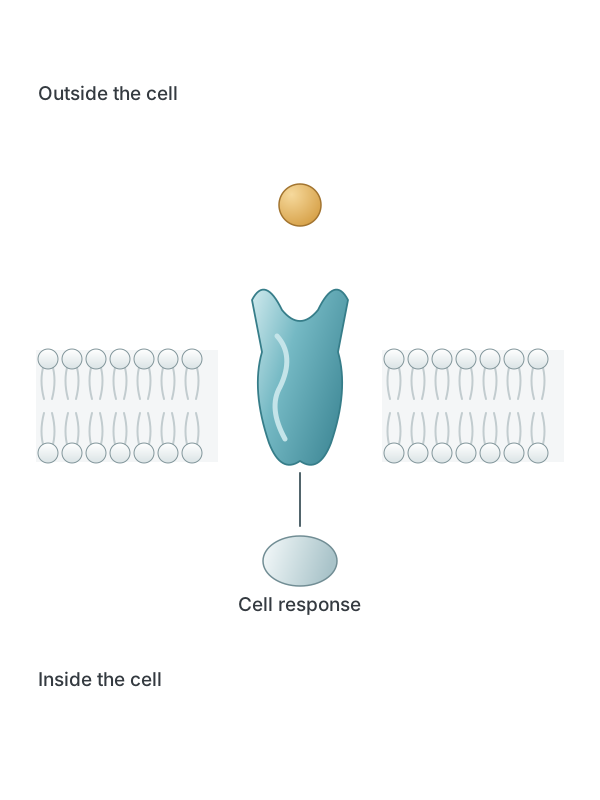
- Dopamine
A messenger can change signaling through its receptor.
- D2 receptor
This receptor symbol identifies a function, not a molecular structure.
- Cell response
The arrow represents a signaling response, not movement through a pore.
Simplified teaching model. Protein shapes, sizes, particle counts and arrows are illustrative, not measurements or experimental structures.
About this illustration
A messenger can activate its receptor and change signalling in the receiving cell. Different receptors produce different effects.
How the Medication Changes Signalling
An antagonist interferes with a messenger’s activation of a receptor. Risperidone acts as an antagonist at dopamine D2 and serotonin type2 receptors. Its active metabolite, 9-hydroxyrisperidone, also contributes to its clinical effects.
Dopamine and serotonin act through different receptor systems. Antagonism does not mean that the medicine removes either messenger or blocks every signal everywhere.
A Closer Look at the Molecular Level
Known action: receptor antagonism is described in UK product pharmacology. Other receptors are affected as well, so this is a selected view.
Receptor binding is not a complete explanation of benefit, side effectsAn effect beyond the intended treatment effectAn effect of a treatment in addition to its intended effect. It may be unwanted, harmful or sometimes beneficial.Read the full definition of Side effect or an individual’s experiences. The product information links pharmacological actions with proposed clinical effects; the diagram cannot test those explanations or predict a person’s response. No binding pose or affinity comparison is inferred.
Sources and References
- Risperidone 0.5 mg: UK SmPC
Product information published on the electronic Medicines Compendium (emc); supplied by pharmaceutical companies.
Scope: United Kingdom.
- What Is a Neurotransmitter?
Scope: International scientific education; not UK regulatory evidence.
Article Information
- Edition
- United Kingdom
- Content updated
- 2026-10-17
- Sources checked
- Listed with each reference above; retained dates for shared scientific content.
- Publication status
- Published
- Scope
- How this medicine works, with UK product information.
Source and coverage limits
- A mechanism lesson is not a complete medicine profile, dosing schedule or individual treatment recommendation.
- Original qualitative SVG diagrams explain direction and target type; they do not measure biological rates, binding geometry or clinical response.