
About this medicine
Mirtazapine is prescribed for depression. Sleepiness can occur before mood improves; sedation alone does not demonstrate that depression has responded.
What is this medicine used for?
The checked UK licence covers adult major depressive episodes. It does not establish a separate licence for insomnia or every anxiety disorder.
Which warning signs need help?
New suicidal thoughts require urgent help. Fever with sore throat or mouth ulcers can indicate a blood-cell problem. Jaundice, blistering rash, or severe agitation with fever and muscle stiffness also need urgent assessment. For life-threatening symptoms in the UK call 999; elsewhere contact local emergency services.
MHRA’s October 2026 communication announced the rollout of a prominent boxed warning in UK antidepressant patient leaflets about self-harm and suicidal behaviour, alongside a patient safety card. This UK patient-information measure is not the US FDA Boxed Warning designation. Read the leaflet supplied with your medicine, seek prompt professional help for new or worsening mood or behaviour changes, and do not stop treatment suddenly without advice.
How do I take it safely?
The oral-solution SmPC describes starting at 15 or 30 mg daily and a usual effective range of 15–45 mg daily. This is educational product information: the prescriber determines the regimen. The checked dissolving tablet can be swallowed without water.
The Rosemont liquid contains 15 mg in each 1 ml, not each teaspoon. Measure the prescribed volume with its oral syringe; it may be swallowed directly or mixed into water for immediate use. Standard tablets are swallowed without chewing; the checked 15 mg tablet can be divided equally.
What side effects should I know about?
Common problems include sleepiness, increased appetite, weight gain, dry mouth, headache and dizziness. Some effects settle, while others need treatment review.
Who needs extra care with this medicine?
Extra care is needed with epilepsy, bipolar disorder, heart disease, diabetes, or impaired liver or kidney function. Previous severe drug reactions matter.
Can it affect my other medicines?
Do not combine it with an MAOI or disregard the required washout interval. Other serotonergic medicines increase serotoninSerotoninA chemical messenger involved in several functions, including sleep, mood and digestion. It acts through different receptors, with effects that depend on the cell.Read the full definition of Serotonin-syndrome risk; alcohol and sedatives increase impairment. Carbamazepine can reduce exposure.
What check-ups will I need?
Review mood, suicidal thinking, alertness, weight and treatment benefit. Infection symptoms can require stopping treatment and a blood count; this is symptom-triggered assessment, not a claim that everybody needs routine blood counts.
The product describes response assessment after two to four weeks at an adequate dose. Lack of benefit calls for reassessment, not indefinite continuation merely because sleep improves. Moderate-to-severe kidney impairment and liver impairment can reduce clearance, while older adults need supervised dose increases.
What about pregnancy, breastfeeding and age?
Use during pregnancy or breastfeeding requires an individual benefits-and-risks discussion. Mirtazapine is not usually recommended below age 18.
Available pregnancy data have not indicated increased congenital-malformation risk, but remain limited. If used near birth, observe the newborn for withdrawalWithdrawalSymptoms that may occur after reducing or stopping a medicine or substance to which the body has adapted.Read the full definition of Withdrawal or adaptation effects. Small amounts enter milk; feeding and treatment decisions should be made together with the care team.
What if I miss a dose or want to stop?
Stopping suddenly can cause withdrawal. Agree a gradual reduction with the prescriber. For a missed once-daily dose, skip it and take the next normally; twice-daily instructions differ.
How does it work?
Mirtazapine changes nerve-cell communication by blocking several kinds of receptorsReceptorA protein that recognizes a signal and helps a cell respond. Different receptor types can produce different responses to the same messenger.Read the full definition of Receptor, the proteins that respond to chemical messages. Some of these receptors normally act as brakes on the release of messengers, while others influence wakefulness and other functions. Its antidepressant effect may involve these changes, but no single receptor action fully explains the benefit.
How Brain Cells Communicate
Nerve cells use chemical messengers, called neurotransmitters, to communicate across small gaps between cells. When a messenger attaches to a receptor, it can change how the cell behaves. Some receptors on the sending side provide feedback that limits further messenger release. This braking system helps regulate communication rather than simply switching it on or off.
What is known: Some receptors limit further release of chemical messengers.
What remains uncertain: The role of a receptor depends on the cells and pathways in which it is found.
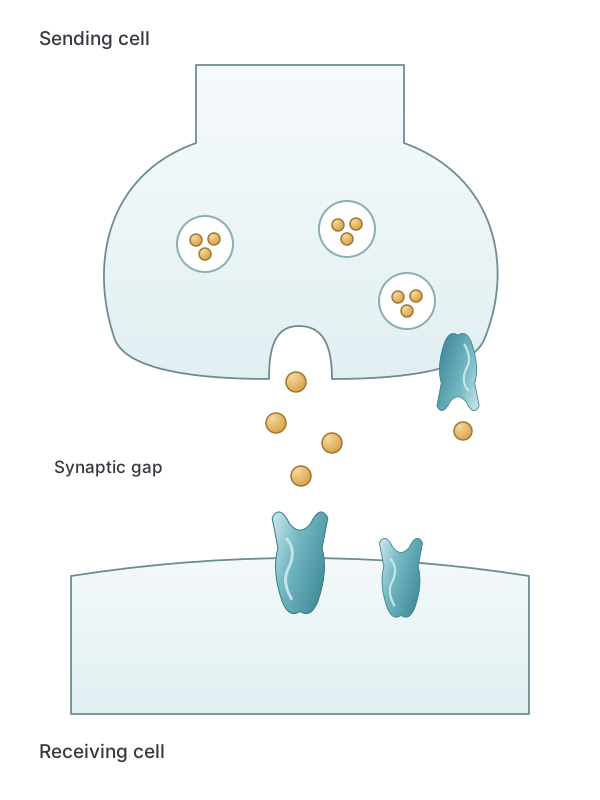
- Sending cell
Vesicles hold chemical messengers before release.
- Chemical messengers
A few illustrated particles identify the messengers; their number and spacing are illustrative.
- Feedback receptor
A receptor on the sending cell can regulate further messenger release.
- Receiving receptor
A receptor responds to an appropriate messenger.
Simplified teaching model. Protein shapes, sizes, particle counts and arrows are illustrative, not measurements or experimental structures.
About this illustration
Released messengers act at receptors; inhibitory feedback can regulate further release. The role of a receptor depends on the cells and pathways in which it is found.
How the Medication Changes Signaling
Mirtazapine blocks receptors called alpha-2 adrenergic receptors, which respond to norepinephrine, a chemical messenger also known as noradrenaline. Some of these receptors normally provide a braking signal, so blocking them can reduce that brake. Laboratory evidence suggests this can increase norepinephrine and serotonin signaling. A medicine that blocks a receptor’s action is called an antagonist; this describes what mirtazapine does at these targets.
What is known: Alpha-2 receptor blockade can reduce inhibitory feedback.
What remains uncertain: The contribution of this effect to antidepressant benefit is not fully established.
Serotonin receptor example
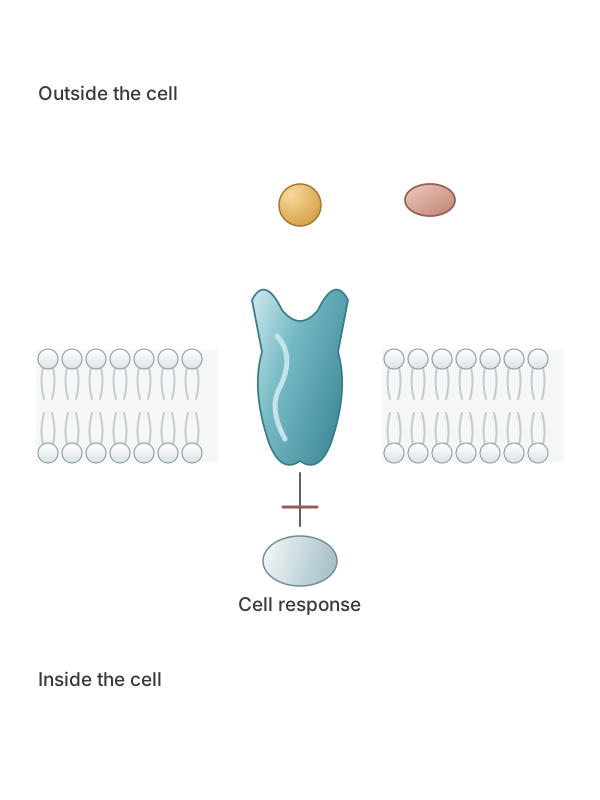
- Serotonin
A messenger can change signaling through its receptor.
- 5-HT2 receptor
This receptor symbol identifies a function, not a molecular structure.
- Mirtazapine: activation opposed
The crossbar marks opposition to receptor activation, not permanent closure.
Simplified teaching model. Protein shapes, sizes, particle counts and arrows are illustrative, not measurements or experimental structures.
Mirtazapine antagonizes serotonin 5-HT2 receptors. This is one example from a wider receptor profile that also includes inhibitory alpha-2 feedback receptors.
Histamine receptor example
- Histamine
A messenger can change signaling through its receptor.
- H1 receptor
This receptor symbol identifies a function, not a molecular structure.
- Mirtazapine: activation opposed
The crossbar marks opposition to receptor activation, not permanent closure.
Simplified teaching model. Protein shapes, sizes, particle counts and arrows are illustrative, not measurements or experimental structures.
Mirtazapine also blocks H1 receptors, which may help explain sleepiness. These two examples do not depict its complete antidepressant mechanism.
About this illustration
Mirtazapine blocks several receptor types. The contribution of this effect to antidepressant benefit is not fully established.
Schematic only: no binding pose or measured occupancy
How does it affect my body?
Increased appetite, weight gain and reduced alertness may affect daily life. Avoid driving while sleepy or unable to concentrate.
How does my body process it?
Liver enzymes, including CYP3A4, CYP2D6 and CYP1A2, help process mirtazapine. Its usual elimination half-lifeThe time for a measured drug level to fall by halfThe time it takes for the concentration of a medicine in a body fluid, usually blood, to decrease by half during elimination.Read the full definition of Half-life is about 20–40 hours.
How do treatment options differ?
Its receptor-blocking mechanism differs from serotonin-reuptakeReuptakeThe return of a released chemical messenger into a cell through a transporter. It is one way to limit a signal; chemical breakdown is another.Read the full definition of Reuptake inhibition. The choice between antidepressants depends on individual benefit, adverse effects and interactions.
The adult depression licence and receptor mechanism do not establish an insomnia indication. Side-effect patterns such as sedation and appetite change may influence a shared treatment decision without making one antidepressant universally preferable.
A closer look at the science
Mirtazapine blocks presynaptic alpha-2 receptors, increasing noradrenergic and serotonergic signalling. Blocking 5-HT2 and 5-HT3 receptors favours signalling through other serotonin pathways. Histamine H1 blockade contributes to sedation.
Mirtazapine is a small organic molecule with a four-ring structure. A racemic chemical form includes both mirror-image forms. The verified drawing represents the parent chemical without selecting one form; it is neither a receptor-bound pose nor a diagram of a dissolving tablet.
Chemical formula: C17H19N3
C, H and N identify carbon, hydrogen and nitrogen atoms. The formula gives the numbers of those atoms; it does not describe the tablet, receptor binding or a clinically effective dose.
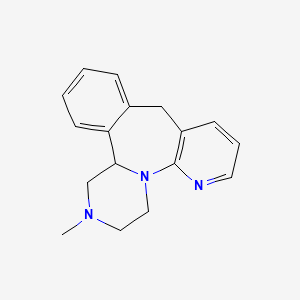
The schematic does not select one mirror-image form of the racemic chemical form or show a protein-bound conformation.
How was this medicine developed?
The checked Milpharm product records a first authorisation in July 2006. This is that product’s history, not mirtazapine’s original discovery date.
Sources and References
- Mirtazapine 15 mg tablets: SmPC, sections 1–5 and 7–10
Product information published on the electronic Medicines Compendium (emc); supplied by pharmaceutical companies.
Scope: United Kingdom product information.
- Mirtazapine: uses, safety and practical information
Scope: NHS website medicines information (England); not a guarantee of identical services across UK nations.
- Mirtazapine 15 mg/ml oral solution: SmPC, sections 2, 4.2–4.6
Product information published on the electronic Medicines Compendium (emc); supplied by pharmaceutical companies.
Scope: United Kingdom product information.
- Mirtazapine 15 mg orodispersible tablets: SmPC, sections 2–4.2
Product information published on the electronic Medicines Compendium (emc); supplied by pharmaceutical companies.
Scope: United Kingdom product information.
- Antidepressants: use and safety
Scope: United Kingdom.
- FDA: Remeron and Remeron SolTab prescribing information
- NIH: What Is a Neurotransmitter?
Shared scientific background. Some references are US product pharmacology or international chemical records; UK product details and prescribing information are verified separately.
Article Information
- Edition
- United Kingdom
- Content updated
- 2026-10-24
- Source check dates
- Listed with each reference above; retained dates for shared scientific content.
- Scope
- exact products checked
Source and coverage limits
- Strengths are restricted to the exact products checked; this is not an exhaustive UK market inventory.
- Remeron is retained as a cross-edition search alias, not asserted to be a current UK brand.