
About this medicine
The UK spelling Efexor differs from American Effexor. XL and XR describe prolonged-release products, but a matching alias does not prove identical instructions or licences.
Venlafaxine is regular treatment whose benefit develops over time, not an as-needed medicine for a panic attack. Follow-up considers functioning and anxiety as well as mood. Continued treatment after improvement can be appropriate to reduce recurrence.
What is this medicine used for?
The checked Efexor XL products treat adults with depression, generalised anxiety, social anxiety and panic disorder, and prevent depressive recurrence. Their anxiety indications should not automatically be assigned to immediate-release tablets.
Dexcel’s immediate-release tablets are licensed for adult major depressive episodes and prevention of recurrence. Their licence does not include the anxiety indications of the checked prolonged-release products.
Which warning signs need help?
An overdose requires immediate assessment even if the person feels well. Seek urgent help for self-harm thoughts, fever with confusion and twitching, severe restlessness, or serious palpitations. Severe allergic reactions need emergency care.
MHRA’s October 2026 communication announced the rollout of a prominent boxed warning in UK antidepressant patient leaflets about self-harm and suicidal behaviour, alongside a patient safety card. This UK patient-information measure is not the US FDA Boxed Warning designation. Read the leaflet supplied with your medicine, seek prompt professional help for new or worsening mood or behaviour changes, and do not stop treatment suddenly without advice.
How do I take it safely?
Adult XL product reference: 75 mg daily is usual initially for depression and generalised anxiety. The labelled maximum is 375 mg for depression and 225 mg for anxiety disorders. Panic treatment begins at 37.5 mg daily for seven days using a suitable product. Dose increases require clinical review. Swallow XL capsules whole; do not crush or chew.
Take the checked XL capsule with food at a consistent time; do not open, dissolve or chew it. For depression, increases are generally separated by at least two weeks, although the label allows shorter intervals in selected severe cases. That exception requires clinical evaluation, not self-escalation. Higher doses did not show added benefit for social anxiety in the cited product studies.
For the checked immediate-release tablets, the label begins at a total of 75 mg daily in two doses with food, and allows clinician-led increases up to 375 mg daily. This is separate from once-daily XL treatment. A prescriber may convert between products using the daily amount and response; do not change frequency or substitute tablets for capsules yourself.
A Genus 37.5 mg XL capsule has also been product-verified. Like the checked Efexor XL capsules, it is taken with food and swallowed whole. Its smaller strength is not permission to open a capsule or design a personal taper.
What side effects should I know about?
Nausea, dry mouth, constipation, headache, sleep disturbance, dizziness, sexual difficulties and weight changes occur. Avoid driving while dizzy or drowsy.
MHRA is adding the term post-SSRI sexual dysfunction (PSSD) to patient leaflets describing persistent sexual difficulties after stopping certain antidepressants, including this medicine. Their frequency and causes remain under study. Persistent symptoms deserve support; this does not mean everyone taking the medicine will experience them.
Who needs extra care with this medicine?
Control existing high blood pressure before treatment. Kidney or liver impairment may require lower doses. Discuss heart disease, seizures, glaucoma, bleeding and previous mania.
Low sodium can produce weakness, confusion or seizures, particularly in older or dehydrated people and those taking diuretics. Bleeding risk, a personal or family history of bipolar illness, and troublesome restlessness also need assessment. Increasing the dose can worsen akathisiaAkathisiaAkathisia is distressing inner restlessness with a strong urge to move, sometimes caused by medication. It may lead to pacing, rocking or difficulty sitting still.Anxiety involves fear or worry; agitation is a broader state of distress or restlessness. These can overlap with akathisia, but the compelling urge to move is an important clue. Tell your prescriber promptly about new or worsening restlessness so the cause can be assessed. rather than relieve it.
Can it affect my other medicines?
Irreversible MAO inhibitors are contraindicated. Other serotonergic medicines, St John’s wort, anticoagulants and medicines affecting heart rhythm need careful review.
The UK leaflet requires at least 14 days after an irreversible MAOI before venlafaxine and at least seven days after venlafaxine before an MAOI; the receiving medicine can require longer. Medicines for migraine, pain, infection or heart rhythm all belong in the review. The leaflet advises avoiding alcohol because it can worsen impairment and other risks.
Before a dopamineDopamineA chemical messenger involved in movement, learning and emotion. Its name does not describe one feeling or one role throughout the brain.Read the full definition of Dopamine-transporterTransporterA protein that moves a substance across a cell membrane. Some transporters help remove released chemical messengers from the space around nerve cells.Read the full definition of Transporter scan using ioflupane, tell the nuclear-medicine team that you take venlafaxine. MHRA has received reports of false-positive scan interpretations. Any temporary interruption must be assessed case by case; do not stop venlafaxine yourself.
What check-ups will I need?
Check blood pressure before treatment, periodically afterwards and after increases. Review mood, adverse effects and withdrawal symptomsWithdrawalSymptoms that may occur after reducing or stopping a medicine or substance to which the body has adapted.Read the full definition of Withdrawal when changing doses.
Blood pressure and pulse deserve attention during dose increases, not only before starting. New activation, sexual symptoms, bleeding or signs of low sodium also guide follow-up. Some people need additional cardiac assessment, depending on history and interacting medicines.
What about pregnancy, breastfeeding and age?
Pregnancy and breastfeeding require an individual assessment. Infants can be exposed through breast milk and may need monitoring. Efexor XL is not recommended below age 18 in the checked UK product information.
Late-pregnancy exposure may be followed by newborn breathing or feeding difficulties, and bleeding after delivery may be increased. The midwife and prescriber need to know about treatment so care can be planned. These risks are considered alongside untreated illness, not as a reason to stop abruptly.
NICE advises against using this medicine to treat depression in children and young people. Anyone already taking it should discuss an individual review and any gradual changes with the prescriber, rather than stopping suddenly.
What if I miss a dose or want to stop?
Do not stop abruptly. NICE identifies venlafaxine as particularly associated with withdrawal. Tapering may take weeks or months. Never double a missed dose.
Withdrawal may include dizziness, disturbed sleep, nausea, sweating, agitation and electric-shock-like sensations; it can be severe or prolonged. A suitable plan may need adjustment if symptoms emerge. Do not open an XL capsule or count its contents to devise a taper without product-specific professional advice.
How does it work?
Venlafaxine slows the return of serotoninSerotoninA chemical messenger involved in several functions, including sleep, mood and digestion. It acts through different receptors, with effects that depend on the cell.Read the full definition of Serotonin and noradrenaline, two chemical messengers, into the nerve cellsNeuronA nerve cell that receives and sends information. Neurons work in connected groups, rather than carrying a whole thought on their own.Read the full definition of Neuron that released them. The body also converts it into an active substance that has similar effects. These changes are thought to contribute to improvement in mood and anxiety, although the full explanation of that benefit remains uncertain.
How Brain Cells Communicate
Nerve cells, or neurons, communicate by releasing chemical messengers called neurotransmitters into tiny gaps between cells. Serotonin and norepinephrine can then attach to receptors, proteins that detect the message and change a cell’s activity. Transporters carry some of the released messenger back into cells. This return process is called reuptake, and it helps regulate how long the messenger remains available.
What is known: Serotonin and norepinephrine are regulated partly through reuptake.
What remains uncertain: Their activity is only one part of the wider systems involved in symptoms.
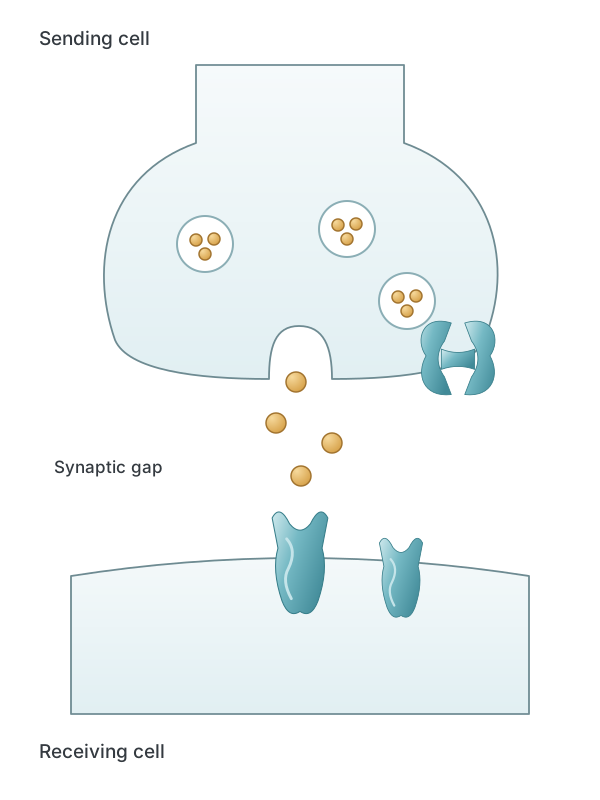
- Sending cell
Vesicles hold chemical messengers before release.
- Chemical messengers
A few illustrated particles identify the messengers; their number and spacing are illustrative.
- Return into the sending cell
A transporter returns some messenger from the gap; it is distinct from the receiving receptor.
- Receiving receptor
A receptor responds to an appropriate messenger.
Simplified teaching model. Protein shapes, sizes, particle counts and arrows are illustrative, not measurements or experimental structures.
About this illustration
Released messengers act across a synapse; transporters return some messenger into the sending cell. Their activity is only one part of the wider systems involved in symptoms.
How the Medication Changes Signaling
Venlafaxine inhibits the reuptake of both serotonin and norepinephrine. In other words, it reduces the activity of the proteins that carry these messengers back into cells, leaving more available between cells. This action gives the medicine its class name: a serotonin and norepinephrine reuptake inhibitor, or SNRI. Changing messenger availability can alter communication, but it does not show that a person’s symptoms began with a simple shortage of either chemical.
What is known: Venlafaxine reduces serotonin and norepinephrine reuptake.
What remains uncertain: Knowing the transport effect does not tell us how much an individual will improve.
Serotonin · SERT
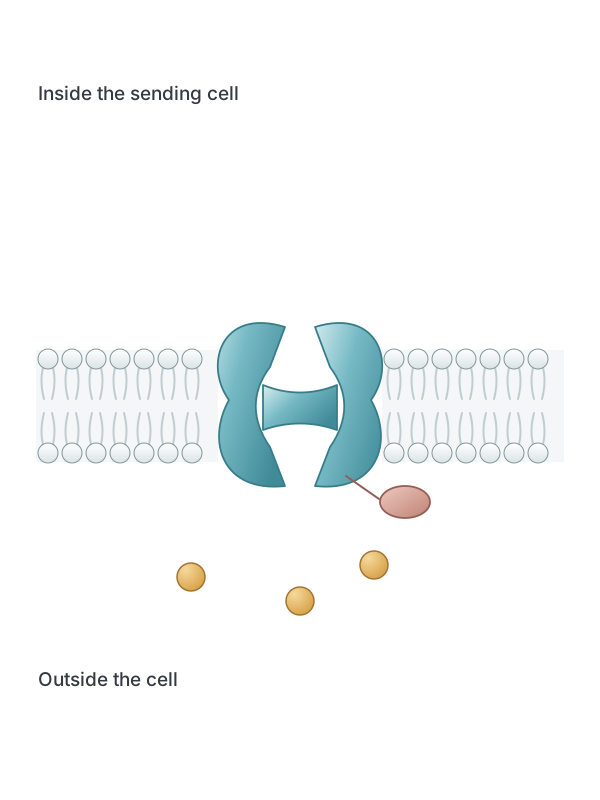
- Serotonin
The messenger is shown outside the sending cell.
- SERT
The SERT transporter returns serotonin into the cell.
- Venlafaxine: uptake inhibited
The interrupted arrow names the action; the symbol is not a molecular shape or binding position.
Simplified teaching model. Protein shapes, sizes, particle counts and arrows are illustrative, not measurements or experimental structures.
Norepinephrine · NET
- Norepinephrine
The messenger is shown outside the sending cell.
- NET
The NET transporter returns norepinephrine into the cell.
- Venlafaxine: uptake inhibited
The interrupted arrow names the action; the symbol is not a molecular shape or binding position.
Simplified teaching model. Protein shapes, sizes, particle counts and arrows are illustrative, not measurements or experimental structures.
About this illustration
Venlafaxine inhibits serotonin and norepinephrine reuptake. Knowing the transport effect does not tell us how much an individual will improve.
How does it affect my body?
Noradrenergic effects can raise blood pressure and pulse. Digestion, sleep and sexual function may also be affected.
How does my body process it?
Venlafaxine’s half-lifeThe time for a measured drug level to fall by halfThe time it takes for the concentration of a medicine in a body fluid, usually blood, to decrease by half during elimination.Read the full definition of Half-life is about five hours and its active metabolite’s about eleven hours. Prolonged-release capsules slow absorption; they do not remove withdrawal risk.
How do treatment options differ?
Immediate-release and prolonged-release venlafaxine have different schedules. Switching between them needs a prescribing plan; the capsule strength alone does not define equivalent treatment.
A closer look at the science
Both venlafaxine and its metabolite O-desmethylvenlafaxine are active. Slower release changes absorption, not the identity of the active ingredient.
Venlafaxine hydrochloride is a salt of venlafaxine. The neutral parent has mirror-image forms; the drawing does not select a single stereoisomer and omits hydrochloride. A molecular drawing does not describe a product release system.
Chemical formula: C17H27NO2 · HCl
This formula describes the venlafaxine hydrochloride salt. Element symbols identify atoms; the dot separates the parent compound from the acid component. The drawing below shows the neutral parent, a different explicitly identified species. Chemical identity alone does not predict clinical benefit.
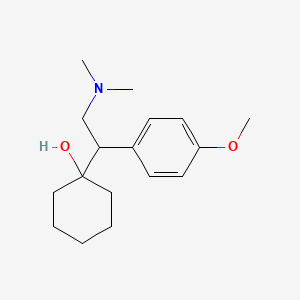
The parent drawing omits the salt counterion. Formulation ingredients and release coatings are not depicted.
How was this medicine developed?
The cited Efexor XL authorisation dates from August 1997. Its release system supports once-daily administration while retaining venlafaxine’s interaction and withdrawal concerns.
Sources and References
- Efexor XL 75 mg: UK SmPC
Product information published on the electronic Medicines Compendium (emc); supplied by pharmaceutical companies.
Scope: United Kingdom product information.
- Efexor XL 150 mg: UK SmPC
Product information published on the electronic Medicines Compendium (emc); supplied by pharmaceutical companies.
Scope: United Kingdom product information.
- Efexor XL: patient leaflet
Product information published on the electronic Medicines Compendium (emc); supplied by pharmaceutical companies.
Scope: United Kingdom product information.
- NHS: Venlafaxine
Scope: NHS website for England — general medicine education, not a four-nation service pathway.
- NICE NG222: Depression in adults, recommendations
Scope: England guidance; applicability or adoption in other UK nations requires separate consideration.
- Antidepressants: use and safety
Scope: United Kingdom.
- Venlafaxine 75 mg immediate-release tablets — Dexcel UK SmPC
Product information published on the electronic Medicines Compendium (emc); supplied by pharmaceutical companies.
Scope: United Kingdom product information.
- Venlafaxine 37.5 mg and 75 mg tablets — Dexcel UK patient leaflet
Product information published on the electronic Medicines Compendium (emc); supplied by pharmaceutical companies.
Scope: United Kingdom product information.
- Venlafaxine XL 37.5 mg prolonged-release capsules — Genus UK SmPC
Product information published on the electronic Medicines Compendium (emc); supplied by pharmaceutical companies.
Scope: United Kingdom product information.
- FDA: Effexor XR prescribing information and Medication Guide
- NIH: What Is a Neurotransmitter?
- Depression in children and young people — recommendations
Scope: United Kingdom; NICE recommendations require attention to national implementation and local pathways.
- MHRA Safety Roundup: ioflupane — venlafaxine and other SNRIs may affect DAT scan interpretation
Scope: United Kingdom.
- A qualitative investigation into the effects of akathisia - Health Research Authority
- Extrapyramidal side effects- Management
- Anxiety and panic attacks - NHS
- Agitation: MedlinePlus Medical Encyclopedia
Shared scientific background. Some references are US product pharmacology or international chemical records; UK product details and prescribing information are verified separately.
Article Information
- Edition
- United Kingdom
- Content updated
- 2026-11-06
- Source check dates
- Listed with each reference above; retained dates for shared scientific content.
- Scope
- exact products checked
Source and coverage limits
- Educational summaries cover the named UK products, not every brand, strength, formulation or prescribing circumstance.
- No claim of pharmacy stock or uniform NHS access is made.
- UK SmPC warnings are used; a US FDA boxed warning is not presented as a UK regulatory designation.
- NICE withdrawal wording was checked in official indexed recommendations; direct page retrieval was blocked.
- Selected Dexcel immediate-release tablets and Genus 37.5 mg XL capsules are checked alongside Efexor XL; this does not verify every brand or current stock.