
About this medicine
Prazosin relaxes blood vessels and can lower blood pressure. A UK manufacturer product record is available for Hypovase; the record does not establish current pharmacy supply.
Its place in a psychiatric reference is principally the separate question of PTSD-related nightmares. Neither lowering blood pressure nor making someone sleepy establishes improvement in the full disorder. A trial needs a defined symptom target and a plan to decide whether benefit outweighs harm.
What is this medicine used for?
Hypovase’s licence covers specified non-psychiatric conditions. NHS Highland describes off-label use for distressing PTSD-related nightmares, with psychiatric assessmentPsychiatric assessmentAn evaluation of mental health, physical health and circumstances to understand a person’s needs and plan care.Read the full definition of Psychiatric assessment and consideration of trauma-focused therapy. This local guidance is not a UK-wide licence or universal recommendation.
NHS Highland’s local guidance asks for assessment of coexisting psychiatric problems and consideration of trauma-focused psychological therapy. It also notes that the optimum treatment duration is not established. This is a local Scottish pathway, not a uniform NHS entitlement or a new marketing authorisation.
Which warning signs need help?
Seek urgent help for severe faintness or collapse. An erection persisting beyond four hours requires immediate medical assistance. Severe allergic breathing symptoms are an emergency. Use UK emergency services only when in the UK; elsewhere contact local services.
How do I take it safely?
For hypertension, the checked SmPC begins with 0.5 mg two or three times daily, with the first dose in the evening and gradual adjustment. This licensed regimen must not be transferred to off-label PTSD treatment.
The hypertension schedule differs from the label’s other non-psychiatric schedules; the condition and co-prescribed treatment matter. Kidney or liver impairment and older age favour particularly cautious initiation. The first-dose blood-pressure effect remains relevant if a specialist prescribes it off-label.
What side effects should I know about?
Dizziness, drowsiness, headache, palpitations, nausea and weakness are among the reported effects. Report troublesome symptoms or increasing swelling.
If treatment causes light-headedness or weakness, the leaflet advises lying down until better and getting up slowly. Recurrent symptoms, falls or fainting should be reported. Avoid driving or machinery while dizzy, drowsy or weak, rather than assuming a bedtime prescription cannot affect daytime safety.
Who needs extra care with this medicine?
Discuss heart failure, kidney or liver disease, previous fainting and upcoming cataract surgery. Allergy to prazosin or related quinazoline medicines prevents use.
Tell the eye surgeon about past as well as current use because alpha-blockers can affect the iris during cataract surgery. Report new ankle swelling or weight gain, particularly with heart failure. The team also needs to know about a history of fainting after urination.
Can it affect my other medicines?
Sildenafil, tadalafil and other blood-pressure-lowering medicines can increase symptomatic hypotension. The combination and timing require clinical review.
Adding a beta-blocker, ACE inhibitor or calcium-channel blocker can produce a substantial additional blood-pressure fall. Another alpha-1 blocker is not a routine add-on. Prazosin can also interfere with some urine-test results; let the requesting clinician know about it.
What check-ups will I need?
Review blood pressure, postural symptoms and the intended treatment benefit. For nightmares, clarify the target and review alongside broader PTSD assessment and psychological treatment.
For a nightmare trial, review frequency and distress, sleep disruption and daytime function alongside standing-related symptoms. NHS Highland suggests discussing withdrawalWithdrawalSymptoms that may occur after reducing or stopping a medicine or substance to which the body has adapted.Read the full definition of Withdrawal after a stable period, particularly when psychological therapy has helped. That is a review principle, not a self-directed stopping schedule.
What about pregnancy, breastfeeding and age?
Pregnancy safety is not established and breastfeeding requires caution. The checked leaflet excludes children under 12; that is not evidence supporting psychiatric use in older children.
What if I miss a dose or want to stop?
Do not double a missed dose. Discuss stopping, restarting after a gap or interrupted supply with the prescriber because symptoms and treatment tolerability need reassessment.
How does it work?
Prazosin reduces some of the signals that tighten blood vessels. This lets blood flow more easily and lowers blood pressure. Its effect on stress-related signals is also one reason it has been studied for nightmares after trauma, although researchers have not fully explained how it may help with those nightmares.
How Brain Cells Communicate
Norepinephrine, also called noradrenaline, is a chemical messenger involved in alertness and the body’s response to stress. It carries messages between nerve cells and also affects organs such as blood vessels. Cells receive these messages through receptors, proteins that respond to particular chemical signals. The term adrenergic refers to signals involving norepinephrine or the related messenger adrenaline.
What is known: The same messenger can affect both alertness and blood pressure.
What remains uncertain: Having nightmares does not tell us how much norepinephrine is present in someone’s brain.
Norepinephrine: Alpha-1 adrenergic receptor
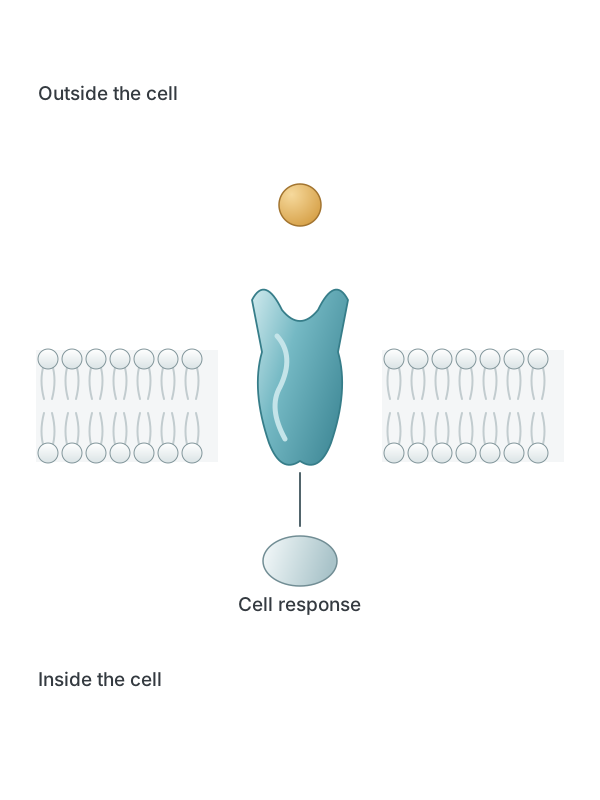
- Messenger
Norepinephrine
- Target
Alpha-1 adrenergic receptor
- Cell context
smooth-muscle cell; simplified membrane, not a binding structure.
Simplified teaching model. Protein shapes, sizes, particle counts and arrows are illustrative, not measurements or experimental structures.
Norepinephrine can activate alpha-1 adrenergic receptor and change signaling in the cell. This is a smooth-muscle cell example, not a complete nervous-system pathway.
About this illustration
Nerve signal; Adrenergic receptor; Cell response. Having nightmares does not tell us how much norepinephrine is present in someone’s brain.
This is a simplified illustration. It does not show exactly how a medicine fits into a protein or predict a dose or response to treatment.
How the Medication Changes Signaling
Prazosin attaches to a type of receptor called alpha-1 and reduces the receptor’s response to norepinephrine. This is called receptor blockade, and a medicine that does it is called an antagonist.
In blood-vessel walls, blocking this signal helps smooth muscle relax. Smooth muscle works without conscious effort. As it relaxes, there is less resistance to blood flowing through.
What is known: Alpha-1 blockade is an established action of prazosin.
What remains uncertain: The prescribing information says the full explanation for its blood-pressure effect is still not known.
Prazosin: Alpha-1 adrenergic receptor
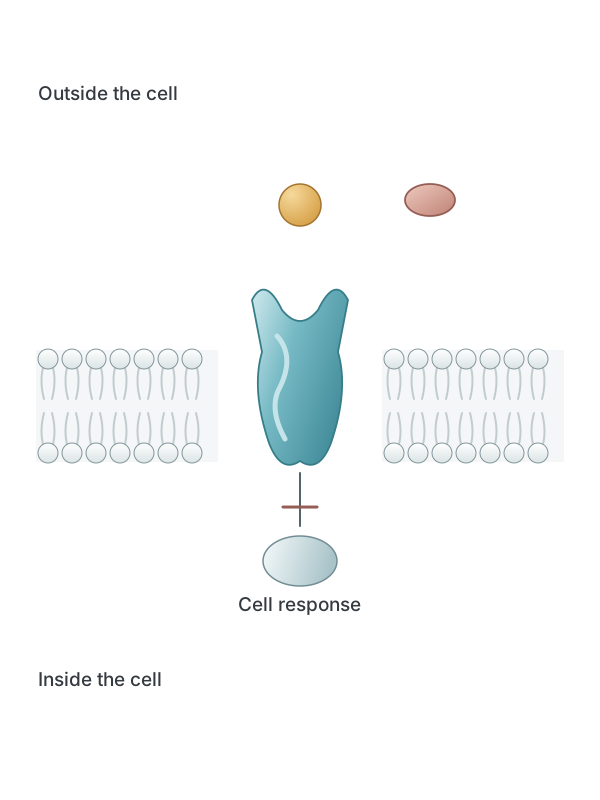
- Messenger
Norepinephrine
- Target
Alpha-1 adrenergic receptor
- Prazosin: receptor activation opposed
The medicine symbol and crossbar indicate antagonist action in a smooth-muscle cell; receptor action does not predict an individual clinical response.
Simplified teaching model. Protein shapes, sizes, particle counts and arrows are illustrative, not measurements or experimental structures.
Prazosin blocks alpha-1 adrenergic receptors. This smooth-muscle example explains a peripheral action; it does not establish nightmare-treatment benefit.
About this illustration
Prazosin; Alpha-1 blockade; Altered response. The prescribing information says the full explanation for its blood-pressure effect is still not known.
This is a simplified illustration. It does not show exactly how a medicine fits into a protein or predict a dose or response to treatment.
How does it affect my body?
A fall in pressure when standing can cause light-headedness or fainting, particularly at initiation. Avoid driving when dizzy or weak.
How does my body process it?
After an oral dose, peak levels usually occur in one to two hours. The usual plasma half-lifeThe time for a measured drug level to fall by halfThe time it takes for the concentration of a medicine in a body fluid, usually blood, to decrease by half during elimination.Read the full definition of Half-life is two to three hours, but illness can alter this.
How do treatment options differ?
Local NHS Highland guidance describes uncertain effects on overall sleep quality and does not support prazosin alone for all PTSD symptoms. Nightmare treatment is a narrower aim.
A medicine for high blood pressure, insomnia or a different anxiety disorder is not automatically a substitute for nightmare treatment. The UK product record contains no psychiatric indication; the local nightmare rationale must remain separate from the licensed cardiovascular and urinary uses.
A closer look at the science
Prazosin selectively blocks postsynaptic alpha-1 adrenergic receptorsReceptorA protein that recognizes a signal and helps a cell respond. Different receptor types can produce different responses to the same messenger.Read the full definition of Receptor in vascular smooth muscle. Reduced vessel resistance allows blood pressure to fall.
Prazosin hydrochloride is the hydrochloride salt of a quinazoline-derived alpha-1 blocker. The displayed structure is the neutral prazosin parent, not the complete salt.
Chemical formula: C19H21N5O4·HCl
The parent contains 19 carbon, 21 hydrogen, five nitrogen and four oxygen atoms. The hydrochloride component follows the dot in the salt formula. The parent drawing and salt formula represent different chemical species and do not determine a product strength or dose.
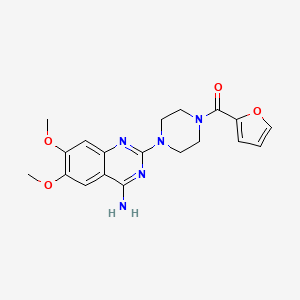
The drawing shows the neutral parent. The hydrochloride salt formula is separately identified; neither determines release rate or dose.
How was this medicine developed?
Hypovase’s checked SmPC lists first authorisation in October 1988 and an April 2021 text revision. The document’s age does not establish current stock or a later PTSD licence.
Sources and References
- Hypovase 0.5 mg tablets: SmPC, sections 1–5 and 9–10
Product information published on the electronic Medicines Compendium (emc); supplied by pharmaceutical companies.
Scope: United Kingdom product information.
- Hypovase 0.5 mg tablets: patient leaflet, sections 1–4
Product information published on the electronic Medicines Compendium (emc); supplied by pharmaceutical companies.
Scope: United Kingdom product information.
- Prazosin for PTSD-related nightmares: indication, off-label status and treatment context
Scope: Scotland — NHS Highland local guidance, not a UK-wide recommendation.
- Prazosin hydrochloride capsules (Biocon): current prescribing information
- Prazosin: patient information — mechanism explanation
Scope: Mechanism explanation only. Source sections checked: Why is this medication prescribed?..
- Clinician’s Guide to Medications for PTSD — mechanism explanation
Scope: Mechanism explanation only. Source sections checked: Prazosin..
- Raskind and colleagues: A parallel group placebo controlled study of prazosin for trauma nightmares and sleep disturbance in combat veterans with post-traumatic stress disorder — mechanism explanation
Scope: Mechanism explanation only. Source sections checked: Abstract: Background (proposed norepinephrine responsiveness), Results..
Shared scientific background. Some references are US product pharmacology or international chemical records; UK product details and prescribing information are verified separately.
Article Information
- Edition
- United Kingdom
- Content updated
- 2026-10-24
- Source check dates
- Listed with each reference above; retained dates for shared scientific content.
- Scope
- exact products checked
Source and coverage limits
- NHS Highland text was retrieved through indexed official-source results. Direct page retrieval returned 403 Forbidden; full current local-guideline validation remains outstanding.
- No PTSD dosage schedule is supplied because current complete guidance was not directly retrievable.
- Only the 0.5 mg UK product is asserted; no US capsule strengths have been imported.
- Minipress is retained only as a cross-edition alias.