
About this medicine
Intuniv is designed to release guanfacine gradually. Psychological, educational and social support remain part of ADHD care.
What is this medicine used for?
The licence covers ages 6–17 when stimulants are unsuitable, not tolerated or ineffective. NICE identifies adult guanfacine as off-labelOff-labelUse of a licensed medicine outside the terms of its UK marketing authorisation.Read the full definition of Off-label and requiring tertiary ADHD advice.
For children, this product’s licensed age range is separate from its place in the NICE treatment sequence. The ADHD article explains when this option may be considered after assessment, environmental changes and review of earlier treatment. Follow the exact formulation’s prescribing information and the agreed specialist monitoring plan.
Which warning signs need help?
Seek urgent help for collapse, marked faintness, a very slow pulse or new suicidal thoughts. Severe headache or confusion after abrupt withdrawalWithdrawalSymptoms that may occur after reducing or stopping a medicine or substance to which the body has adapted.Read the full definition of Withdrawal needs urgent assessment. The checked product carries UK additional-monitoring status; this is not an FDA boxed-warning designation.
How do I take it safely?
The SmPC starts at 1 mg once daily, increasing by no more than 1 mg weekly. Maintenance and maximum doses depend on age, weight and response. Do not crush, chew or split Intuniv, or take it with grapefruit juice or a high-fat meal.
The usual maintenance range is 0.05–0.12 mg/kg/day. The labelled maximum is 4 mg/day for children aged 6–12 weighing at least 25 kg; adolescent maxima vary by weight, up to 7 mg/day. These are specialist prescribing boundaries, not a home titrationTitrationAdjusting a medicine dose in planned stages, guided by the intended benefit and unwanted effects.Read the full definition of Titration guide.
What side effects should I know about?
Sleepiness, fatigue, headache and abdominal pain are common. Weight gain and dizziness may also require review.
Who needs extra care with this medicine?
Tell the specialist about fainting, heart problems, low blood pressure and other psychiatric conditions. Allergy to guanfacine or a product ingredient prevents use.
Dehydration can worsen fainting risk. Heart block, QT prolongation or a family history of sudden unexplained death need particular assessment. Kidney or liver impairment can require dose reduction.
Can it affect my other medicines?
CYP3A4 inhibitors or inducers can change exposure. Sedatives, alcohol and medicines lowering blood pressure or pulse can add to adverse effects.
Examples include ketoconazole, which can raise exposure, and carbamazepine, which can reduce it. Starting or stopping such medicines may require retitration; the prescriber should manage this rather than the patient compensating with extra tablets.
What check-ups will I need?
Baseline cardiovascular and growth checks are followed by weekly review during titration, at least three-monthly in the first year and six-monthly thereafter, with additional checks after dose changes.
Longer-term review also considers whether benefit still justifies treatment. Any trial off medication must be planned with the specialist because abrupt withdrawal can raise blood pressure.
What about pregnancy, breastfeeding and age?
The product information advises against using guanfacine during pregnancy. Breastfeeding decisions need medical advice. Safety and efficacy are not established for children under 6 or adults in this licence.
What if I miss a dose or want to stop?
If two or more consecutive doses are missed, ask the prescriber about restarting. When stopping, the SmPC limits reductions to 1 mg every 3–7 days, with pulse and blood-pressure monitoring.
How does it work?
Guanfacine acts at a particular type of receptorReceptorA protein that recognizes a signal and helps a cell respond. Different receptor types can produce different responses to the same messenger.Read the full definition of Receptor, a protein that receives chemical messages in the brain. It activates alpha-2A receptors, which respond to noradrenaline, a chemical messenger. The full connection between this action and improvement in attention-deficit/hyperactivity disorder (ADHD) symptoms is not yet understood.
How Brain Cells Communicate
Norepinephrine carries messages between nerve cells and also helps regulate activity in the body. Its receptors come in several types, with alpha-2A naming one of those receiving sites. Activating a receptor starts a response within the cell, but that response depends on the site involved and its place in a network. A receptor used in one brain pathway therefore need not have exactly the same effects everywhere.
What is known: Alpha-2A receptors are one way that cells receive norepinephrine messages.
What remains uncertain: Their presence does not show that a person’s attention difficulties have a single chemical cause.
Norepinephrine: Alpha-2A receptor
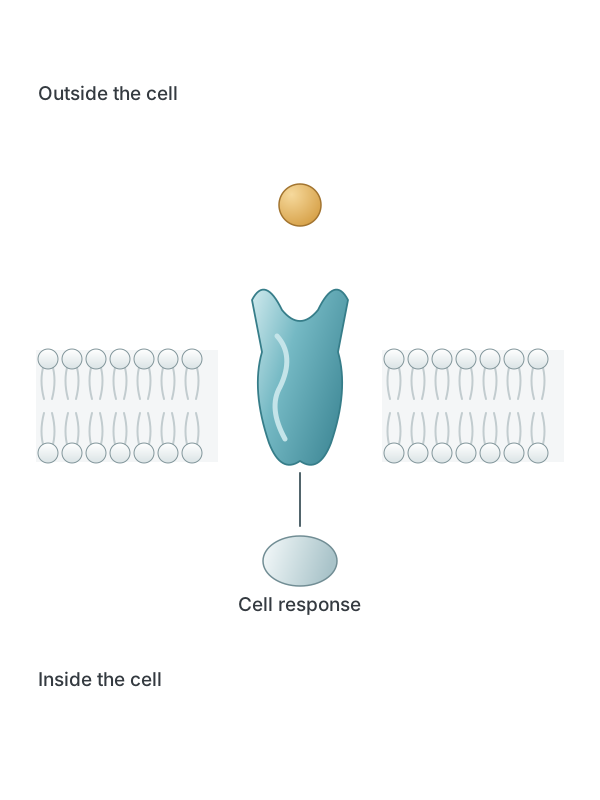
- Norepinephrine
A messenger can change signaling through its receptor.
- Alpha-2A receptor
This receptor symbol identifies a function, not a molecular structure.
- Cell response
The arrow represents a signaling response, not movement through a pore.
Simplified teaching model. Protein shapes, sizes, particle counts and arrows are illustrative, not measurements or experimental structures.
Norepinephrine can activate alpha-2a receptor and change signaling in the cell.
About this illustration
Norepinephrine; Alpha-2A receptor; Cell signaling. Their presence does not show that a person’s attention difficulties have a single chemical cause.
This is a simplified illustration. It does not show exactly how a medicine fits into a protein or predict a dose or response to treatment.
How the Medication Changes Signaling
Guanfacine is an agonist, meaning it activates a receptor rather than blocking its activation. It binds more strongly to alpha-2A receptors than at the related alpha-2B and alpha-2C types in laboratory binding studies. The term binding affinity describes how strongly a substance attaches to a target under those conditions. That preference identifies a principal target; it is not a percentage showing how much attention or impulse control will improve.
What is known: Guanfacine activates alpha-2A receiving sites in the brain.
What remains uncertain: The complete sequence from this receptor action to ADHD benefit remains uncertain.
Guanfacine: Alpha-2A receptor
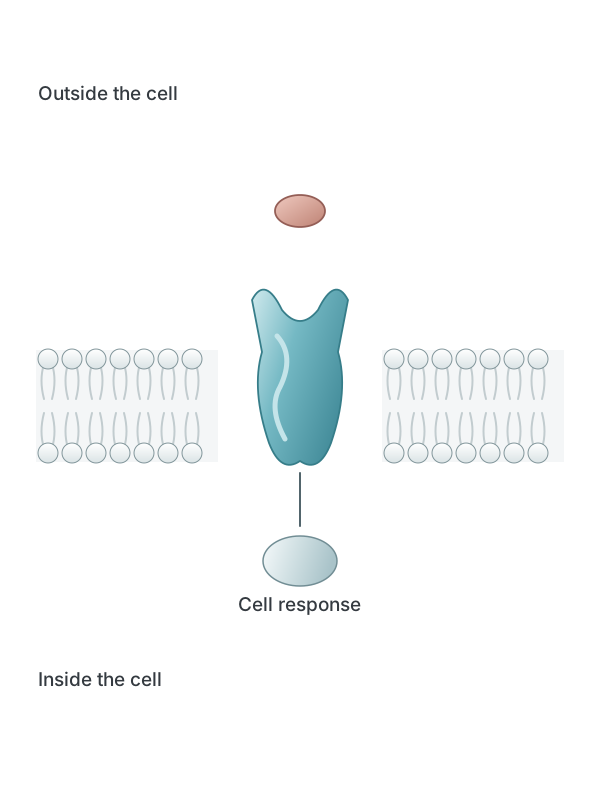
- Guanfacine
The oval identifies the medicine acting at the Alpha-2A receptor. It is a concept symbol, not a molecular shape or binding pose.
- Alpha-2A receptor
This receptor symbol identifies a function, not a molecular structure.
- Guanfacine: activation
The arrow represents a signaling response, not movement through a pore.
Simplified teaching model. Protein shapes, sizes, particle counts and arrows are illustrative, not measurements or experimental structures.
Guanfacine activates alpha-2A receptors. This receptor action does not fully explain improvement in ADHD.
About this illustration
Guanfacine; Alpha-2A activation; Changed signaling. The complete sequence from this receptor action to ADHD benefit remains uncertain.
This is a simplified illustration. It does not show exactly how a medicine fits into a protein or predict a dose or response to treatment.
How does it affect my body?
Reduced sympathetic nerve activity can lower heart rate and blood pressure. These physiological effects help explain fainting and dizziness risks.
How does my body process it?
CYP3A4 and CYP3A5 process guanfacine. Both liver and kidney function can affect exposure; its elimination half-lifeThe time for a measured drug level to fall by halfThe time it takes for the concentration of a medicine in a body fluid, usually blood, to decrease by half during elimination.Read the full definition of Half-life is approximately 18 hours.
How do treatment options differ?
It offers a different non-stimulant mechanism from atomoxetine. Individual suitability depends on benefit, sedation, cardiovascular effects and the treatment pathway, not a universal ranking.
Immediate-release guanfacine is not interchangeable with Intuniv milligram for milligram. Prolonged release changes the concentration profile; an equivalent ingredient name does not establish an equivalent product.
A closer look at the science
It preferentially activates alpha-2A adrenergic receptors. Preclinical evidence links these receptors to signalling in the prefrontal cortexCerebral cortexThe folded outer layer of the cerebrum, the large upper part of the brain. Its regions work with deeper structures in connected systems.Read the full definition of Cerebral cortex and basal ganglia; this is not proof of a single complete ADHD mechanism.
Guanfacine hydrochloride is a hydrochloride salt. The drawing shows the neutral parent, guanfacine, and excludes the hydrochloride component.
Chemical formula: C9H9Cl2N3O · HCl
C, H, N, O and Cl denote chemical elements where present; the numbers count atoms. The neutral parent composition is C9H9Cl2N3O; the added HCl describes the hydrochloride salt. Composition does not specify the tablet or capsule release rate.
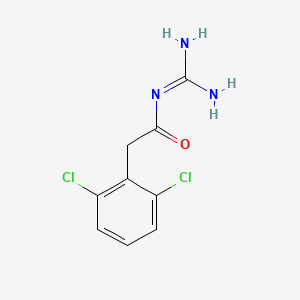
The neutral parent drawing and hydrochloride salt formula identify different, explicitly distinguished chemical species.
How was this medicine developed?
The Scottish Medicines Consortium accepted Intuniv for the specified paediatric ADHD indication in 2016. That decision concerns NHS Scotland and does not create identical access arrangements across the UK.
Sources and References
- Intuniv 1 mg prolonged-release tablets: SmPC, sections 4–5
Product information published on the electronic Medicines Compendium (emc); supplied by pharmaceutical companies.
Scope: United Kingdom product information.
- Intuniv 1, 2, 3 and 4 mg prolonged-release tablets: patient leaflet, sections 1–4
Product information published on the electronic Medicines Compendium (emc); supplied by pharmaceutical companies.
Scope: United Kingdom product information.
- Guanfacine (Intuniv), SMC 1123/16: advice and evidence, pages 1–7
Scope: United Kingdom product information.
- ADHD: diagnosis and management, NG87 recommendation 1.7.17
Scope: NICE guidance for England; application in other UK nations determined separately.
- Intuniv: current prescribing information
- ADHD: full recommendations PDF
Scope: United Kingdom; NICE recommendations require attention to national implementation and local pathways.
Shared scientific background. Some references are US product pharmacology or international chemical records; UK product details and prescribing information are verified separately.
Article Information
- Edition
- United Kingdom
- Content updated
- 2026-10-30
- Source check dates
- Listed with each reference above; retained dates for shared scientific content.
- Scope
- exact products checked
Source and coverage limits
- Tenex is a cross-edition alias only; immediate-release guanfacine is not asserted to be a current UK equivalent.
- Do not substitute immediate-release and prolonged-release products milligram for milligram.
- NICE text was accessible through official indexed results, while direct page retrieval was blocked.
- SMC 2016 acceptance is a historical national decision; current local stock or commissioning was not independently checked.