
About this medicine
Different brands release different proportions at different times. The name of the exact product matters as well as its milligram strength.
What is this medicine used for?
The checked products cover ADHD from age six and in adults when non-drug measures alone are insufficient. NICE also discusses use at age five, which must not be confused with these product licences. Other uses need their own licence check.
Which warning signs need help?
In the UK, chest pain, seizures, stroke symptoms or severe breathing difficulty need emergency help. Elsewhere use local emergency services. New hallucinationsHallucinationsA hallucination is a sensory experience without a corresponding external source—for example, hearing a voice when nobody is speaking. It can involve hearing, sight, touch, smell or taste and may feel very real.A hallucination is an experience; a delusion is a belief. Hallucinations can have different causes, so an assessment is needed to understand them. or marked mood changes require urgent assessment. MHRA warns that careless switching of long-acting products can destabilise symptom control.
How do I take it safely?
For people new to methylphenidate, Concerta XL commonly starts at 18 mg each morning; increases are usually weekly. Its checked maximum is 54 mg/day in children and 72 mg/day in adults. Swallow it whole. Medikinet XL has different release and meal requirements; do not transfer Concerta instructions to it.
Medikinet XL’s adult starting regimen is 10 mg/day, adjusted weekly and divided between morning and lunchtime meals; its adult ceiling is 1 mg/kg/day, never above 80 mg/day. The child ceiling is 60 mg/day. The checked 60 mg capsule is not a starting dose; lower prescribed strengths are needed for titrationTitrationAdjusting a medicine dose in planned stages, guided by the intended benefit and unwanted effects.Read the full definition of Titration.
Medikinet XL may be opened onto a spoonful of apple sauce or yoghurt, swallowed immediately and followed with fluid. Do not chew the granules or store the mixture. Food is necessary for its intended prolonged release; Concerta XL has different instructions.
Immediate-release Ritalin is a scored 10 mg tablet, divisible into equal 5 mg doses. Its UK licence includes ADHD from age six and in adults. The label starts children at 5 mg once or twice daily, with weekly adjustment; adults usually start at 10 mg twice daily, sometimes 5 mg twice daily.
Label maxima are 60 mg/day in children and 80 mg/day in adults, usually divided into two or three doses. These are product-label examples, not instructions to change a prescription.
Immediate-release medicine acts over a shorter part of the day; modified-release products release it in stages. Different modified-release brands can differ in food instructions, timing and effect. A switch should be planned with the prescriber or pharmacist, with the new instructions explained and response reviewed.
What side effects should I know about?
Headache, trouble sleeping, appetite loss, nausea, dry mouth and abdominal pain may occur. Report sustained weight loss, tics or mood changes.
Who needs extra care with this medicine?
The label excludes certain serious cardiac, vascular and psychiatric conditions, glaucoma and recent MAOI use. A cardiovascular and mental-health assessment is required before prescribing.
Can it affect my other medicines?
MAOIs and medicines that affect blood pressure require checking. Medikinet XL also has formulation-specific restrictions with medicines that reduce stomach acidity.
Medikinet XL must not be combined with proton-pump inhibitors, H2 blockers or antacids because raised stomach pH can disrupt its release. This restriction must not be presented as a universal rule for every methylphenidate product.
What check-ups will I need?
Monitor pulse and blood pressure after dose changes and every six months. Review weight, growth, appetite, sleep, mental state and risk of misuse or diversion.
Before starting, establish childhood symptom history, impairment and cardiovascular and psychiatric risk; a response to a stimulant is not a diagnostic test. Review new psychiatric symptoms at visits and dose changes. Longer-term treatment needs periodic reassessment of benefit, not automatic continuation.
For children, NICE recommends height every six months; weight every three months at age ten or younger, and at three and six months after starting then every six months above ten, or more often when needed. Check pulse and blood pressure before and after dose changes and every six months. Track appetite, sleep, mood and practical benefit; routine ECGs are not required without a clinical indication.
What about pregnancy, breastfeeding and age?
Pregnancy decisions balance limited safety information against treatment benefit. Breastfeeding may be possible after review, with observation of feeding, sleep and weight.
What if I miss a dose or want to stop?
Skip a forgotten dose rather than doubling. Discuss planned stopping; abrupt withdrawalWithdrawalSymptoms that may occur after reducing or stopping a medicine or substance to which the body has adapted.Read the full definition of Withdrawal can cause symptoms including depression. Long-term need is reviewed periodically.
How does it work?
Methylphenidate changes the handling of dopamineDopamineA chemical messenger involved in movement, learning and emotion. Its name does not describe one feeling or one role throughout the brain.Read the full definition of Dopamine and noradrenaline, chemical messengers used by nerve cellsNeuronA nerve cell that receives and sends information. Neurons work in connected groups, rather than carrying a whole thought on their own.Read the full definition of Neuron. It reduces their return into cells, allowing more to remain available between them. This action is well described, although the complete explanation of how it improves attention-deficit/hyperactivity disorder (ADHD) symptoms remains uncertain.
How Brain Cells Communicate
Nerve cells communicate by releasing chemicals called neurotransmitters. Dopamine and norepinephrine, also called noradrenaline, are two such messengers involved in networks that support attention and activity. Proteins called transporters return these messengers into nerve cells after release, a process known as reuptake. Receiving sites called receptors respond to the messages, while transporters help control how much messenger remains available.
What is known: Release and reuptake help regulate communication between nerve cells.
What remains uncertain: These processes do not show that an individual has a single chemical deficiency.
Dopamine and DAT
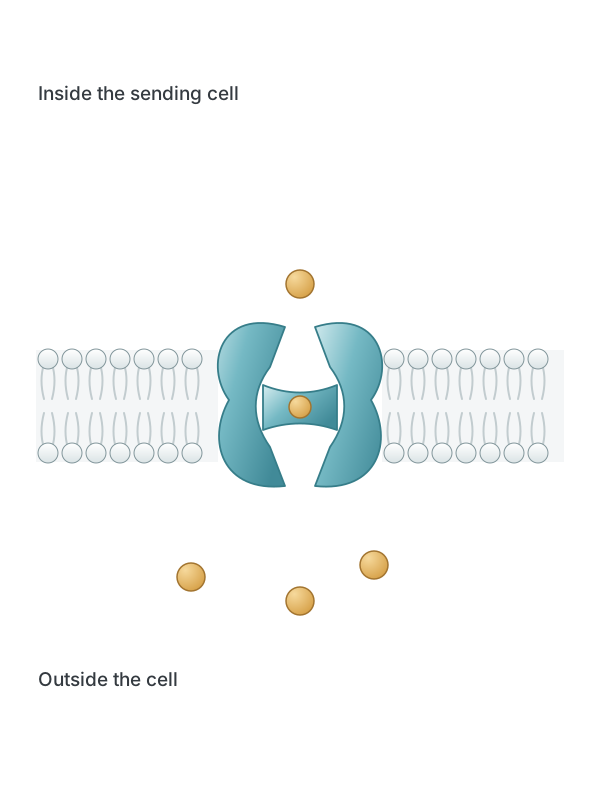
- Dopamine
The messenger is shown outside the sending cell.
- DAT
This transporter returns dopamine from outside into the sending cell.
- Return into the cell
The arrow shows transport direction, without a measured rate.
Simplified teaching model. Protein shapes, sizes, particle counts and arrows are illustrative, not measurements or experimental structures.
The DAT transporter returns dopamine from outside the nerve cell into the cell. This is a separate transport system.
Norepinephrine and NET
- Norepinephrine
The messenger is shown outside the sending cell.
- NET
This transporter returns norepinephrine from outside into the sending cell.
- Return into the cell
The arrow shows transport direction, without a measured rate.
Simplified teaching model. Protein shapes, sizes, particle counts and arrows are illustrative, not measurements or experimental structures.
The NET transporter returns norepinephrine from outside the nerve cell into the cell. This is a separate transport system.
About this illustration
Messenger released → Dopamine / norepinephrine → Reuptake transporters. These processes do not show that an individual has a single chemical deficiency.
Normal release and recycling are shown as a qualitative sequence.
Qualitative model · no scale, rate, dose or binding pose
How the Medication Changes Signaling
Methylphenidate inhibits the transporters that take dopamine and norepinephrine back into nerve cells. Inhibiting means reducing their activity, so the return of these messengers is slowed. The prescribing information also describes increased release into the space outside cells. Together, these actions change signaling across connected cells, but the effects on a particular person’s attention and everyday functioning still need to be observed during treatment.
What is known: Methylphenidate changes the availability of dopamine and norepinephrine between cells.
What remains uncertain: A transporter effect does not reveal exactly how much clinical improvement someone will experience.
Methylphenidate and DAT
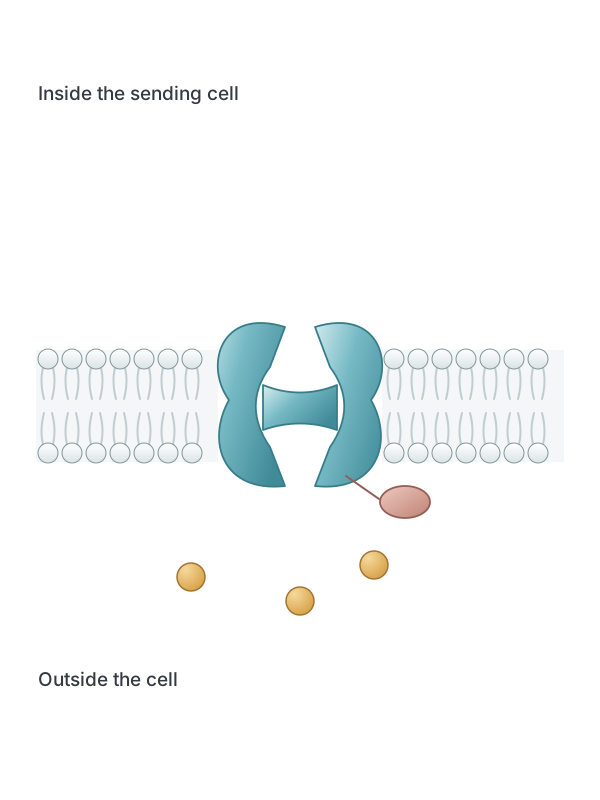
- Dopamine
The messenger is shown outside the sending cell.
- DAT
This transporter returns dopamine from outside into the sending cell.
- Methylphenidate: uptake inhibited
The interrupted arrow names the action; the symbol is not a molecular shape or binding position.
Simplified teaching model. Protein shapes, sizes, particle counts and arrows are illustrative, not measurements or experimental structures.
Methylphenidate reduces dopamine reuptake. This focused uptake illustration does not exclude other release effects described in the label.
Methylphenidate and NET
- Norepinephrine
The messenger is shown outside the sending cell.
- NET
This transporter returns norepinephrine from outside into the sending cell.
- Methylphenidate: uptake inhibited
The interrupted arrow names the action; the symbol is not a molecular shape or binding position.
Simplified teaching model. Protein shapes, sizes, particle counts and arrows are illustrative, not measurements or experimental structures.
Methylphenidate also reduces norepinephrine reuptake. These target actions do not fully explain clinical benefit or establish an ADHD diagnosis.
About this illustration
Methylphenidate → Reuptake inhibited → Signaling changes. A transporter effect does not reveal exactly how much clinical improvement someone will experience.
Inhibition changes messenger handling; no binding pose, concentration or occupancy is depicted.
Qualitative model · no scale, rate, dose or binding pose
How does it affect my body?
Reduced appetite, insomnia, headache and stomach symptoms are common. Pulse and blood pressure can increase, so monitoring matters.
How does my body process it?
Methylphenidate is broken down mainly by de-esterification into a largely inactive metabolite. Modified-release design changes absorption over the day.
How do treatment options differ?
Concerta XL and Medikinet XL cannot be assumed equivalent from total daily milligrams. Brand, release profile, food instructions and the person’s response guide supervised switching.
Ritalin can be taken with or without food, unlike meal-dependent Medikinet XL. Immediate release changes dosing frequency and coverage; neither the same ingredient nor the same daily total establishes a safe unsupervised switch.
A closer look at the science
It inhibits monoamine reuptakeReuptakeThe return of a released chemical messenger into a cell through a transporter. It is one way to limit a signal; chemical breakdown is another.Read the full definition of Reuptake. The medicine is a mixture of two molecular orientations; the d-isomer has greater pharmacological activity. The exact therapeutic mechanism is not fully established.
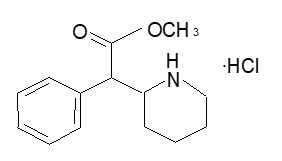
Methylphenidate hydrochloride is a salt containing the racemic d,l-threo drug. The label’s diagram depicts connectivity without selecting only the d enantiomer.
Chemical formula: C14H19NO2 · HCl
The letters denote carbon, hydrogen, nitrogen, oxygen and chlorine; the dot identifies the hydrochloride salt component. A formula does not describe the extended-release tablet mechanism.
How was this medicine developed?
Concerta XL 54 mg’s record dates first authorisation to February 2002. MHRA issued a specific long-acting methylphenidate switching warning in 2022.
Sources and References
- Concerta XL 54 mg prolonged-release tablets — UK SmPC
Product information published on the electronic Medicines Compendium (emc); supplied by pharmaceutical companies.
Scope: United Kingdom product information.
- Medikinet XL 60 mg modified-release capsules — UK SmPC
Product information published on the electronic Medicines Compendium (emc); supplied by pharmaceutical companies.
Scope: United Kingdom product information.
- Modified-release methylphenidate: caution when switching products
Scope: United Kingdom; NICE recommendations require attention to national implementation and local pathways.
- About methylphenidate for adults
Scope: NHS website medicines information (England); not a guarantee of identical services across UK nations.
- Taking methylphenidate for adults
Scope: NHS website medicines information (England); not a guarantee of identical services across UK nations.
- Methylphenidate side effects
Scope: NHS website medicines information (England); not a guarantee of identical services across UK nations.
- Methylphenidate in pregnancy and breastfeeding
Scope: NHS website medicines information (England); not a guarantee of identical services across UK nations.
- ADHD: diagnosis and management — recommendations
Scope: United Kingdom; NICE recommendations require attention to national implementation and local pathways.
- Ritalin 10 mg tablets — UK SmPC
Product information published on the electronic Medicines Compendium (emc); supplied by pharmaceutical companies.
Scope: United Kingdom product information.
- Ritalin (methylphenidate): prescribing information — mechanism explanation
Scope: Mechanism explanation only. Source sections checked: 12.1 Mechanism of Action; 12.2 Pharmacodynamics; 12.3 Pharmacokinetics..
- Concerta extended-release tablets: current prescribing information
- ADHD: rationale and impact
Scope: United Kingdom; NICE recommendations require attention to national implementation and local pathways.
- Prescribing and switching between modified-release methylphenidate
Scope: United Kingdom; NICE recommendations require attention to national implementation and local pathways.
- Schizophrenia
- NIMH: Understanding psychosis
Shared scientific background. Some references are US product pharmacology or international chemical records; UK product details and prescribing information are verified separately.
Article Information
- Edition
- United Kingdom
- Content updated
- 2026-10-30
- Source check dates
- Listed with each reference above; retained dates for shared scientific content.
- Scope
- exact products checked
Source and coverage limits
- This concise educational record does not audit every UK manufacturer, pack or local formulary. Product strengths are not a personal dosing schedule.
- Named immediate-release and modified-release products are checked, not every manufacturer or release technology. Equasym and Delmosart remain recognised aliases, not independently specified products here.
- NICE recommendations checked through official indexed text; direct page access returned HTTP 403.