
About this medicine
Nerve-pain treatment and depression treatment use different dose ranges. Pamelor is a retained US search alias, not a verified UK brand here.
What is this medicine used for?
The exact Blackrock licence is for depression. Nerve-pain use described by the NHS is off-labelOff-labelUse of a licensed medicine outside the terms of its UK marketing authorisation.Read the full definition of Off-label for these products; their SmPC does not recommend childhood depression treatment.
Which warning signs need help?
Get urgent advice after any excess dose. Collapse, seizures, breathing difficulty or a fast irregular heartbeat need emergency assessment. New self-harm thoughts also require immediate help.
MHRA’s October 2026 communication announced the rollout of a prominent boxed warning in UK antidepressant patient leaflets about self-harm and suicidal behaviour, alongside a patient safety card. This UK patient-information measure is not the US FDA Boxed Warning designation. Read the leaflet supplied with your medicine, seek prompt professional help for new or worsening mood or behaviour changes, and do not stop treatment suddenly without advice.
How do I take it safely?
Blackrock tablet depression reference: start low, for example 50 mg once daily or 25 mg two to three times daily, and increase cautiously. Doses above 150 mg daily are not recommended. Older patients start at 10–20 mg daily. These are prescribing references, not personal instructions.
Flamingo’s 50 mg tablet is another checked UK presentation licensed for adult major depressive episodes, not for under-18s. It does not make 50 mg the right starting amount for every patient. Dose selection, cardiac precautions and monitoring remain necessary regardless of tablet strength.
Liquid availability needs particular care: the former Colonis 10 mg/5 ml and 25 mg/5 ml solutions are currently marked discontinued. A 2024 NHS/DHSC supply notice described unlicensed special suspensions as possible alternatives. It is not evidence of today’s stock. A prescriber and pharmacist must confirm a suitable preparation, its concentration and licensing status for someone who cannot swallow tablets; do not assume any liquid is interchangeable.
What side effects should I know about?
Dry mouth, constipation, sweating, dizziness, blurred vision, sexual difficulties and weight changes can occur.
MHRA is adding the term post-SSRI sexual dysfunction (PSSD) to patient leaflets describing persistent sexual difficulties after stopping certain antidepressants, including this medicine. Their frequency and causes remain under study. Persistent symptoms deserve support; this does not mean everyone taking the medicine will experience them.
Who needs extra care with this medicine?
Discuss heart disease, epilepsy, glaucoma, urinary retention, thyroid problems and previous mania. Brugada syndrome or a family history of sudden cardiac death is particularly relevant.
Recent heart attack, heart block or other cardiac arrhythmia are contraindicationsA medical reason a medicine should not be usedA medical reason a medicine should not be used in a particular situation because it may be harmful.Read the full definition of Contraindication, not merely reasons for routine caution. Older people are particularly susceptible to confusion and blood-pressure falls on standing.
Can it affect my other medicines?
MAO inhibitors are incompatible. Other antidepressants, decongestants, sedatives and heart-rhythm medicines may interact; show the pharmacist a complete medicines list.
Fluoxetine can substantially raise nortriptyline concentrations and continues to matter after stopping because it clears slowly. Other anticholinergic medicines can worsen constipation, urinary problems and overheating. Tell the anaesthetic team before surgery.
What check-ups will I need?
The SmPC requires plasma-level monitoring above 100 mg daily. Mood, blood pressure, cardiac symptoms and adverse effects also need review.
Older people needing more than 50 mg/day require ECG and plasma-level checks under this product’s instructions. Clinical symptoms take precedence over a reassuring drug level. Fever or sore throat early in treatment can require a blood count.
What about pregnancy, breastfeeding and age?
Pregnancy or breastfeeding needs specialist discussion. The checked SmPC and leaflet differ in breastfeeding wording; do not use this summary to decide whether to start or stop treatment.
The SmPC allows breastfeeding when maternal benefit outweighs infant risk, while the leaflet is more restrictive. Pregnancy can change drug concentrations; monitoring may be needed. Use near delivery can cause newborn withdrawalWithdrawalSymptoms that may occur after reducing or stopping a medicine or substance to which the body has adapted.Read the full definition of Withdrawal or anticholinergic symptoms such as feeding, breathing, urinary or bowel difficulties.
What if I miss a dose or want to stop?
Take a missed dose when remembered unless the next is nearly due; never double up. Planned stopping is usually gradual over weeks or longer.
How does it work?
Nortriptyline slows reuptakeReuptakeThe return of a released chemical messenger into a cell through a transporter. It is one way to limit a signal; chemical breakdown is another.Read the full definition of Reuptake, the return of chemical messengers into the nerve cellsNeuronA nerve cell that receives and sends information. Neurons work in connected groups, rather than carrying a whole thought on their own.Read the full definition of Neuron that released them. Its effect on noradrenaline reuptake is stronger than its effect on serotoninSerotoninA chemical messenger involved in several functions, including sleep, mood and digestion. It acts through different receptors, with effects that depend on the cell.Read the full definition of Serotonin reuptake, changing the messages available between cells. This helps describe its action, but does not fully explain how symptoms improve or predict the response of an individual.
How does it affect my body?
Its effects include dry mouth, constipation and changes in pulse or blood pressure. Dizziness can increase falls risk.
How does my body process it?
CYP2D6 activity varies between people. Liver impairment and interacting medicines can raise concentrations; the average elimination half-lifeThe time for a measured drug level to fall by halfThe time it takes for the concentration of a medicine in a body fluid, usually blood, to decrease by half during elimination.Read the full definition of Half-life is about 26 hours.
How do treatment options differ?
Pain doses described by the NHS are lower than many depression doses. Comparing tablet strengths alone can therefore be misleading.
A closer look at the science
Nortriptyline is also the main active metabolite of amitriptyline. Anticholinergic activity remains clinically important despite being less marked than amitriptyline’s.
Nortriptyline is a tricyclic amine supplied as a hydrochloride salt.
Chemical formula: C19H21N · HCl
The drawing depicts neutral nortriptyline, C19H21N; HCl is shown separately in the product formula.
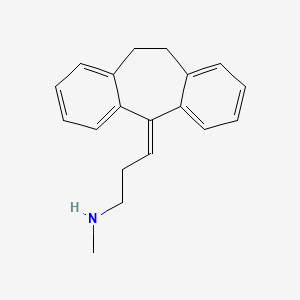
The drawing shows the neutral parent. The product salt formula is separately identified; neither determines release rate or dose.
How was this medicine developed?
This Blackrock authorisation record dates from January 2025; it does not mark nortriptyline’s original introduction.
Sources and References
- Nortriptyline 10 mg — UK SmPC
Product information published on the electronic Medicines Compendium (emc); supplied by pharmaceutical companies.
Scope: United Kingdom product information.
- Nortriptyline 25 mg — UK SmPC
Product information published on the electronic Medicines Compendium (emc); supplied by pharmaceutical companies.
Scope: United Kingdom product information.
- Nortriptyline — patient leaflet
Product information published on the electronic Medicines Compendium (emc); supplied by pharmaceutical companies.
Scope: United Kingdom product information.
- NHS: How and when to take nortriptyline
Scope: NHS website medicines information (England); not a guarantee of identical services across UK nations.
- NHS: About nortriptyline
Scope: NHS website medicines information (England); not a guarantee of identical services across UK nations.
- Antidepressants: use and safety
Scope: United Kingdom.
- Nortriptyline 50 mg film-coated tablets — SmPC
Product information published on the electronic Medicines Compendium (emc); supplied by pharmaceutical companies.
Scope: United Kingdom; named product information.
- Nortriptyline 10 mg/5 ml oral solution — discontinued product record
Product information published on the electronic Medicines Compendium (emc); supplied by pharmaceutical companies.
Scope: United Kingdom; former named product.
- Nortriptyline 25 mg/5 ml oral solution — discontinued product record
Product information published on the electronic Medicines Compendium (emc); supplied by pharmaceutical companies.
Scope: United Kingdom; former named product.
- Nortriptyline oral solutions: discontinuation — MSN/2024/061
Scope: England medicines-supply advice; historical notification, not a present UK stock guarantee.
- Nortriptyline hydrochloride capsules prescribing information — mechanism explanation
Scope: Mechanism explanation only. Source sections checked: Clinical Pharmacology; Warnings; Drug Interactions—Drugs Metabolized by P450 2D6; Dosage and Administration..
- What Is a Neurotransmitter? — mechanism explanation
Scope: Mechanism explanation only. Source sections checked: How Neurotransmitters Work; Types of Neurotransmitters..
Shared scientific background. US product pharmacology and chemical references do not establish UK licences, doses, formulations or NHS recommendations.
Article Information
- Edition
- United Kingdom
- Content updated
- 2026-10-24
- Source check dates
- Listed with each reference above; retained dates for shared scientific content.
- Scope
- exact products checked
Source and coverage limits
- Educational summaries cover the named UK products, not every formulation or prescribing circumstance.
- Listings do not guarantee local stock or NHS access.
- UK product warnings are not US FDA boxed-warning designations.
- The NHS page discusses teenage dosing, whereas these product SmPCs do not recommend depression treatment under 18. Product licensing is stated separately.
- SmPC 4.6 permits breastfeeding after risk–benefit assessment; its PIL says not to use while breastfeeding. This discrepancy requires professional resolution.
- Representative 10, 25 and 50 mg tablets are checked. Former licensed liquids are documented as discontinued; no present unlicensed-special supplier or stock is claimed.