
About this medicine
Faverin is the verified UK brand. Luvox and Luvox CR are retained US aliases; modified-release products must not be assumed equivalent.
What is this medicine used for?
Childhood use is specifically for OCD, not depression. The leaflet describes OCD treatment from age 8; the SmPC’s paediatric dosing paragraph uses “over 8”. Specialist assessment remains necessary.
The adult indications are major depressive episodes and OCD. Treatment response is reviewed over weeks; continuing OCD treatment requires periodic reassessment, and medication does not replace appropriate psychological treatment.
Which warning signs need help?
Urgent assessment is needed for self-harm thoughts, severe restlessness, seizures, a blistering or peeling rash, or fever with confusion and twitching. Seek urgent advice after excess doses.
MHRA’s October 2026 communication announced the rollout of a prominent boxed warning in UK antidepressant patient leaflets about self-harm and suicidal behaviour, alongside a patient safety card. This UK patient-information measure is not the US FDA Boxed Warning designation. Read the leaflet supplied with your medicine, seek prompt professional help for new or worsening mood or behaviour changes, and do not stop treatment suddenly without advice.
How do I take it safely?
Adult product reference: depression starts at 50 or 100 mg in the evening; OCD starts at 50 mg daily. The maximum is 300 mg daily, with doses above 150 mg divided. Children with OCD have a lower, specialist-managed schedule and 200 mg daily maximum. These are not personal titrationTitrationAdjusting a medicine dose in planned stages, guided by the intended benefit and unwanted effects.Read the full definition of Titration instructions.
The childhood OCD schedule starts at 25 mg/day, using the scored tablet as prescribed. Adult and childhood dose-division rules differ. Liver or kidney impairment calls for a low starting dose and closer supervision.
What side effects should I know about?
Nausea, vomiting, headache, sweating, tremor, disturbed sleep and bowel symptoms are recognised. Persistent symptoms deserve review.
MHRA is adding the term post-SSRI sexual dysfunction (PSSD) to patient leaflets describing persistent sexual difficulties after stopping certain antidepressants, including this medicine. Their frequency and causes remain under study. Persistent symptoms deserve support; this does not mean everyone taking the medicine will experience them.
Who needs extra care with this medicine?
Discuss previous mania, epilepsy, bleeding problems, diabetes, glaucoma and liver or kidney disease.
Can it affect my other medicines?
Tizanidine, pimozide and MAO inhibitors are incompatible. Strong CYP1A2/CYP2C19 inhibition affects many medicines, including clozapine and theophylline. Caffeine effects can increase; a pharmacist should check every medicine and supplement.
What check-ups will I need?
Review mood and tolerability early, including unusual agitation. Drug concentrations or other checks may be needed when an interacting medicine is prescribed.
Behavioural change, suicidal thinking and severe restlessness need particular attention early in treatment or after dose changes. Increasing a dose can worsen akathisiaAkathisiaAkathisia is distressing inner restlessness with a strong urge to move, sometimes caused by medication. It may lead to pacing, rocking or difficulty sitting still.Anxiety involves fear or worry; agitation is a broader state of distress or restlessness. These can overlap with akathisia, but the compelling urge to move is an important clue. Tell your prescriber promptly about new or worsening restlessness so the cause can be assessed.—the distressing inability to keep still.
What about pregnancy, breastfeeding and age?
Pregnancy needs an individual decision; the product advises against breastfeeding during treatment. Children treated for OCD need monitoring of behaviour, growth and development.
What if I miss a dose or want to stop?
Avoid abrupt stopping: withdrawal symptomsWithdrawalSymptoms that may occur after reducing or stopping a medicine or substance to which the body has adapted.Read the full definition of Withdrawal can occur after missed doses or discontinuation. Agree a gradual reduction and do not double a missed dose.
Switching to or from an MAOI requires a clinician-managed separation period. Withdrawal symptoms can resemble anxiety or relapse; new symptoms after a reduction deserve assessment rather than an automatic dose increase.
How does it work?
Fluvoxamine slows the return of serotoninSerotoninA chemical messenger involved in several functions, including sleep, mood and digestion. It acts through different receptors, with effects that depend on the cell.Read the full definition of Serotonin, a chemical messenger, into the nerve cellsNeuronA nerve cell that receives and sends information. Neurons work in connected groups, rather than carrying a whole thought on their own.Read the full definition of Neuron that released it. This process is called reuptakeReuptakeThe return of a released chemical messenger into a cell through a transporter. It is one way to limit a signal; chemical breakdown is another.Read the full definition of Reuptake; reducing it leaves more serotonin available between cells and changes how they communicate. The action does not establish that depression is caused by a simple serotonin shortage.
How Brain Cells Communicate
Nerve cells use chemical messengers called neurotransmitters to communicate across tiny gaps, known as synapses. Serotonin can attach to receptors, proteins that detect the message and influence the receiving cell. The serotonin transporter, or SERT, carries some serotonin back into the sending cell. This return process, called reuptake, helps regulate how long the message is available.
What is known: Serotonin signaling is regulated partly by reuptake.
What remains uncertain: Mood and repetitive thoughts or behaviours involve more than one chemical messenger.
Serotonin and SERT
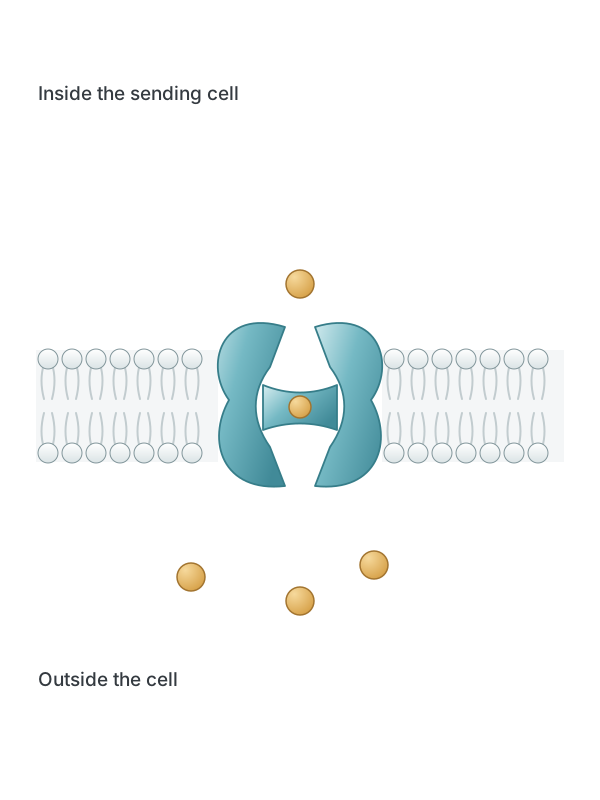
- Serotonin
The messenger is shown outside the sending cell.
- SERT
This transporter returns serotonin from outside into the sending cell.
- Return into the cell
The arrow shows transport direction, without a measured rate.
Simplified teaching model. Protein shapes, sizes, particle counts and arrows are illustrative, not measurements or experimental structures.
The SERT transporter returns serotonin from outside the nerve cell into the cell. This is a separate transport system.
About this illustration
Nerve-cell signal; Receptor or transporter; Network activity. Mood and repetitive thoughts or behaviours involve more than one chemical messenger.
This is a simplified illustration. It does not show exactly how a medicine fits into a protein or predict a dose or response to treatment.
How the Medication Changes Signaling
Fluvoxamine inhibits SERT, meaning it reduces the transporter’s activity and slows serotonin recycling. This is why it is described as a selective serotonin reuptake inhibitor, or SSRI. Its effects on communication are thought to contribute to improvements in mood or obsessive-compulsive symptoms: obsessions are unwanted, recurring thoughts or urges, while compulsions are repetitive actions or mental rituals a person feels driven to perform. The amount of transport inhibition does not directly measure an individual’s improvement.
What is known: Fluvoxamine inhibits serotonin reuptake.
What remains uncertain: Changes in transport cannot by themselves measure improvement in mood or compulsive symptoms.
Fluvoxamine and SERT
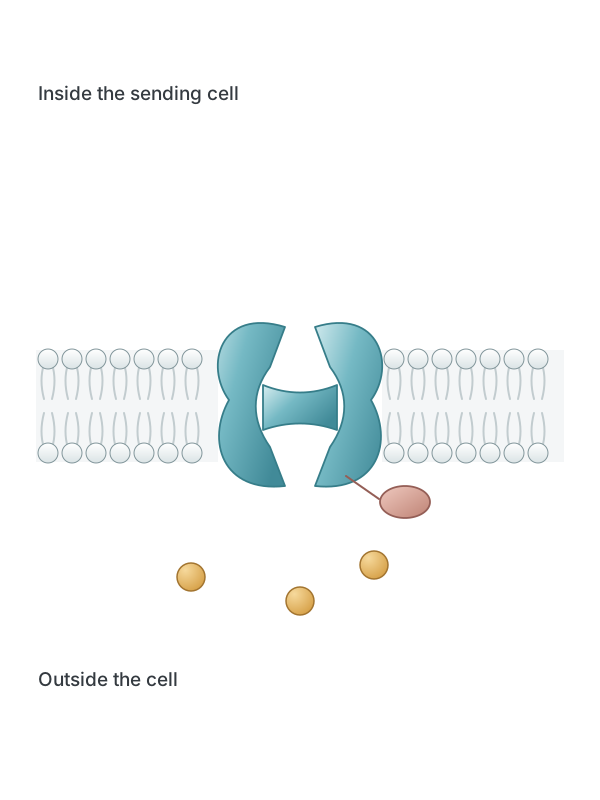
- Serotonin
The messenger is shown outside the sending cell.
- SERT
This transporter returns serotonin from outside into the sending cell.
- Fluvoxamine: uptake inhibited
The interrupted arrow names the action; the symbol is not a molecular shape or binding position.
Simplified teaching model. Protein shapes, sizes, particle counts and arrows are illustrative, not measurements or experimental structures.
Fluvoxamine inhibits neuronal serotonin reuptake. The precise link between this action and improvement in OCD is not established.
About this illustration
Fluvoxamine; Molecular actions; Clinical effects. Changes in transport cannot by themselves measure improvement in mood or compulsive symptoms.
This is a simplified illustration. It does not show exactly how a medicine fits into a protein or predict a dose or response to treatment.
How does it affect my body?
Nausea, sleep changes, restlessness and sexual effects can accompany treatment. Sexual symptoms sometimes persist after stopping.
How does my body process it?
It undergoes extensive liver metabolism. Repeated dosing gives a mean half-lifeThe time for a measured drug level to fall by halfThe time it takes for the concentration of a medicine in a body fluid, usually blood, to decrease by half during elimination.Read the full definition of Half-life around 17–22 hours; liver disease can reduce clearance.
How do treatment options differ?
Its enzyme inhibition makes the interaction profile distinct from other SSRIs; a shared class name does not imply interchangeability.
A closer look at the science
ReceptorReceptorA protein that recognizes a signal and helps a cell respond. Different receptor types can produce different responses to the same messenger.Read the full definition of Receptor-binding studies show little direct binding at the major muscarinic, histamine, adrenergic and dopamineDopamineA chemical messenger involved in movement, learning and emotion. Its name does not describe one feeling or one role throughout the brain.Read the full definition of Dopamine receptors assessed in the SmPC.
Fluvoxamine is an E-configured oxime compound supplied as a 1:1 maleate salt.
Chemical formula: C15H21F3N2O2 · C4H4O4
The verified image depicts neutral fluvoxamine, C15H21F3N2O2. Maleic acid is identified separately; the drawing does not show tablet or capsule release.
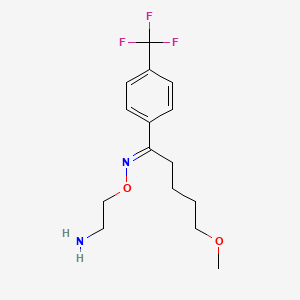
The drawing shows the neutral parent. The product salt formula is separately identified; neither determines release rate or dose.
How was this medicine developed?
The Faverin 50 mg record lists June 2009 as its authorisation date. This is a product-record date, not the drug’s discovery.
Sources and References
- Faverin 50 mg Film-coated Tablets: UK SmPC — mechanism explanation
Product information published on the electronic Medicines Compendium (emc); supplied by pharmaceutical companies.
Scope: Mechanism explanation only. Source sections checked: 4.1 Therapeutic indications; 4.5 Interactions; 5.1 Pharmacodynamic properties; 5.2 Pharmacokinetic properties, Metabolism..
- Faverin 100 mg — UK SmPC
Product information published on the electronic Medicines Compendium (emc); supplied by pharmaceutical companies.
Scope: United Kingdom product information.
- Faverin 50 and 100 mg — patient leaflet
Product information published on the electronic Medicines Compendium (emc); supplied by pharmaceutical companies.
Scope: United Kingdom product information.
- Antidepressants: use and safety
Scope: United Kingdom.
- Fluvoxamine maleate tablets prescribing information — mechanism explanation
Scope: Mechanism explanation only. Source sections checked: 1 Indications and Usage; 7.1 Potential Interactions with Drugs that Inhibit or are Metabolized by Cytochrome P450 Isoenzymes; 12.1 Mechanism of Action; 12.2 Pharmacodynamics; 12.3 Pharmacokinetics..
- What Is a Neurotransmitter? — mechanism explanation
Scope: Mechanism explanation only. Source sections checked: How Neurotransmitters Work; Types of Neurotransmitters..
- Fluvoxamine ER: current prescribing information
Scope: Shared scientific explanation; source remains US, not UK prescribing authority.
- A qualitative investigation into the effects of akathisia - Health Research Authority
- Extrapyramidal side effects- Management
- Anxiety and panic attacks - NHS
- Agitation: MedlinePlus Medical Encyclopedia
Shared scientific background. US product pharmacology and chemical references do not establish UK licences, doses, formulations or NHS recommendations.
Article Information
- Edition
- United Kingdom
- Content updated
- 2026-10-24
- Source check dates
- Listed with each reference above; retained dates for shared scientific content.
- Scope
- exact products checked
Source and coverage limits
- Educational summaries cover the named UK products, not every formulation or prescribing circumstance.
- Listings do not guarantee local stock or NHS access.
- UK product warnings are not US FDA boxed-warning designations.
- SmPC wording “over 8 years” and PIL wording “8 years and older” are retained as an explicit age-wording nuance.
- No UK modified-release formulation was verified.