
About this medicine
The primary record here is Blackrock’s 10 mg tablet. Another checked UK SmPC also names Parnate; neither listing guarantees current branded stock.
This is a regular specialist antidepressant treatment, not an immediate calming medicine. A workable plan includes checking every new medicine and following the food restrictions after treatment ends as well as during treatment. The practical burden of those precautions is part of deciding whether it is suitable.
What is this medicine used for?
Blackrock’s licence covers adult major depressive episodes after other antidepressant types have failed. It is not indicated below 18.
Which warning signs need help?
Get emergency help for severe headache, neck stiffness, chest pain or palpitations. Avoid the leaflet’s tyramine/dopa-rich foods during treatment and for two weeks afterwards, including mature cheese, yeast/meat extracts, fermented or spoiled protein foods, broad-bean pods and alcoholic/non-alcoholic beer or wine. Follow the full diet sheet.
New self-harm thoughts, seizures, severe confusion or suspected overdose also need immediate assessment.
MHRA’s October 2026 communication announced the rollout of a prominent boxed warning in UK antidepressant patient leaflets about self-harm and suicidal behaviour, alongside a patient safety card. This UK patient-information measure is not the US FDA Boxed Warning designation. Read the leaflet supplied with your medicine, seek prompt professional help for new or worsening mood or behaviour changes, and do not stop treatment suddenly without advice.
A severe headache during treatment should not simply be treated with an over-the-counter cold or pain remedy while waiting: dangerously high blood pressure is one possibility. The leaflet also calls for prompt review of jaundice, unusual bruising, fever with sore throat, or new hallucinationsHallucinationsA hallucination is a sensory experience without a corresponding external source—for example, hearing a voice when nobody is speaking. It can involve hearing, sight, touch, smell or taste and may feel very real.A hallucination is an experience; a delusion is a belief. Hallucinations can have different causes, so an assessment is needed to understand them. or marked overactivity.
How do I take it safely?
Adult product reference: 10 mg morning and afternoon; an extra 10 mg at midday may be prescribed after a week. Doses above 30 mg daily need particular caution. Older people require slower increases and lower doses. Do not adjust treatment yourself.
The Blackrock leaflet advises taking the afternoon dose before 3 pm, reflecting the possibility of disturbed sleep. Swallow the tablets whole. The dose may be reduced once benefit is established; adding tablets because an early response is incomplete is unsafe. UK tablet instructions must not be replaced with the higher starting or maximum doses in an American Parnate label.
What side effects should I know about?
Insomnia, dizziness, dry mouth, nausea, tiredness and postural light-headedness are recognised.
Who needs extra care with this medicine?
Liver disease, phaeochromocytoma, hyperthyroidism, certain blood disorders and severe cardiovascular or cerebrovascular disease are contraindicationsA medical reason a medicine should not be usedA medical reason a medicine should not be used in a particular situation because it may be harmful.Read the full definition of Contraindication.
Porphyria is another listed contraindication. Kidney impairment, epilepsy and a history of alcohol or drug dependence need particular assessment. Tell surgical and dental teams early: the UK leaflet describes a planned reduction and stopping at least two weeks before procedures when the anaesthetic requires it. Do not organise that withdrawalWithdrawalSymptoms that may occur after reducing or stopping a medicine or substance to which the body has adapted.Read the full definition of Withdrawal yourself.
Can it affect my other medicines?
The Blackrock leaflet excludes use within five weeks of fluoxetine, two weeks of other SSRIs or MAOIs, and three weeks of tricyclic/tetracyclic antidepressants. Pethidine, nefopam, dextromethorphan and decongestants can be dangerous. A specialist must determine the complete switch; these examples are not a protocol.
Examples involving cough remedies, decongestants and painkillers illustrate why non-prescription products matter. A pharmacist needs the actual ingredient, not only a brand name. Tranylcypromine can also interact with diabetes treatment and sedating antihistamines; a medicine sold without a prescription is not automatically safe alongside an MAOI.
What check-ups will I need?
Review blood pressure, standing dizziness, sleep, mood and medicine/food interactions. Inform the anaesthetist before planned procedures.
Monitor both high-pressure symptoms and dizziness on standing, which have different significance. Follow mood, sleep, daily functioning and any increase in the urge to take more medicine. Make sure the person can obtain and understand the current diet and interaction advice throughout treatment.
What about pregnancy, breastfeeding and age?
Pregnancy use is reserved for situations considered essential. Breastfeeding requires a decision about stopping nursing or treatment; older people need closer blood-pressure monitoring.
What if I miss a dose or want to stop?
Skip forgotten doses and never double up. Stopping is gradual under supervision; dietary restrictions continue for two weeks afterwards.
Abrupt stopping can cause nausea, vomiting, sweating and insomnia. The prescriber plans a reduction and the subsequent drug-free interval if another antidepressant is needed. Enzyme inhibition persists after the last tablet; neither feeling well nor a short blood half-lifeThe time for a measured drug level to fall by halfThe time it takes for the concentration of a medicine in a body fluid, usually blood, to decrease by half during elimination.Read the full definition of Half-life makes an early switch safe.
How does it work?
Tranylcypromine changes nerve-cell communication by reducing the breakdown of a group of chemical messengers called monoamines. It does this by inhibiting monoamine oxidase, an enzyme that helps process these chemicals. This is the proposed basis of its antidepressant action, although the full sequence leading to symptom improvement is not completely understood.
How does it affect my body?
Tyramine can accumulate and sharply increase blood pressure. Postural dizziness and disturbed sleep can occur separately.
How does my body process it?
The plasma half-life is about two hours, but enzyme inhibition persists much longer. Rapid blood clearance does not make another medicine safe immediately.
How do treatment options differ?
UK product doses differ from other MAOI regimens. SPS advises specialist support for switching and warns against many overlapping antidepressant combinations.
A closer look at the science
This non-hydrazine medicine irreversibly inhibits both MAO-A and MAO-B. It therefore differs structurally from phenelzine while sharing important interaction hazards.
Tranylcypromine is a non-hydrazine trans-phenylcyclopropylamine supplied as a sulfate salt.
Chemical formula: (C9H11N)2 · H2SO4
The product is racemic trans-tranylcypromine sulfate with two parent molecules per sulfate. The neutral-parent drawing, C9H11N, does not show the salt or specify a single-enantiomer product.
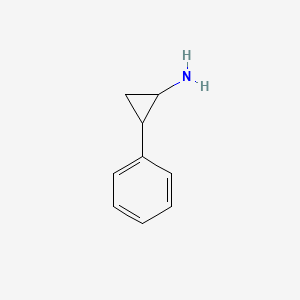
The drawing shows the neutral parent. The product salt formula is separately identified; neither determines release rate or dose.
How was this medicine developed?
The Blackrock record dates from February 2026; the separately checked Mercury/Parnate record dates from October 2005. These are product records, not discovery dates.
Sources and References
- Tranylcypromine 10 mg — UK SmPC
Product information published on the electronic Medicines Compendium (emc); supplied by pharmaceutical companies.
Scope: United Kingdom product information.
- Parnate / Tranylcypromine 10 mg — UK SmPC
Product information published on the electronic Medicines Compendium (emc); supplied by pharmaceutical companies.
Scope: United Kingdom product information.
- Tranylcypromine 10 mg — patient leaflet
Product information published on the electronic Medicines Compendium (emc); supplied by pharmaceutical companies.
Scope: United Kingdom product information.
- NHS SPS: MAOI to other antidepressants, switching in adults
Scope: NHS Specialist Pharmacy Service — professional medicines advice; individual and local implementation.
- Antidepressants: use and safety
Scope: United Kingdom.
- Parnate prescribing information — mechanism explanation
Scope: Mechanism explanation only. Source sections checked: 5.9 Persistence of MAO Inhibition after Discontinuation; 7.2 Tyramine-Containing Foods and Beverages; 12.1 Mechanism of Action; 12.2 Pharmacodynamics..
- What Is a Neurotransmitter? — mechanism explanation
Scope: Mechanism explanation only. Source sections checked: How Neurotransmitters Work; Types of Neurotransmitters..
- Schizophrenia
- NIMH: Understanding psychosis
Shared scientific background. US product pharmacology and international chemical records support molecular explanations only; UK product details and prescribing information are verified separately.
Article Information
- Edition
- United Kingdom
- Content updated
- 2026-10-24
- Source check dates
- Listed with each reference above; retained dates for shared scientific content.
- Scope
- exact products checked
Source and coverage limits
- Educational summaries cover the named UK products, not every formulation or prescribing circumstance.
- Listings do not guarantee local stock or NHS access.
- UK product warnings are not US FDA boxed-warning designations.
- Blackrock SmPC 4.5 contains apparent wording “5 weeks after starting Fluoxetine”; its PIL clearly excludes use if fluoxetine was taken within the last five weeks. The PIL wording is used; no erroneous starting-based interval is reproduced as advice.
- Blackrock SmPC and PIL differ in some TCA and MAOI intervals; the more restrictive PIL examples are identified and no personal switching algorithm is offered.
- The full product food list is required; this summary gives examples only.
- Parnate is a name within a checked UK SmPC; branded pack supply has not been confirmed.