
What should I know first?
Amfetamines affect dopamineDopamineA chemical messenger involved in movement, learning and emotion. Its name does not describe one feeling or one role throughout the brain.Read the full definition of Dopamine and noradrenaline signalling through both reuptake and release. Amphetamine is another spelling of the class name. Dexamfetamine is the active substance produced from lisdexamfetamine, the prodrug in UK Elvanse.
The UK lesson uses the Elvanse mechanism record and experimental comparisons, not an American Adderall XR licence. Mixed amfetamine salts, dexamfetamine and lisdexamfetamine are not interchangeable names for the same formulation.
This is a mechanism lesson, not a complete medicine guide. A diagram cannot choose treatment, predict your response, or tell you how to change a prescription.
How Brain Cells Communicate
A nerve ending stores messengers in small packets called vesiclesVesicleA tiny membrane-bound pouch inside a cell. At many nerve endings, vesicles hold chemical messengers until they are released.Read the full definition of Vesicle. Releasing a messenger into the space outside a cell and returning it through a transporterTransporterA protein that moves a substance across a cell membrane. Some transporters help remove released chemical messengers from the space around nerve cells.Read the full definition of Transporter are different processes.
Dopamine · DAT
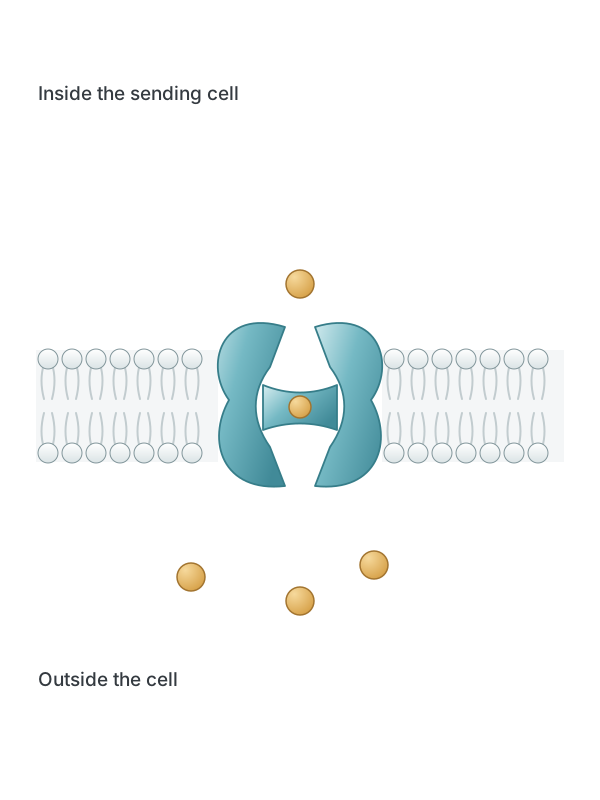
- Dopamine
The messenger is shown outside the sending cell.
- DAT
The DAT transporter returns dopamine into the cell.
- Return into the cell
The arrow shows transport direction, without a measured rate.
Simplified teaching model. Protein shapes, sizes, particle counts and arrows are illustrative, not measurements or experimental structures.
Norepinephrine · NET
- Norepinephrine
The messenger is shown outside the sending cell.
- NET
The NET transporter returns norepinephrine into the cell.
- Return into the cell
The arrow shows transport direction, without a measured rate.
Simplified teaching model. Protein shapes, sizes, particle counts and arrows are illustrative, not measurements or experimental structures.
About this illustration
Messenger return runs from outside toward the nerve cell. This is distinct from release from inside to outside.
How the Medication Changes Signalling
Amphetamine pharmacology includes inhibition of dopamine and noradrenaline reuptake and increased release of these messengers outside nerve cellsNeuronA nerve cell that receives and sends information. Neurons work in connected groups, rather than carrying a whole thought on their own.Read the full definition of Neuron. The outward arrow in the release panel represents the latter effect; it is not the same inward reuptake arrow.
Experiments comparing amphetamine isomers with methylphenidate found different effects on storage and release. The exact effects vary with the preparation and measurement. No universal release rate is shown.
A Closer Look at the Molecular Level
The UK Elvanse information describes inhibition of monoamine reuptake and increased release by its active dexamfetamine. Lisdexamfetamine itself is a prodrug: conversion, mainly in red blood cells, precedes this activity.
The full therapeutic pathway in ADHD remains uncertain. The illustrated target actions cannot rank stimulant medicines, predict an individual’s response, or equate immediate-release, modified-release and prodrug products.
Sources and References
- Elvanse 30 mg capsules: UK SmPC
Product information published on the electronic Medicines Compendium (emc); supplied by pharmaceutical companies.
Scope: United Kingdom.
- What Is a Neurotransmitter?
Scope: International scientific education; not UK regulatory evidence.
- Easton and colleagues: comparison of stimulant effects in rat preparations
Scope: International laboratory research.
Article Information
- Edition
- United Kingdom
- Content updated
- 2026-10-17
- Sources checked
- Listed with each reference above; retained dates for shared scientific content.
- Publication status
- Published
- Scope
- How this medicine works, with UK product information.
Source and coverage limits
- A mechanism lesson is not a complete medicine profile, dosing schedule or individual treatment recommendation.
- Original qualitative SVG diagrams explain direction and target type; they do not measure biological rates, binding geometry or clinical response.