
About this medicine
Zolpidem is a sleeping medicine intended for brief treatment. Persistent insomnia still needs assessment of its causes and a broader plan for sleep.
The aim is brief relief while the reasons for insomnia are addressed. Failure to improve after 7–14 days should prompt reassessment for another physical or mental health problem. Zolpidem is not a treatment for the underlying cause of every sleep difficulty.
What is this medicine used for?
The checked products license short-term severe adult insomnia. Treatment usually should not exceed four weeks including withdrawalWithdrawalSymptoms that may occur after reducing or stopping a medicine or substance to which the body has adapted.Read the full definition of Withdrawal. The licence does not establish routine suitability for chronic nightly use.
Which warning signs need help?
If sleepwalking, driving, eating or other activities occur without full awareness, stop zolpidem and contact the prescriber promptly. Alcohol and other sedatives increase risk. Abnormal breathing or inability to wake requires emergency help: 999 in the UK, local emergency services elsewhere.
Complex sleep behaviours can lead to injury and require stopping the medicine and prompt prescriber contact, not merely reducing the dose unaided. Severe allergy, breathing difficulty or an overdose needs urgent medical assessment. There is no safe home test that excludes toxicity after excess tablets.
How do I take it safely?
The adult label specifies a single dose immediately before bed, no more than 10 mg in 24 hours. Older or debilitated people usually receive 5 mg. Allow at least eight hours before activities needing alertness, and never re-dose the same night.
The dissolving Zalzo tablet is placed on the tongue and swallowed after it disintegrates; it is not a separate middle-of-the-night rescue formulation. Neither the UK immediate-release tablet nor Zalzo should inherit American Ambien CR strengths or sex-specific starting rules. Liver impairment usually calls for a lower starting dose; severe impairment is a contraindicationA medical reason a medicine should not be usedA medical reason a medicine should not be used in a particular situation because it may be harmful.Read the full definition of Contraindication.
What side effects should I know about?
Sleepiness, dizziness, headache, nausea and memory difficulties are recognised. HallucinationsHallucinationsA hallucination is a sensory experience without a corresponding external source—for example, hearing a voice when nobody is speaking. It can involve hearing, sight, touch, smell or taste and may feel very real.A hallucination is an experience; a delusion is a belief. Hallucinations can have different causes, so an assessment is needed to understand them., worsening mood or unusual behaviour warrant review.
Who needs extra care with this medicine?
The checked label excludes obstructive sleep apnoea, myasthenia gravis, severe liver impairment and acute or severe respiratory depressionRespiratory depressionRespiratory depression means breathing becomes too slow, shallow or ineffective. It is a breathing problem, not depression of mood. Opioids and some sedating medicines can cause it, with greater risk when combined with other sedatives or alcohol.Very slow or difficult breathing, unusual severe sleepiness, or being unable to wake someone requires emergency medical help immediately.. Previous substance-use difficulties require careful review.
Can it affect my other medicines?
Opioids and other sedatives can dangerously intensify effects. Medicines that inhibit or induce CYP3A4 can change exposure. Tell the clinician about supplements, including St John’s wort.
The UK leaflet advises against combinations with fluvoxamine, ciprofloxacin or St John’s wort. Sedating antihistamines, antidepressants and other sleeping medicines can add to impairment. Avoid alcohol. An interaction that lowers the apparent sleep effect is not permission to take an extra dose.
What check-ups will I need?
Review insomnia, daytime function, unusual sleep behaviour and continuing need. Dependence and tolerance deserve regular discussion even when treatment follows the prescription.
MHRA’s 2026 warning emphasises that dependence, addiction, tolerance and withdrawal can occur even with prescribed short-term treatment. Review escalating use, craving, reduced effect and daytime safety, as well as hours slept. This is a reason for support and reassessment, not an assumption that every patient misuses treatment.
What about pregnancy, breastfeeding and age?
The checked products are not recommended below 18 years. Pregnancy and breastfeeding need advice; late-pregnancy exposure can affect newborn breathing and adaptation.
The checked leaflet advises against use in pregnancy and breastfeeding. Late exposure can cause newborn low muscle tone, feeding or breathing difficulty and withdrawal. Pregnancy or plans to breastfeed should trigger a timely treatment review; a US express-and-discard interval should not be imported as a UK recommendation.
What if I miss a dose or want to stop?
Skip a forgotten bedtime dose rather than taking it later at night. Do not double. Regular use should end with an individual reduction plan because rebound insomnia and withdrawal can occur.
The ending plan should be agreed when treatment starts. Rebound insomnia, anxiety and physical withdrawal can occur, and some people need a slower reduction than expected. Physical dependence is not synonymous with addiction, but both deserve non-judgemental support. Do not add alcohol or another sedative to manage withdrawal.
How does it work?
Zolpidem strengthens the response to GABA, a chemical messenger that reduces activity in many brain cells. This can help bring on sleep, while also affecting memory, coordination and alertness. The same medicine can continue to affect those functions after a person has woken.
How Brain Cells Communicate
Nerve cells pass messages across small gaps called synapses. When GABA reaches a receiving protein called a GABA-A receptor, it opens a channel that lets electrically charged particles move through the cell’s outer membrane. This usually makes the cell less likely to send an electrical signal of its own. The term inhibition describes this restraint on activity, which is important in both sleeping and waking brain networks.
What is known: GABA-A receptors connect a chemical message with a change in a cell’s electrical behavior.
What remains uncertain: Difficulty sleeping does not establish a deficiency at one receptor type.
GABA-A signaling
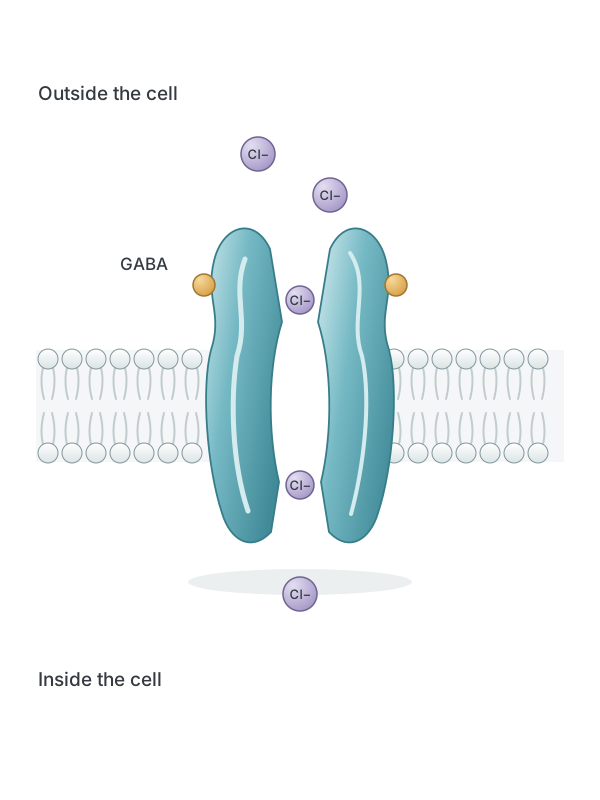
Optional motion shows inward ion movement in this example. Counts and timing are illustrative.
- Chloride · Cl−
Inward movement is a typical mature-cell example; ion gradients can differ.
- GABA-A receptor / channel
GABA activates this ion channel.
- Open channel
The arrow shows a qualitative direction, not an ion count or measured rate.
Simplified teaching model. Protein shapes, sizes, particle counts and arrows are illustrative, not measurements or experimental structures.
GABA acts at GABA-A receptor channels. Inward chloride movement is a typical mature-cell example; the effect depends on the cell and ion gradients.
About this illustration
GABA signaling; Receptor complex; Neural inhibition. Difficulty sleeping does not establish a deficiency at one receptor type.
This is a simplified illustration. It does not show exactly how a medicine fits into a protein or predict a dose or response to treatment.
How the Medication Changes Signalling
Zolpidem attaches at a benzodiazepine-sensitive site on the GABA-A receptor and makes the response to GABA stronger. The label links its action mainly to receptors containing a protein component called the alpha-1 subunit. In the presence of GABA, the channel opens more frequently and inhibition increases. Zolpidem has a different chemical structure from benzodiazepines, even though part of its receptor action overlaps with theirs.
What is known: Zolpidem enhances an existing GABA signal rather than providing a new messenger.
What remains uncertain: The exact contribution of each receptor subtype to a person’s sleep response is not established.
Zolpidem and GABA-A
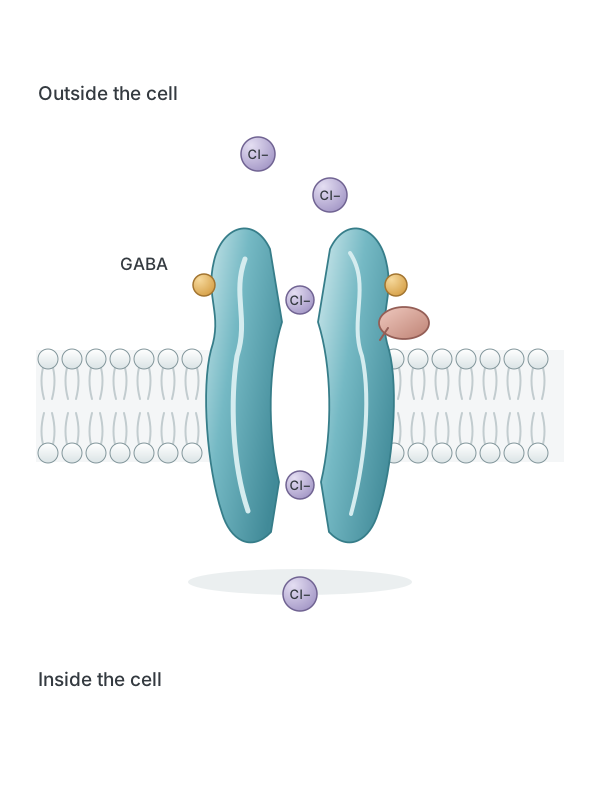
- Chloride · Cl−
Inward movement is a typical mature-cell example; ion gradients can differ.
- GABA-A receptor / channel
GABA activates this ion channel.
- Zolpidem: GABA response enhanced
The medicine symbol labels an action, not an experimentally determined binding position.
Simplified teaching model. Protein shapes, sizes, particle counts and arrows are illustrative, not measurements or experimental structures.
Zolpidem preferentially binds benzodiazepine sites on alpha-1-containing GABA-A receptors and enhances inhibitory signaling. It is chemically distinct from benzodiazepines.
About this illustration
Zolpidem; GABA-related action; Sleep and sedation. The exact contribution of each receptor subtype to a person’s sleep response is not established.
This is a simplified illustration. It does not show exactly how a medicine fits into a protein or predict a dose or response to treatment.
How does it affect my body?
Sleepiness may begin within about half an hour. Some people remain sleepy the next day. Never drive or use dangerous machinery while alertness, concentration or coordination is impaired.
Memory gaps and impaired coordination are relevant even after a person has woken. Leaving eight hours before driving reduces a recognised risk but does not guarantee fitness to drive. Older people are especially vulnerable to falls and injury.
How does my body process it?
The liver metabolises zolpidem, chiefly through CYP3A4. Its average half-lifeThe time for a measured drug level to fall by halfThe time it takes for the concentration of a medicine in a body fluid, usually blood, to decrease by half during elimination.Read the full definition of Half-life is around 2.4 hours, but exposure rises in older people and liver impairment; a short half-life does not guarantee next-morning safety.
How do treatment options differ?
Its related sedative mechanism does not make zolpidem interchangeable with benzodiazepines. UK immediate-release and dissolving products should not inherit US Ambien CR dosing instructions.
A closer look at the science
Chemically it is an imidazopyridine. It preferentially modulates GABA-A receptorsReceptorA protein that recognizes a signal and helps a cell respond. Different receptor types can produce different responses to the same messenger.Read the full definition of Receptor containing an alpha-1 subunit, influencing chloride-channel activity; its receptor profile differs from broader benzodiazepine binding.
Zolpidem is an imidazopyridine compound supplied as zolpidem tartrate. Its structure differs from benzodiazepines despite activity at a related receptor site.
Chemical formula: (C19H21N3O)2 · C4H6O6
Zolpidem tartrate contains two zolpidem molecules with a tartrate component. The image shows only neutral zolpidem, C19H21N3O. Salt composition does not show a tablet’s release design.
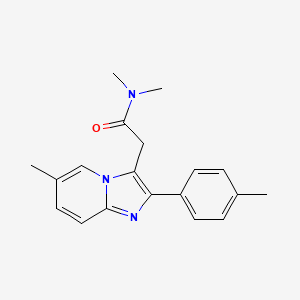
The drawing shows the neutral parent. The product salt formula is separately identified; neither determines release rate or dose.
How was this medicine developed?
Ambien and Ambien CR are retained as existing US search aliases. Zalzo identifies the verified UK dissolving formulation; this is a product distinction, not evidence of local stock.
Sources and References
- NHS: common questions about zolpidem
Scope: NHS website for England — general medicine education, not a four-nation service pathway.
- Zolpidem tartrate 10 mg tablets — SmPC, sections 4.1–4.9, 5.1–5.2 and 7–10
Product information published on the electronic Medicines Compendium (emc); supplied by pharmaceutical companies.
Scope: United Kingdom product information.
- Zalzo 5 mg orodispersible tablets — SmPC, sections 4.1–4.9, 5.1–5.2 and 7–10
Product information published on the electronic Medicines Compendium (emc); supplied by pharmaceutical companies.
Scope: United Kingdom product information.
- Zolpidem 5 mg and 10 mg tablets — patient leaflet, sections 1–4 and 6
Product information published on the electronic Medicines Compendium (emc); supplied by pharmaceutical companies.
Scope: United Kingdom product information.
- Strengthened information on dependence, addiction, withdrawal and tolerance — benzodiazepines, Z-drugs and gabapentinoids
Scope: United Kingdom.
- Ambien: current prescribing information
Scope: United States scientific pharmacology only; not UK prescribing evidence.
- Zolpidem: MedlinePlus Drug Information — mechanism explanation
Scope: Mechanism explanation only. Source sections checked: How should this medicine be used?; What special precautions should I follow?..
- Schizophrenia
- NIMH: Understanding psychosis
- All Opioid Pain Medicines: Drug Safety Communication - FDA Updates Prescribing Information to Provide Additional Guidance for Safe Use | FDA
- New Safety Measures Announced for Opioid Analgesics, Prescription Opioid Cough Products, and Benzodiazepines | FDA
Shared scientific background. US product pharmacology and international chemical records support molecular explanations only; UK product details and prescribing information are verified separately.
Article Information
- Edition
- United Kingdom
- Content updated
- 2026-10-24
- Source check dates
- Listed with each reference above; retained dates for shared scientific content.
- Scope
- exact products checked
Source and coverage limits
- Product information establishes the checked product and label, not current pharmacy stock or local NHS funding.
- This is a selected-product educational record, not an exhaustive inventory of UK brands, presentations or specialist protocols.
- Ambien and Ambien CR are cross-edition aliases, not asserted UK products.
- The 2026 MHRA warning is used for dependence risk rather than older NHS wording suggesting very low short-term risk.