
About this medicine
Lunivia is a prescription treatment for severe, disabling or very distressing insomnia in adults. Assessment should also look for physical illness, depression, other medicines and sleep habits contributing to sleeplessness.
What is this medicine used for?
The UK indication is adult insomnia, usually for short periods. The licence is not a treatment recommendation for every person with poor sleep and does not establish local NHS funding.
Which warning signs need help?
Sleep-walking, sleep-driving or other activities without awareness need urgent clinical review and no further dose until advised. Slow breathing, severe allergy or overdose need emergency assessment. Avoid driving or hazardous tasks particularly within 12 hours after a dose.
New hallucinationsHallucinationsA hallucination is a sensory experience without a corresponding external source—for example, hearing a voice when nobody is speaking. It can involve hearing, sight, touch, smell or taste and may feel very real.A hallucination is an experience; a delusion is a belief. Hallucinations can have different causes, so an assessment is needed to understand them., marked behavioural change or worsening depression need prompt clinical review. Seek urgent help for self-harm thoughts or immediate danger; a sleeping medicine does not treat the underlying depression.
How do I take it safely?
The adult reference starting dose is 1 mg at bedtime; clinicians may increase it to a maximum 3 mg. Usually treatment, including tapering, is no longer than four weeks; extension needs reassessment. The maximum for older adults is 2 mg.
Plan a full night's sleep; take only one dose at bedtime. Selected chronic-insomnia treatment can extend to six months only with repeated benefit–risk review, not automatic repeats. A higher tablet strength does not itself justify longer treatment.
The UK product ceiling is also 2 mg in severe kidney impairment; severe liver insufficiency is a contraindicationA medical reason a medicine should not be usedA medical reason a medicine should not be used in a particular situation because it may be harmful.Read the full definition of Contraindication, not a reason to reuse the US liver-disease dose rule. Dose selection needs the actual UK product information and clinical review.
What side effects should I know about?
An unpleasant taste is particularly recognised. Headache, dizziness, dry mouth, nausea and sleepiness can also occur. Report persistent symptoms instead of increasing the dose yourself.
Who needs extra care with this medicine?
The product excludes severe sleep apnoea, severe respiratory or liver failure, myasthenia gravis and previous complex sleep behaviour with hypnotics. Depression and substance-use history require careful assessment.
Can it affect my other medicines?
Alcohol, opioids and other sedatives can dangerously compound sedation and breathing suppression. Strong CYP3A4 inhibitors increase exposure; in older adults that combination is contraindicated.
For other adults taking a potent CYP3A4 inhibitor, the ceiling is 2 mg. An inhibitor raises exposure while an inducer may lower it; starting or stopping another medicine calls for review rather than guessing a replacement dose.
What check-ups will I need?
Review benefit, next-day functioning, unusual night-time behaviours and continuing need. Agree a stopping strategy before starting; lack of improvement after 7–14 days warrants reassessment of the cause.
What about pregnancy, breastfeeding and age?
It is not for under-18s. Pregnancy is not recommended and the product should not be used while breastfeeding. Discuss pregnancy plans and any accidental exposure with the prescriber.
What if I miss a dose or want to stop?
Do not take an extra dose later in the same night. Dependence and withdrawal can develop; agree an individual reduction plan rather than abruptly stopping regular treatment.
How does it work?
Eszopiclone’s sleep-promoting effect is thought to involve GABA, a chemical messenger that helps restrain nerve-cell activity. It acts at receiving structures associated with this messenger, although the precise steps that produce sleep are not fully understood. Its effects can include both sleepiness and reduced alertness after waking.
How Brain Cells Communicate
Brain cells use chemical messages to influence whether neighboring cells send electrical signals. GABA is one of the main inhibitory messengers, meaning it generally makes further activity less likely. It acts through receptor complexes, groups of proteins that receive the message and change the cell’s response. These connections participate in sleep as well as memory, movement and attention.
What is known: Inhibitory signaling is a normal part of how brain networks regulate activity.
What remains uncertain: Insomnia does not point to a single faulty GABA receptor or a measurable shortage of GABA.
GABA-A signaling
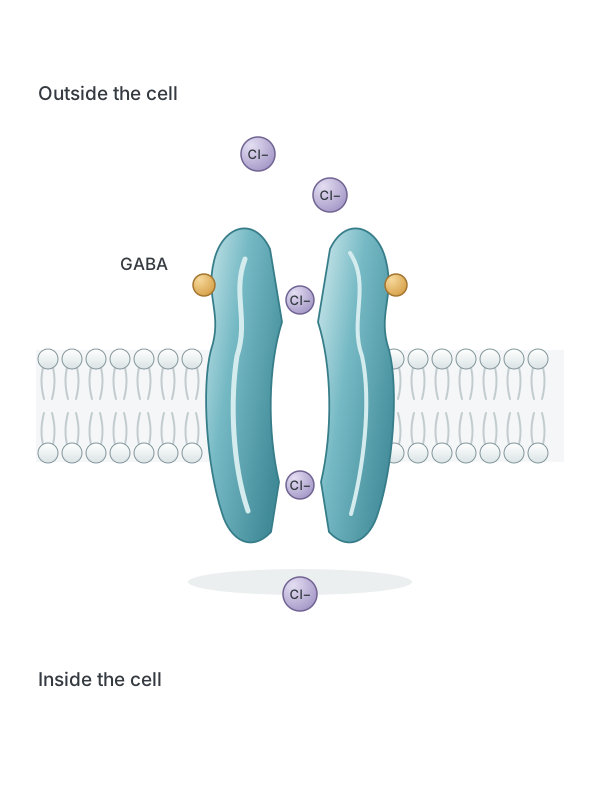
Optional motion shows inward ion movement in this example. Counts and timing are illustrative.
- Chloride · Cl−
Inward movement is a typical mature-cell example; ion gradients can differ.
- GABA-A receptor / channel
GABA activates this ion channel.
- Open channel
The arrow shows a qualitative direction, not an ion count or measured rate.
Simplified teaching model. Protein shapes, sizes, particle counts and arrows are illustrative, not measurements or experimental structures.
GABA-A receptor complexes participate in inhibitory signaling. The chloride direction shown is an illustrative mature-cell example, not a rule for every cell.
About this illustration
GABA signaling; Receptor complex; Neural inhibition. Insomnia does not point to a single faulty GABA receptor or a measurable shortage of GABA.
This is a simplified illustration. It does not show exactly how a medicine fits into a protein or predict a dose or response to treatment.
How does it affect my body?
Reduced alertness can persist into the following day. Memory disturbance, falls and impaired coordination matter especially in older people; sufficient time in bed does not guarantee safe driving.
How does my body process it?
CYP3A4 and CYP2E1 participate in metabolism. Age, severe kidney impairment, liver disease and enzyme-inhibiting medicines can alter exposure, so the same tablet strength is not appropriate for everybody.
How do treatment options differ?
Lunivia is not a milligram-for-milligram replacement for zopiclone. Similar-sounding names and shared sedative actions do not establish identical dosing or interchangeability.
A closer look at the science
Eszopiclone is a cyclopyrrolone, chemically different from benzodiazepines. Its effects are thought to involve GABA-A receptorReceptorA protein that recognizes a signal and helps a cell respond. Different receptor types can produce different responses to the same messenger.Read the full definition of Receptor complexes; the precise mechanism is not completely established.
Eszopiclone is the S-enantiomer of zopiclone, a cyclopyrrolone-class compound with a single chiral center.
Chemical formula: C17H17ClN6O3
The formula describes the parent compound. The stereochemical bond in the verified structure indicates its S configuration; racemic zopiclone is a different composition and is not an interchangeable name.
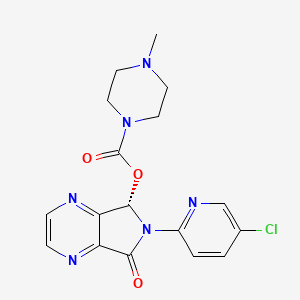
The structure does not establish receptor occupancy, dose equivalence or individual response.
How was this medicine developed?
The 2009 Lunivia centralised European application was withdrawn. Current UK product records checked in 2026 are separate evidence; that old event must not be used to label today's UK product unavailable.
Sources and References
- Lunivia 1 mg film-coated tablets: UK SmPC
Product information published on the electronic Medicines Compendium (emc); supplied by pharmaceutical companies.
Scope: United Kingdom.
- Lunivia 3 mg film-coated tablets: UK SmPC
Product information published on the electronic Medicines Compendium (emc); supplied by pharmaceutical companies.
Scope: United Kingdom.
- Lunivia: patient leaflet
Product information published on the electronic Medicines Compendium (emc); supplied by pharmaceutical companies.
Scope: United Kingdom.
- Lunivia: withdrawn application
Scope: European Union, historical.
- Lunivia 2 mg film-coated tablets: UK SmPC
Product information published on the electronic Medicines Compendium (emc); supplied by pharmaceutical companies.
Scope: United Kingdom.
- Eszopiclone — UK product-information inventory
Product information published on the electronic Medicines Compendium (emc); supplied by pharmaceutical companies.
Scope: United Kingdom.
- Lunesta: current prescribing information
Scope: Shared science only; original source jurisdiction retained in title/publisher.
- Eszopiclone: MedlinePlus Drug Information — mechanism explanation
Scope: Mechanism explanation only. Source sections checked: Why is this medication prescribed?; What special precautions should I follow?..
- Schizophrenia
- NIMH: Understanding psychosis
Shared scientific background. US product pharmacology and international chemical references do not establish UK licences, doses, formulations or NHS recommendations.
Article Information
- Edition
- United Kingdom
- Content updated
- 2026-10-24
- Source check dates
- Listed with each reference above; retained dates for shared scientific content.
- Scope
- UK Lunivia 1 mg, 2 mg and 3 mg film-coated tablets for adult insomnia; educational product overview with retained shared mechanism and molecular science
Source and coverage limits
- UK SmPC warnings are not assigned the FDA boxed-warning designation.
- All three currently listed Lunivia tablet strengths have product provenance. This is not a stock feed, exhaustive manufacturer directory or individual specialist prescribing protocol.