
About this medicine
Ketamine is a dissociative anaesthetic used in medical procedures. Ketalar is a brand of ketamine hydrochloride injection. The UK Ketalar licence covers anaesthetic uses, not depression. Specialist use for a psychiatric condition is off-label: outside the authorised indications of that product.
Racemic ketamine contains equal amounts of two mirror-image forms, R-ketamine (arketamine) and S-ketamine (esketamine). Spravato contains esketamine alone and has a separate nasal formulation and depression licence. Neither the chemical relationship nor an anaesthetic licence makes the products interchangeable.
This article covers licensed injectable Ketalar and the evidence and limitations of specialist psychiatric ketamine treatment. It does not provide instructions for self-administration. A private clinic offering a treatment does not, by itself, establish a licence for that use or NHS funding.
What is this medicine used for?
Licensed Ketalar uses include anaesthesia for suitable diagnostic or surgical procedures, induction before another general anaesthetic, and supplementation of other anaesthetic agents. The UK SmPC covers children and adults in those anaesthetic settings. It does not establish a paediatric psychiatric indication.
Some specialist services consider off-label IV ketamine for adults with treatment-resistant depressionTreatment-Resistant DepressionDepression that has not improved sufficiently after adequate treatment trials.Read the full definition of Treatment-Resistant Depression after reviewing previous adequate antidepressant trials and other options. Treatment-resistant depression describes a difficult treatment course, not a failure by the patient. Assessment should revisit diagnosisDiagnosisA clinical conclusion about the condition that best explains a person’s symptoms and other findings.Read the full definition of Diagnosis, adherence, coexisting illness, and the adequacy of previous treatment.
Trials support rapid symptom improvement in some patients, but not everyone benefits and improvement may be short-lived. Evidence is less certain about long-term maintenance, cumulative harm and which patients will sustain benefit. The Ketalar SmPC does not recommend long-term use; repeated psychiatric treatment therefore needs explicit specialist justification, consent and review.
The 2023 ELEKT-D trial compared IV ketamine with ECT in selected adults with nonpsychotic treatment-resistant major depression. Its short-term noninferiority finding does not establish ketamine as a universal replacement for ECT or justify extrapolation to psychotic depression, compounded home products or every severe depressive illness.
Which warning signs need help?
Ketamine can cause substantial sedation, altered perception, raised blood pressure and respiratory complications. A supervised service needs staff and equipment capable of managing airway or breathing problems and cardiovascular reactions. Severe chest pain, collapse, inability to awaken, seizure or breathing difficulty requires immediate medical help.
Prolonged exposure, especially misuse, has been associated with cystitis, bleeding from the bladder, reduced bladder capacity, ureteric damage, hydronephrosis and kidney injury. Liver injury and bile-duct dilatation are also recognised. Tell the team promptly about painful or bloody urination, increasing urinary frequency, abdominal pain or jaundice.
ContraindicationsA medical reason a medicine should not be usedA medical reason a medicine should not be used in a particular situation because it may be harmful.Read the full definition of Contraindication in the Ketalar SmPC include hypersensitivity, situations where raising blood pressure would be hazardous, pre-eclampsia or eclampsia, and severe coronary or myocardial disease, stroke or cerebral trauma. Other cardiovascular illness, raised intracranial pressure, psychotic symptoms and a history of substance misuse require particular assessment.
Ketamine is a Class B, Schedule 2 controlled drug in the UK. Prescribing, supply, storage and record-keeping must follow applicable controlled-drug requirements and service governance. Tolerance, dependence and diversion are possible; legal access does not remove these risks.
At-home oral or sublingual preparations and compounded nasal sprays do not reproduce the safeguards of supervised infusion care. Their formulation-specific evidence and quality need scrutiny. They are not Spravato, and evidence for IV treatment cannot establish their safety or effectiveness.
How is my dose chosen and changed?
These are educational distinctions, not prescribing instructions. The checked UK product is Ketalar 50 mg/ml solution for injection or infusion, used intravenously or intramuscularly in anaesthesia. A concentration states how much medicine is in a volume; it is not a treatment dose.
There is no licensed Ketalar depression dosing schedule. Specialist psychiatric services may use a short course of supervised infusions with reassessment, but continuation frequency, stopping criteria and follow-up must be individually justified. Anaesthetic dosing instructions must not be treated as a depression protocol. The SmPC expressly does not recommend long-term use.
Oral, sublingual and compounded nasal approaches have less established and formulation-specific evidence. An investigational prolonged-release oral product failed its primary efficacy endpoint in a 2026 trial; it was not a validation of compounded lozenges. No at-home dosing, conversion or self-titrationTitrationAdjusting a medicine dose in planned stages, guided by the intended benefit and unwanted effects.Read the full definition of Titration instructions are provided here. Missed treatment or discontinuation should be discussed with the service.
What side effects should I know about?
DissociationDissociationA change in the usual sense of connection with oneself, one’s body or the surroundings.Read the full definition of Dissociation, dizziness, nausea, vomiting, perceptual disturbance, anxiety, vivid dreams and temporary increases in blood pressure or pulse can occur. Recovery reactions may include confusion or unpleasant hallucinationsHallucinationsA hallucination is a sensory experience without a corresponding external source—for example, hearing a voice when nobody is speaking. It can involve hearing, sight, touch, smell or taste and may feel very real.A hallucination is an experience; a delusion is a belief. Hallucinations can have different causes, so an assessment is needed to understand them.. The experience can be distressing and should be discussed beforehand.
Dissociation is a change in awareness or sense of connection with oneself or surroundings. It does not establish a dissociative disorder, prove antidepressant benefit or mean that a stronger experience is more therapeutic.
Can it affect my other medicines?
Alcohol, opioids, benzodiazepines and other sedating medicines can increase or prolong sedation and breathing impairment. A combination chosen by an anaesthetic team with monitoring is different from unsupervised co-use.
Sympathomimetic medicines and thyroid hormones can increase cardiovascular effects. Theophylline or aminophylline can increase seizure risk. CYP3A4 inhibitors or inducers may alter ketamine exposure. The specialist must review prescriptions, non-prescription medicines, supplements and substance use. Do not change existing psychiatric treatment independently in preparation for a session.
What check-ups will I need?
Before treatment, a specialist assesses diagnosis, previous treatment, physical health, blood pressure, respiratory and cardiovascular risks, substance use, pregnancy, psychotic or manic symptoms, and suicide risk. Consent should clearly identify off-label prescribing, evidence limits, costs or funding arrangements and alternatives.
During treatment and recovery, the service monitors consciousness, breathing, oxygenation and cardiovascular status, with resuscitation equipment available. Clinical recovery, safe discharge and travel arrangements are essential. Follow the team's driving restrictions; the Ketalar patient advice includes not driving or operating machinery for at least 24 hours after anaesthesia and until recovered.
Repeated treatment requires review of symptoms and daily functioning as well as urinary and liver safety. Baseline and follow-up testing should be guided by the specialist, exposure and symptoms; there is no single UK psychiatric monitoring schedule established by the anaesthetic licence. Increasing frequency without reviewing benefit and cumulative harm is not a substitute for a treatment plan.
For licensed anaesthetic use, the product instructions specify hospital use by, or under the supervision of, experienced medically qualified anaesthetists, except in emergencies. Psychiatric treatment remains a separately justified off-label use.
What if my health or circumstances change?
The UK Ketalar SmPC does not recommend use during pregnancy except for its specified obstetric anaesthetic uses. Safe use during breastfeeding has not been established and is not recommended in the SmPC. These decisions need specialist advice; repeated psychiatric exposure must not be assumed safe. Anaesthetic use in children does not demonstrate the safety or effectiveness of psychiatric treatment in that age group.
Older adults, people with liver impairment, unstable cardiovascular or respiratory illness, or a history of mania, psychosisPsychosisPsychosis describes symptoms that affect a person’s ability to tell what is real. These can include hallucinations, delusions and disorganised thinking or speech.Psychosis can occur with different mental or physical health conditions, some medicines or substance use. It does not automatically mean schizophrenia. New symptoms need prompt professional assessment. or substance use disorder need a careful individual assessment. A dissociative experience should not be mistaken for evidence that a treatment is resolving trauma or another condition.
Ketamine-assisted psychotherapy describes different combinations of medicine and psychological treatment. Small studies of psychotherapy after ketamine have important limitations; they do not establish one optimal approach or prove commercial packages superior. Off-label care may be available through limited specialist or private services, but access and funding differ locally across England, Scotland, Wales and Northern Ireland. The esketamine appraisals do not confer an NHS entitlement to racemic ketamine.
How does it work?
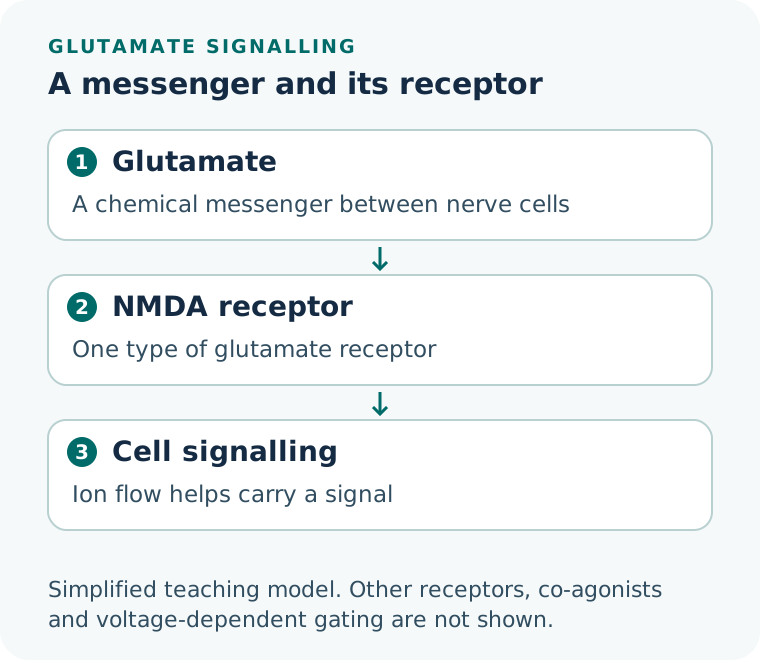
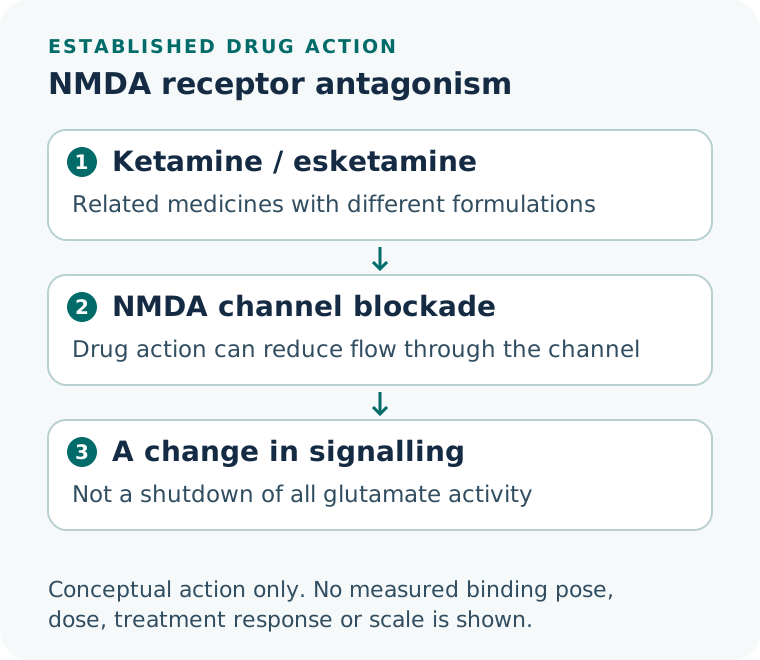
Ketamine affects glutamateGlutamateAn important excitatory chemical messenger used by nerve cells.Read the full definition of Glutamate, a chemical messenger nerve cellsNeuronA nerve cell that receives and sends information. Neurons work in connected groups, rather than carrying a whole thought on their own.Read the full definition of Neuron use to communicate. It can block NMDA receptorsNMDA ReceptorA receptor-channel involved in signalling by the chemical messenger glutamate.Read the full definition of NMDA Receptor, proteins containing channels that let electrically charged particles, or ionsIonAn atom or group of atoms with an electrical charge. Movement of ions such as sodium and potassium helps produce nerve-cell electrical signals.Read the full definition of Ion, move through a cell’s outer membraneCell membraneThe thin boundary of a cell. It separates the inside from the surroundings and contains proteins that control transport and signaling.Read the full definition of Cell membrane. This blocking action, called antagonism, reduces one part of glutamate signalling without switching off the whole system. These channels normally depend on helper chemicals called co-agonists and on the cell’s electrical state, a feature known as voltage-dependent gating.
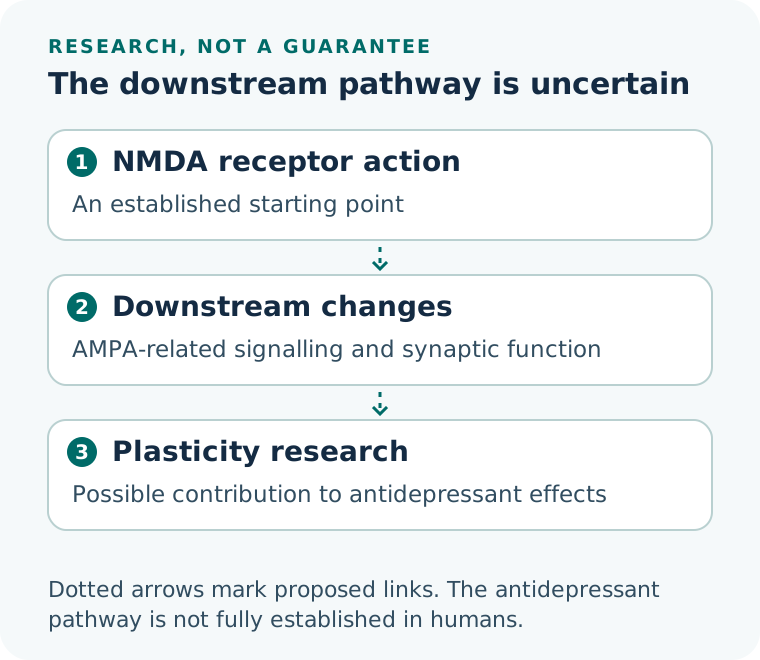
Researchers are investigating later changes involving AMPA receptorsReceptorA protein that recognizes a signal and helps a cell respond. Different receptor types can produce different responses to the same messenger.Read the full definition of Receptor, another type of glutamate receptor, and signals that help connections between nerve cells change. This ability to change their strength or structure is called synaptic plasticityNeuroplasticityThe nervous system’s ability to change its activity and connections over time.Read the full definition of Neuroplasticity. Studies in animals have found such changes after ketamine, but this does not prove that treatment repairs a person’s brain. The complete pathway producing antidepressant benefit in people remains uncertain.
The liver processes ketamine into other substances called metabolites, including norketamine. Products given into a vein, injected into muscle, swallowed or placed under the tongue enter the body and are processed differently. These routes are called intravenous, intramuscular, oral and sublingual, respectively. Similar names or stated doses do not establish the same exposure—the amount reaching the body over time—or the same effects.
How do treatment options differ?
Standard antidepressants, psychological treatment, augmentation, repetitive transcranial magnetic stimulation and ECT may be relevant parts of a specialist plan. ECT remains an established option for selected severe depressive illness. Choice depends on the whole clinical situation, not simply whether a treatment can act rapidly.
Ketamine vs Esketamine
Composition: racemic ketamine contains equal proportions of R-ketamine (arketamine) and S-ketamine (esketamine). Spravato contains only esketamine. They are related medicines, not interchangeable products.
Routes and evidence: psychiatric ketamine research is strongest for supervised intravenous infusions. Ketalar injection also has intramuscular anaesthetic uses. Spravato is a standardised nasal spray with its own depression trials. Results from one route or product cannot simply be transferred to oral lozenges or compounded nasal sprays.
Licensed psychiatric use: Ketalar has an anaesthetic licence; depression treatment is off-label. Spravato is licensed with an SSRI or SNRI for adult treatment-resistant depression and with an oral antidepressant for its separate acute psychiatric-emergency indication.
Setting and monitoring: both require clinical assessment and professional oversight. Spravato is given in an appropriate clinical setting with observation until stable, including blood-pressure checks; UK Register and Alert System requirements apply. Specialist ketamine services need suitable physiological monitoring and emergency facilities.
Frequency: Spravato has labelled induction and maintenance phases for treatment-resistant depression. Off-label ketamine services use varying initial courses and individually reviewed continuation plans; there is no universally approved depression schedule.
Regulation and access: both are Class B, Schedule 2 controlled drugs. A marketing authorisation does not guarantee NHS funding. Access depends on indication, nation, local service capacity and commissioning.
How was this medicine developed?
Ketamine's clinical history began in anaesthesia, well before its investigation as a psychiatric treatment. Interest in depression grew from studies of glutamate signalling and rapid changes in depressive symptoms after supervised administration. That scientific development did not add depression to the Ketalar licence.
A distinct regulatory step occurred when esketamine nasal spray received its first authorisation in December 2019. Subsequent UK decisions separated marketing authorisation from NHS funding, with different outcomes for particular indications and nations. Research has continued into infusions, oral formulations and combinations with psychological treatment, alongside increasing recognition of urinary and hepatobiliary harm from repeated exposure.
The 2026 ACMD review considered both medical use and misuse; specialist oversight and uncertainty about long-term psychiatric treatment remain important.
Sources and References
- Ketalar 50 mg/ml: UK Summary of Product Characteristics (text revised October 2024)
Product covered: Ketalar 50 mg/ml Injection. Marketing authorisation holder: Pfizer Limited. Label text revised 2024-10; source record updated 2025-03-21. Product identity and links checked 2026-10-19; this does not change the article’s clinical check date.
Company-supplied UK Patient Information Leaflet hosted by emc — patient text revised 2023-11. PIL includes 10 mg/ml and 50 mg/ml; selected SmPC is 50 mg/ml. PIL is older than SmPC: do not replace newer SmPC safety information with the older leaflet.
Product information published on the electronic Medicines Compendium (emc); supplied by pharmaceutical companies.
- Ketalar 50 mg/ml Injection — Company-supplied UK Patient Information Leaflet hosted by emc
- Spravato 28 mg nasal spray: UK Summary of Product Characteristics
Product information published on the electronic Medicines Compendium (emc); supplied by pharmaceutical companies.
- Ketamine: updated government review of use, harms and controlled-drug status
- Ketamine and neural changes: animal research and its limits
- Ketamine versus ECT for nonpsychotic treatment-resistant major depression (randomised trial, 2023)
- Oral prolonged-release ketamine for treatment-resistant depression (randomised trials, 2026)
- CBT after ketamine: small proof-of-concept randomised clinical trial
- NICE TA854: esketamine for treatment-resistant depression
- Ketalar prescribing information — mechanism explanation
Scope: Mechanism explanation only. Source sections checked: 12.1 Mechanism of Action; 12.2 Pharmacodynamics; 12.3 Pharmacokinetics. This does not establish UK product authorisation or prescribing..
- What Is a Neurotransmitter? — mechanism explanation
Scope: Mechanism explanation only. Source sections checked: How Neurotransmitters Work; Types of Neurotransmitters. This does not establish UK product authorisation or prescribing..
- Ketamine Lifts Depression via a Byproduct of its Metabolism — mechanism explanation
Scope: Mechanism explanation only. Source sections checked: Mouse experiments involving hydroxynorketamine and AMPA receptors; confirmation in humans explicitly pending. This does not establish UK product authorisation or prescribing..
- Multiple mechanisms of ketamine blockade of N-methyl-D-aspartate receptors — mechanism explanation
Scope: Mechanism explanation only. Source sections checked: Abstract: channel-opening experiments and conclusions. This does not establish UK product authorisation or prescribing..
- Structural basis for channel gating and blockade in tri-heteromeric GluN1-2B-2D NMDA receptor — mechanism explanation
Scope: Mechanism explanation only. Source sections checked: Summary; Introduction; S-(+)-ketamine closes the GluN1a-2B-2D NMDAR channel gate and blocks the pore. This does not establish UK product authorisation or prescribing..
- Schizophrenia
- NIMH: Understanding psychosis
Article Information
- Edition
- United Kingdom
- Content updated
- 2026-10-24
- Source check dates
- Listed with each reference above; retained dates for shared scientific content.
- Scope
- Country-specific educational article covering the named UK product and the stated psychiatric evidence.
Source and coverage limits
- Product authorisation does not establish stock, local service provision or NHS funding.
- There is no licensed UK Ketalar depression regimen; the SmPC does not recommend long-term use.