
What should I know first?
Bupropion affects catecholamine signalling differently from SSRIs. The UK product example is Zyban, used with support to help people stop smoking.
Zyban’s smoking-cessation licence must not be replaced by the American Wellbutrin XL depression licence. A pharmacological category does not establish a licensed indication, and a familiar foreign brand does not prove UK availability.
This is a mechanism lesson, not a complete medicine guide. A diagram cannot choose treatment, predict your response, or tell you how to change a prescription.
How Brain Cells Communicate
Noradrenaline, also called norepinephrine, and dopamine are chemical messengers with their own transport systems. Returning a messenger into a nerve cellNeuronA nerve cell that receives and sends information. Neurons work in connected groups, rather than carrying a whole thought on their own.Read the full definition of Neuron is called reuptakeReuptakeThe return of a released chemical messenger into a cell through a transporter. It is one way to limit a signal; chemical breakdown is another.Read the full definition of Reuptake. This process is one part of signalling, not a direct measure of mood.
Dopamine · DAT
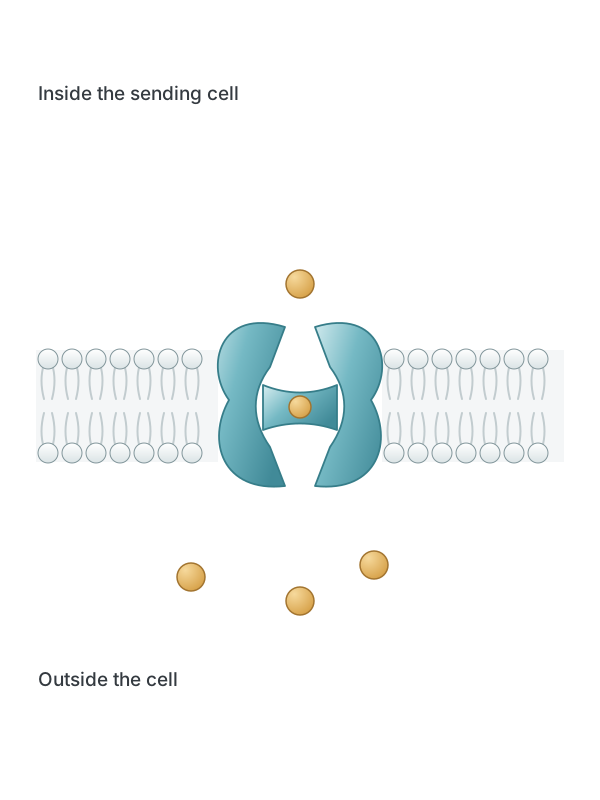
- Dopamine
The messenger is shown outside the sending cell.
- DAT
The DAT transporter returns dopamine into the cell.
- Return into the cell
The arrow shows transport direction, without a measured rate.
Simplified teaching model. Protein shapes, sizes, particle counts and arrows are illustrative, not measurements or experimental structures.
Norepinephrine · NET
- Norepinephrine
The messenger is shown outside the sending cell.
- NET
The NET transporter returns norepinephrine into the cell.
- Return into the cell
The arrow shows transport direction, without a measured rate.
Simplified teaching model. Protein shapes, sizes, particle counts and arrows are illustrative, not measurements or experimental structures.
About this illustration
Norepinephrine and dopamine transporters return the respective messengers into cells. Each transporter is distinct.
How the Medication Changes Signalling
The UK Zyban information describes inhibition of neuronal noradrenaline and dopamine reuptake, with little effect on serotoninSerotoninA chemical messenger involved in several functions, including sleep, mood and digestion. It acts through different receptors, with effects that depend on the cell.Read the full definition of Serotonin reuptake. Bupropion is not an SSRI and does not inhibit monoamine oxidase.
The teaching symbol is qualitative. Laboratory target effects cannot by themselves establish which clinical use is licensed or how medicines compare for an individual.
A Closer Look at the Molecular Level
Active metabolites contribute to bupropion exposure, so the parent medicine alone does not describe every aspect of its effects.
The precise mechanism supporting smoking cessation is unknown. This diagram does not establish that depression or nicotine dependence is caused by a simple shortage of dopamine or noradrenaline. It gives no dose, transporterTransporterA protein that moves a substance across a cell membrane. Some transporters help remove released chemical messengers from the space around nerve cells.Read the full definition of Transporter occupancy or complete prediction of response.
Sources and References
- Zyban 150 mg prolonged-release tablets: UK SmPC
Product information published on the electronic Medicines Compendium (emc); supplied by pharmaceutical companies.
Scope: United Kingdom.
- What Is a Neurotransmitter?
Scope: International scientific education; not UK regulatory evidence.
Article Information
- Edition
- United Kingdom
- Content updated
- 2026-10-17
- Sources checked
- Listed with each reference above; retained dates for shared scientific content.
- Publication status
- Published
- Scope
- How this medicine works, with UK product information.
Source and coverage limits
- A mechanism lesson is not a complete medicine profile, dosing schedule or individual treatment recommendation.
- Original qualitative SVG diagrams explain direction and target type; they do not measure biological rates, binding geometry or clinical response.