
What should I know first?
Memantine affects the NMDA receptor/channel, which participates in glutamateGlutamateAn important excitatory chemical messenger used by nerve cells.Read the full definition of Glutamate signalling. Glutamate is a chemical messenger used widely in the nervous system.
The UK Ebixa product information covers moderate to severe Alzheimer’s disease. That does not mean that any memory difficulty is an indication, or that every medicine affecting NMDA receptors has the same clinical use.
This is a mechanism lesson, not a complete medicine guide. A diagram cannot choose treatment, predict your response, or tell you how to change a prescription.
How Brain Cells Communicate
NMDA is one type of receptorReceptorA protein that recognizes a signal and helps a cell respond. Different receptor types can produce different responses to the same messenger.Read the full definition of Receptor that responds within glutamate signalling. It also forms a channel through which positively charged ionsIonAn atom or group of atoms with an electrical charge. Movement of ions such as sodium and potassium helps produce nerve-cell electrical signals.Read the full definition of Ion can move when the activation conditions are met.
Glutamate signalling has normal functions. It should not be described as a toxin that the brain needs to remove completely. A single messenger is not a complete explanation of Alzheimer’s disease.
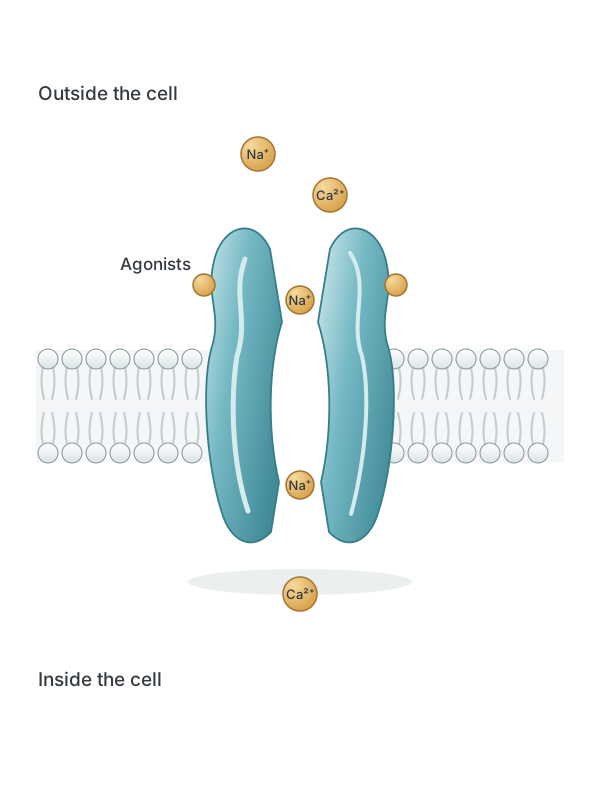
- Sodium / calcium · Na⁺ / Ca²⁺
This example shows inward movement of positively charged ions.
- NMDA glutamate receptor / channel
The pore opens under appropriate activation conditions.
- Open channel
The arrow shows a qualitative direction, not an ion count or measured rate.
Simplified teaching model. Protein shapes, sizes, particle counts and arrows are illustrative, not measurements or experimental structures.
About this illustration
Under the appropriate activation conditions, an NMDA receptor channel permits positively charged ions to pass. The arrow shows a teaching example of inward current.
How the Medication Changes Signalling
Memantine is an uncompetitive, open-channel NMDA receptor antagonist. In plain language, its blocking action is associated with channels that have opened. It can limit current through these channels.
The bar on the diagram means reduced passage in this teaching model. It is not a measured atomic site, a permanently sealed channel, or a command to eliminate all NMDA activity.
A Closer Look at the Molecular Level
UK product information describes voltage-dependent, uncompetitive NMDA receptor antagonism. A proposed role for altered glutamate signalling in Alzheimer’s disease is not the same as demonstrating the cause of an individual’s symptoms.
Memantine can help with symptoms but does not cure Alzheimer’s disease. A channel action does not prove that it stops underlying degeneration. Benefits and burdens require clinical review rather than interpretation of a schematic.
Sources and References
- Ebixa 10 mg film-coated tablets: UK SmPC
Product information published on the electronic Medicines Compendium (emc); supplied by pharmaceutical companies.
Scope: United Kingdom.
- What Is a Neurotransmitter?
Scope: International scientific education; not UK regulatory evidence.
- Memantine
Scope: United Kingdom medicine education.
Article Information
- Edition
- United Kingdom
- Content updated
- 2026-10-17
- Sources checked
- Listed with each reference above; retained dates for shared scientific content.
- Publication status
- Published
- Scope
- How this medicine works, with UK product information.
Source and coverage limits
- A mechanism lesson is not a complete medicine profile, dosing schedule or individual treatment recommendation.
- Original qualitative SVG diagrams explain direction and target type; they do not measure biological rates, binding geometry or clinical response.