
What should I know first?
Memantine affects a receptor/channel called NMDA, which participates in glutamate signaling. Glutamate is a chemical messenger used widely in the nervous system.
This example covers U.S. immediate-release memantine hydrochloride tablets for moderate to severe dementia of the Alzheimer’s type. It does not extend that use to every memory difficulty or to all medicines affecting NMDA receptors.
This is a mechanism lesson, not a complete medicine guide. A diagram cannot choose treatment, predict your response, or tell you how to change a prescription.
How Brain Cells Communicate
NMDA is one type of receptor that responds within glutamate signaling. It also forms a channel through which positively charged ions can move when the activation conditions are met.
Glutamate signaling has normal functions. It should not be described as a toxin that the brain needs to remove completely. A single messenger is not a complete explanation of Alzheimer’s disease.
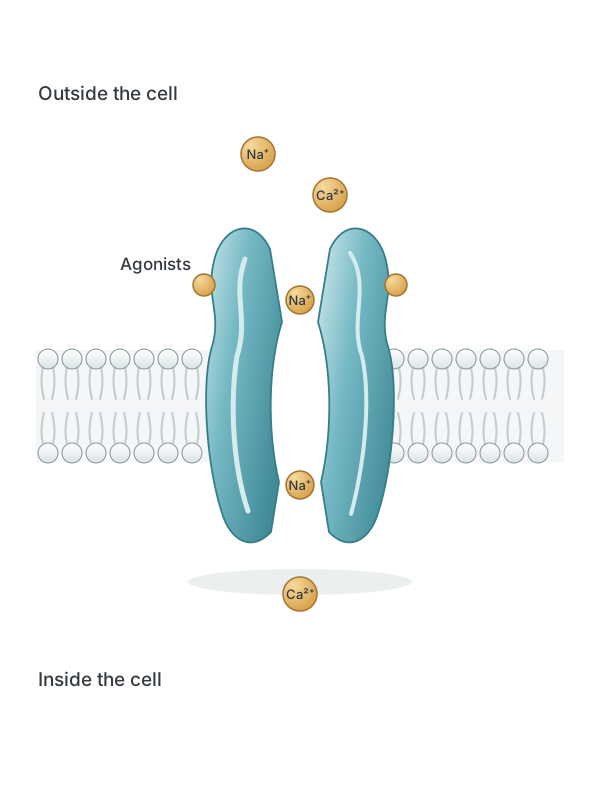
- Sodium / calcium · Na⁺ / Ca²⁺
This example shows inward movement of positively charged ions.
- NMDA glutamate receptor / channel
The pore opens under appropriate activation conditions.
- Open channel
The arrow shows a qualitative direction, not an ion count or measured rate.
Simplified teaching model. Protein shapes, sizes, particle counts and arrows are illustrative, not measurements or experimental structures.
About this illustration
Under the appropriate activation conditions, an NMDA receptor channel permits positively charged ions to pass. The arrow shows a teaching example of inward current.
How the Medication Changes Signaling
Memantine is an uncompetitive, open-channel NMDA receptor antagonist. In plain language, its blocking action is associated with channels that have opened. It can limit current through these channels.
The bar on the diagram means reduced passage in this teaching model. It is not a measured atomic site, a permanently sealed channel, or a command to eliminate all NMDA activity.
Explore the mechanism
What does open-channel antagonism mean?
- Sodium / calcium · Na⁺ / Ca²⁺
This example shows inward movement of positively charged ions.
- NMDA glutamate receptor / channel
The pore opens under appropriate activation conditions.
- Open channel
The arrow shows a qualitative direction, not an ion count or measured rate.
Simplified teaching model. Protein shapes, sizes, particle counts and arrows are illustrative, not measurements or experimental structures.
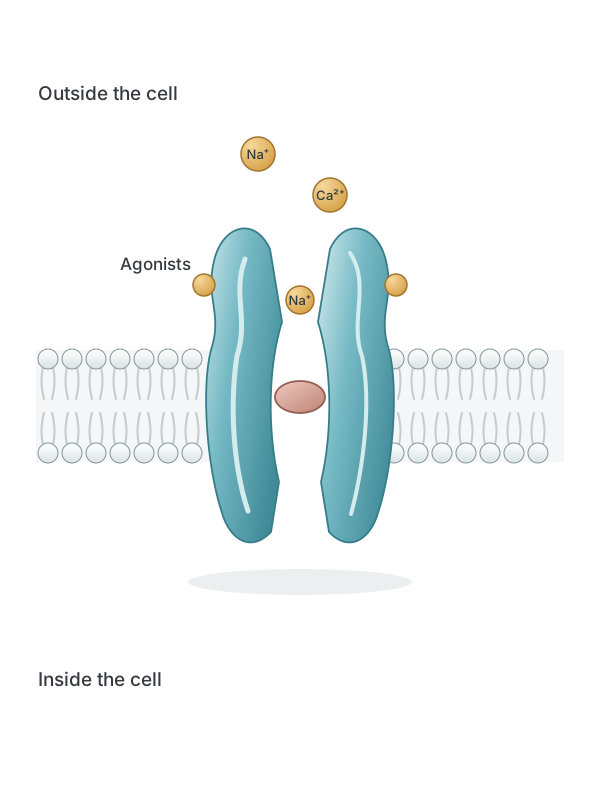
- Sodium / calcium · Na⁺ / Ca²⁺
This example shows inward movement of positively charged ions.
- NMDA glutamate receptor / channel
The pore opens under appropriate activation conditions.
- Memantine: open-channel block
The medicine symbol labels an action, not an experimentally determined binding position.
Simplified teaching model. Protein shapes, sizes, particle counts and arrows are illustrative, not measurements or experimental structures.
What this model cannot tell us
Not proof of disease slowing
- Not proof of disease slowing The clinical explanation remains uncertain.
- Limits of inference An experimental result does not by itself predict one person’s treatment response.
Static overview. Start the steps when you are ready.
Reduced motion is on. Use the step buttons or read the complete sequence.
Guide to the illustration: Outlines identify a cell membrane or target; arrows mark the direction explained in each caption. Medicine symbols are labels, not measured shapes or binding poses. No quantity, size or rate is to scale.
Read the complete sequence
- Before medicine: an open channel. Under the appropriate activation conditions, an NMDA receptor channel permits positively charged ions to pass. The arrow shows a teaching example of inward current.
- With memantine. Memantine’s action is described as open-channel antagonism. The crossbar marks reduced current in the schematic, not an experimentally verified position or permanent closure.
- Symptom treatment has limits. The product label does not establish prevention or slowing of the underlying degeneration. A target effect does not guarantee a particular clinical response.
Evidence and model limits
Current generic tablet record reconciled with reference-product FDA labeling. The original Namenda brand tablets are discontinued in the FDA product record; this lesson does not claim current brand availability.
Qualitative NMDA channel model, not atomic geometry. Target action is not evidence of slowing neurodegeneration.
A Closer Look at the Molecular Level
Known action: open-channel antagonism is described in the labeling. Persistent NMDA activation has been proposed as a contributor to symptoms, but a proposed disease mechanism is not the same as an established cause in one person.
Clinical limitation: the label does not establish that memantine prevents or slows the underlying nerve-cell degeneration in Alzheimer’s disease. A channel effect must not be presented as a cure or a guarantee of benefit.
Sources and References
The sources below support the specific medicine and experimental context described here. Drawings are original qualitative teaching models; positions, arrows and timing do not give atomic geometry, occupancy or rates.
Article Information
- Content updated
- 2026-10-16
- Sources checked
- 2026-10-16
- Publication status
- Published
Illustration information
- What does open-channel antagonism mean?
Checked 2026-10-16 · Created for Psychiatry Atlas · Original project artwork