
What should I know first?
Selective serotonin reuptake inhibitors, or SSRIs, affect the return of serotonin into nerve cells. This lesson uses sertraline, the active medicine in Zoloft, as the specific example.
The U.S. Zoloft tablet and oral-solution labels include depression and several other specified conditions. This lesson explains a target action, not the full range of uses, age limits or safety advice.
This is a mechanism lesson, not a complete medicine guide. A diagram cannot choose treatment, predict your response, or tell you how to change a prescription.
How Brain Cells Communicate
Serotonin is a chemical messenger. At a chemical synapse, it is released into a small gap and can act at receptors. A transporter is a protein that carries a substance across a cell membrane.
The serotonin transporter, often shortened to SERT, returns serotonin into the sending nerve cell. This return is called reuptake. A transporter moves a messenger; a receptor responds to it.
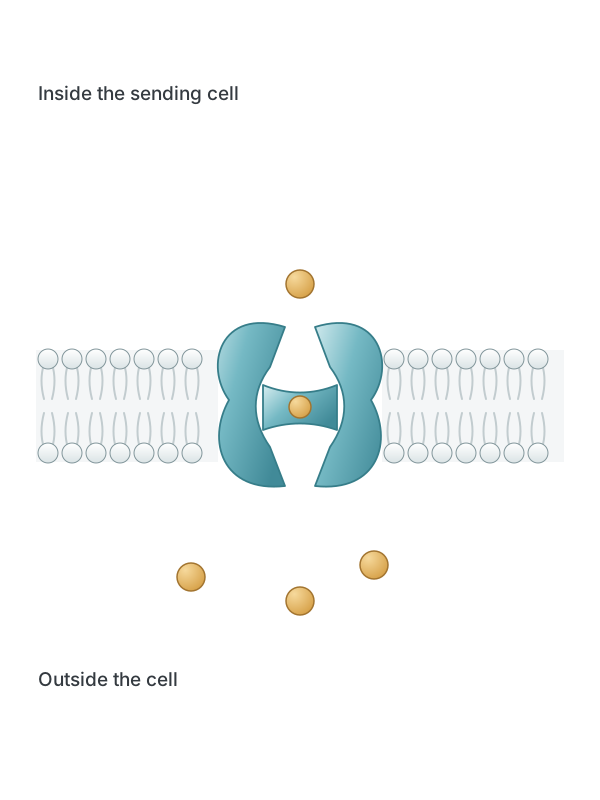
- Serotonin
The messenger is shown outside the sending cell.
- SERT
The serotonin transporter returns serotonin into the cell.
- Return into the cell
The arrow shows transport direction, without a measured rate.
Simplified teaching model. Protein shapes, sizes, particle counts and arrows are illustrative, not measurements or experimental structures.
About this illustration
A transporter returns serotonin from the space outside the nerve cell into the cell. The arrow points inward; it does not show a measured transport rate.
How the Medication Changes Signaling
Sertraline inhibits neuronal serotonin reuptake. This changes serotonin availability and signaling. The medicine marker in the diagram names that action without showing an exact molecular binding position.
The diagram pauses at separate teaching steps. It does not imply that all brain connections respond together or that a clinical response occurs as quickly as the illustration advances.
Explore the mechanism
What does blocking serotonin reuptake change?
- Serotonin
The messenger is shown outside the sending cell.
- SERT
The serotonin transporter returns serotonin into the cell.
- Return into the cell
The arrow shows transport direction, without a measured rate.
Simplified teaching model. Protein shapes, sizes, particle counts and arrows are illustrative, not measurements or experimental structures.
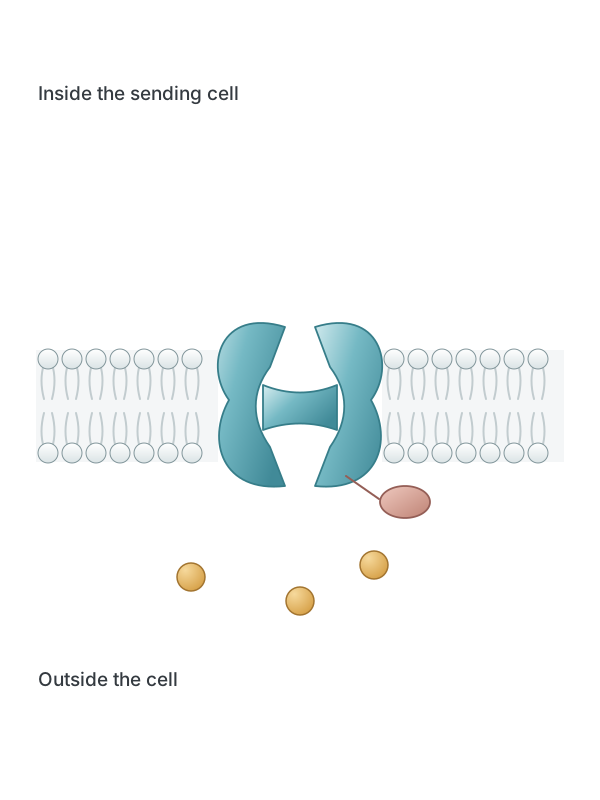
- Serotonin
The messenger is shown outside the sending cell.
- SERT
The serotonin transporter returns serotonin into the cell.
- Sertraline: uptake inhibited
The interrupted arrow names the action; the symbol is not a molecular shape or binding position.
Simplified teaching model. Protein shapes, sizes, particle counts and arrows are illustrative, not measurements or experimental structures.
What this model cannot tell us
Response is not predicted
- Response is not predicted The clinical explanation remains uncertain.
- Limits of inference An experimental result does not by itself predict one person’s treatment response.
Static overview. Start the steps when you are ready.
Reduced motion is on. Use the step buttons or read the complete sequence.
Guide to the illustration: Outlines identify a cell membrane or target; arrows mark the direction explained in each caption. Medicine symbols are labels, not measured shapes or binding poses. No quantity, size or rate is to scale.
Read the complete sequence
- Before medicine: reuptake. A transporter returns serotonin from the space outside the nerve cell into the cell. The arrow points inward; it does not show a measured transport rate.
- With sertraline. Sertraline inhibits this reuptake process. The missing flow arrow marks inhibition, not complete removal of every transporter.
- Beyond the transporter. A molecular action does not establish the cause of a person’s depression or predict their response. Many connected cells and processes contribute.
Evidence and model limits
Sertraline labeling separates neuronal reuptake action from human platelet and animal in-vitro observations. FDA NDA019839 latest linked label verified2026-10-16: August2023.
Qualitative serotonin-transport schematic; no measured counts, timing, binding geometry or prediction of response.
A Closer Look at the Molecular Level
Known action: sertraline affects serotonin reuptake. The label describes uptake findings in human platelets and laboratory animal preparations; these findings are not a direct movie of a living human synapse.
Clinical uncertainty: a transporter effect alone cannot explain who will benefit, how long benefit will take, or every side effect. Depression is not established by this diagram to be a simple serotonin shortage. No receptor occupancy or dose-response scale is shown.
Learn more about sertraline
The complete sertraline article now explains the selected Zoloft uses, age limits, forms and safety. Follow the medicine link below. The MedlinePlus patient-information reference remains available for further reading.
Sources and References
The sources below support the specific medicine and experimental context described here. Drawings are original qualitative teaching models; positions, arrows and timing do not give atomic geometry, occupancy or rates.
Article Information
- Content updated
- 2026-10-16
- Sources checked
- 2026-10-16
- Publication status
- Published
Illustration information
- What does blocking serotonin reuptake change?
Checked 2026-10-16 · Created for Psychiatry Atlas · Original project artwork