
What should I know first?
Lamotrigine can inhibit voltage-sensitive sodium currents in experimental systems. Its role in bipolar maintenance does not establish a complete molecular explanation of that benefit.
Read the linked Lamotrigine medication article for its formulation-specific uses and important safety information, including serious rash and restarting precautions.
This is a mechanism lesson, not a complete medicine guide. A diagram cannot choose treatment, predict your response, or tell you how to change a prescription.
How Brain Cells Communicate
A neuron is a nerve cell. Its membrane separates the inside from the outside. Charged particles, called ions, move through selected channels in that membrane. Their movement helps produce a brief electrical signal along the axon, the cell’s long communicating branch.
At a chemical synapse, an electrical signal can trigger release of a neurotransmitter, a chemical messenger that acts on a nearby cell. The electrical signal and the messenger crossing the gap are different steps.
Known action: Electrical and chemical signaling are linked parts of communication between many neurons.
What remains uncertain: This simplified drawing omits many channels, supporting cells and network effects. It does not represent a whole brain or an individual illness.
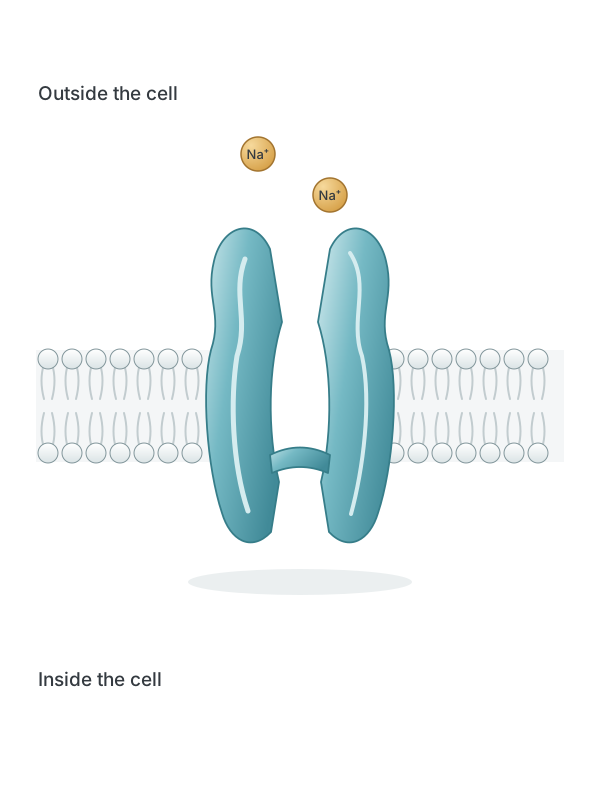
- Sodium · Na+
Sodium can enter through an available open channel.
- Voltage-sensitive sodium channel
Closed, open and inactivated are distinct channel states.
- Closed and ready
No flow arrow is shown through the closed pore.
Simplified teaching model. Protein shapes, sizes, particle counts and arrows are illustrative, not measurements or experimental structures.
About this illustration
A closed but available sodium channel can open when the membrane voltage changes. The bar indicates no sodium flow through this closed channel.
How the Medication Changes Signaling
Voltage-sensitive sodium channels change state as the membrane voltage changes. A channel can be closed but ready, open briefly, or temporarily inactivated before becoming available again. Sodium entry during opening helps the electrical signal rise.
Experiments show that lamotrigine can inhibit sodium currents in a way that depends on channel state and repeated activity. This can limit repetitive firing under the experimental conditions. It does not permanently close every channel.
Known action: State-dependent sodium-current inhibition has been observed in cell experiments.
What remains uncertain: Different preparations and conditions affect the findings. The animation brief has no measured rates and cannot predict firing or treatment effects in a person.
Explore the mechanism
What changes when lamotrigine affects sodium channels?
- Sodium · Na+
Sodium can enter through an available open channel.
- Voltage-sensitive sodium channel
Closed, open and inactivated are distinct channel states.
- Closed and ready
No flow arrow is shown through the closed pore.
Simplified teaching model. Protein shapes, sizes, particle counts and arrows are illustrative, not measurements or experimental structures.
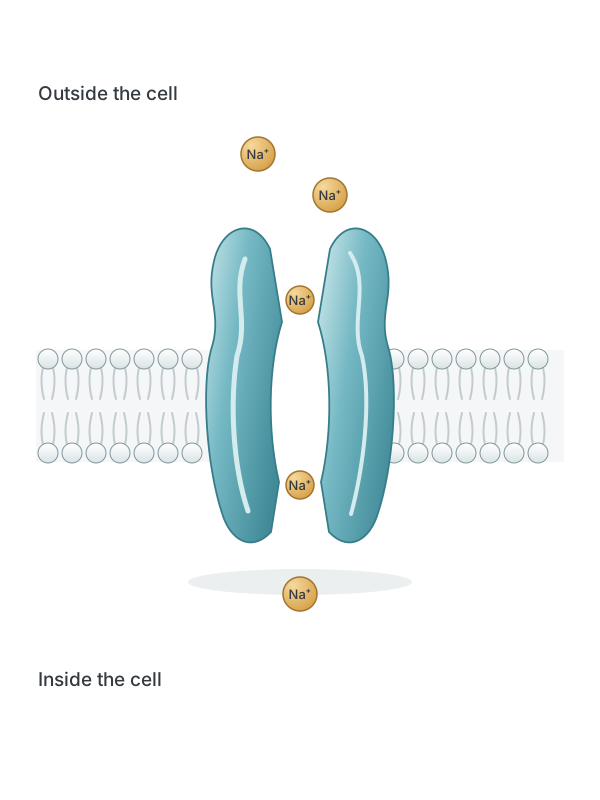
Optional motion shows inward ion movement in this example. Counts and timing are illustrative.
- Sodium · Na+
Sodium can enter through an available open channel.
- Voltage-sensitive sodium channel
Closed, open and inactivated are distinct channel states.
- Open channel
The arrow shows a qualitative direction, not an ion count or measured rate.
Simplified teaching model. Protein shapes, sizes, particle counts and arrows are illustrative, not measurements or experimental structures.
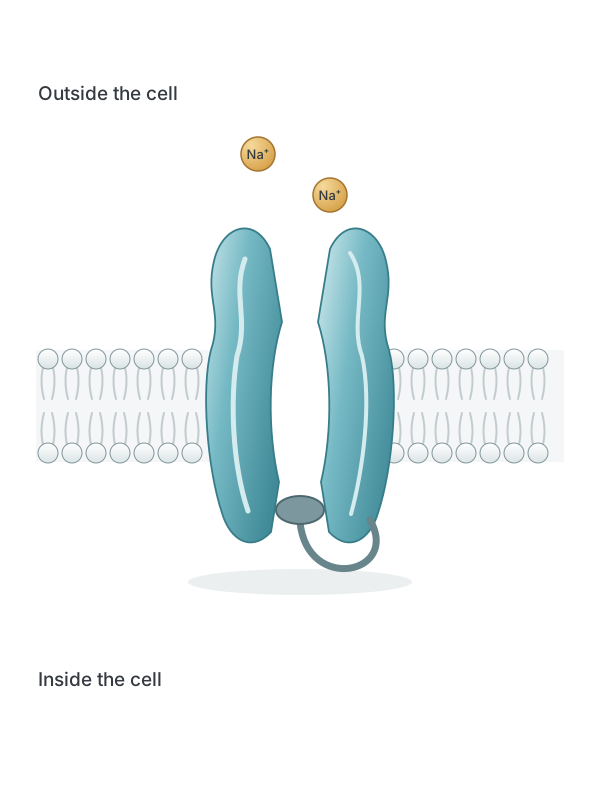
- Sodium · Na+
Sodium can enter through an available open channel.
- Voltage-sensitive sodium channel
Closed, open and inactivated are distinct channel states.
- Temporarily unavailable
The inactivation mark differs from the closed, available gate.
Simplified teaching model. Protein shapes, sizes, particle counts and arrows are illustrative, not measurements or experimental structures.
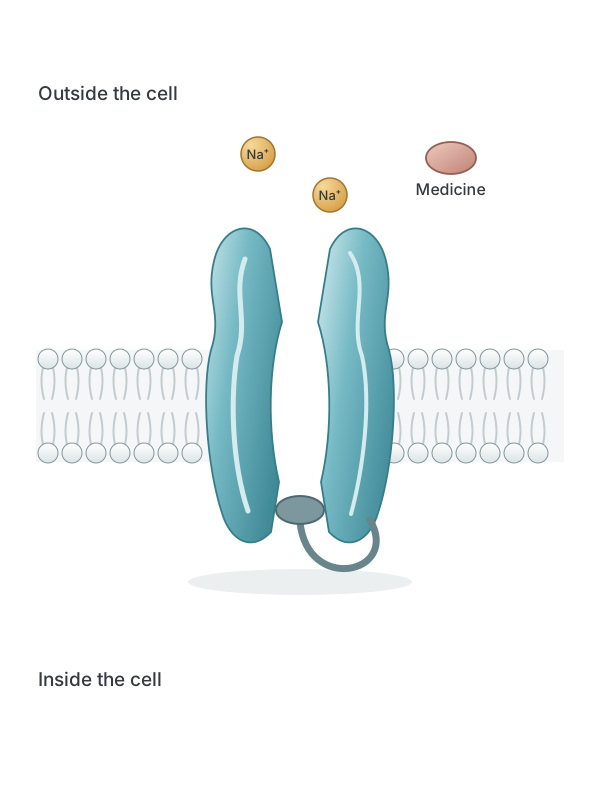
- Sodium · Na+
Sodium can enter through an available open channel.
- Voltage-sensitive sodium channel
Closed, open and inactivated are distinct channel states.
- Lamotrigine: current reduced
The medicine symbol labels an action, not an experimentally determined binding position.
Simplified teaching model. Protein shapes, sizes, particle counts and arrows are illustrative, not measurements or experimental structures.
Static overview. Start the steps when you are ready.
Reduced motion is on. Use the step buttons or read the complete sequence.
Guide to the illustration: Outlines identify a cell membrane or target; arrows mark the direction explained in each caption. Medicine symbols are labels, not measured shapes or binding poses. No quantity, size or rate is to scale.
Read the complete sequence
- Without medicine: ready. A closed but available sodium channel can open when the membrane voltage changes. The bar indicates no sodium flow through this closed channel.
- Without medicine: open. Sodium can move inward through the open channel and help the rising electrical signal. The arrow shows direction, not a measured rate.
- Without medicine: inactivated. The channel becomes temporarily unavailable before it can participate again. This is a normal state, different from being closed and ready.
- With lamotrigine: laboratory effect. State- and activity-dependent inhibition of sodium currents has been measured in cell preparations. The medicine symbol is placed beside the channel only as a label, not at a verified binding position.
Evidence and model limits
State-dependent sodium-current inhibition has been observed in cell experiments. Xie1995: recombinant rat brainIIA channel in CHO and rat hippocampal cells; Kuo/Lu1997: rat hippocampal cells.
Different preparations and conditions affect the findings. The animation brief has no measured rates and cannot predict firing or treatment effects in a person.
A Closer Look at the Molecular Level
A target is a biological component a medicine can affect. Here the relevant targets are voltage-sensitive sodium channels, which are proteins in cell membranes. Patch-clamp experiments measure electrical currents through cell membranes.
The cited studies used rat nerve cells or a rat sodium-channel protein expressed in cultured cells. These are useful experimental systems, but they do not establish an exact human protein-bound pose or how bipolar maintenance benefit arises.
Known action: Reduced sodium currents and effects on repetitive firing are experimentally supported in the stated systems.
What remains uncertain: The mechanism of therapeutic action in bipolar disorder remains unestablished. No verified protein structure or docking position is asserted here.
Sources and References
The sources below support the specific medicine and experimental context described here. Drawings are original qualitative teaching models; positions, arrows and timing do not give atomic geometry, occupancy or rates.
Article Information
- Content updated
- 2026-10-16
- Sources checked
- 2026-10-16
- Publication status
- Published
Illustration information
- What changes when lamotrigine affects sodium channels?
Checked 2026-10-16 · Created for Psychiatry Atlas · Original project artwork