
What should I know first?
Guanfacine is an agonist at alpha-2A adrenergic receptors. An agonist activates a receptor. This action differs from blocking a messenger’s return through a transporter.
The U.S. Intuniv extended-release product is used for ADHD on its own or with a stimulant. Immediate-release guanfacine has different product information; the forms should not be treated as interchangeable.
This is a mechanism lesson, not a complete medicine guide. A diagram cannot choose treatment, predict your response, or tell you how to change a prescription.
How Brain Cells Communicate
Norepinephrine can act at several adrenergic receptor types. Alpha-2A names one subtype. A receptor response can change internal signaling rather than directly moving a messenger across the membrane.
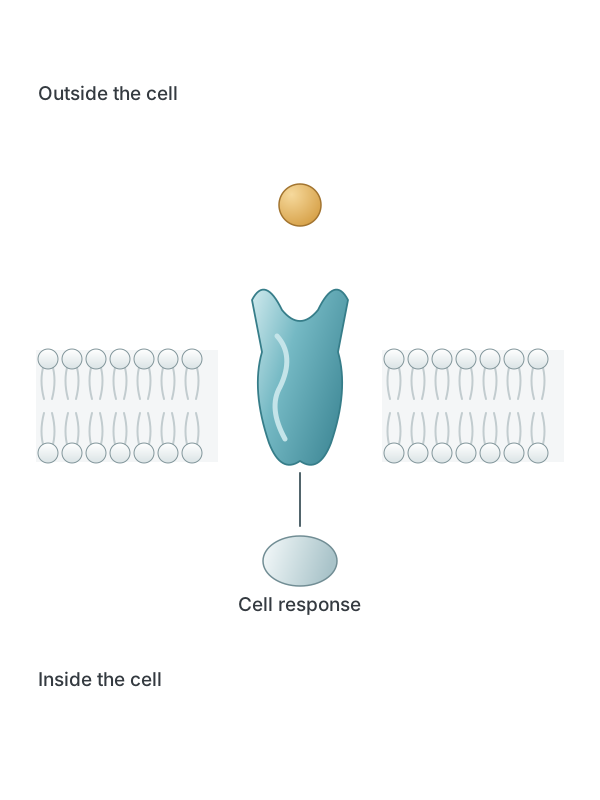
- Norepinephrine
A messenger can change signaling through its receptor.
- Alpha-2A receptor
This receptor symbol identifies a function, not a molecular structure.
- Cell response
The arrow represents a signaling response, not movement through a pore.
Simplified teaching model. Protein shapes, sizes, particle counts and arrows are illustrative, not measurements or experimental structures.
About this illustration
A messenger acts at a receptor and changes cell signaling. Alpha-2A is one of several adrenergic receptor subtypes.
How the Medication Changes Signaling
Guanfacine activates central alpha-2A receptors. It is not a central nervous system stimulant. Receptor activation affects cell signaling, but it does not mean that all norepinephrine activity simply increases.
The label also describes effects on sympathetic nerve signals, heart rate and blood pressure. These help explain why the mechanism lesson cannot replace the product’s precautions.
Explore the mechanism
How is receptor activation different from reuptake inhibition?
- Norepinephrine
A messenger can change signaling through its receptor.
- Alpha-2A receptor
This receptor symbol identifies a function, not a molecular structure.
- Cell response
The arrow represents a signaling response, not movement through a pore.
Simplified teaching model. Protein shapes, sizes, particle counts and arrows are illustrative, not measurements or experimental structures.
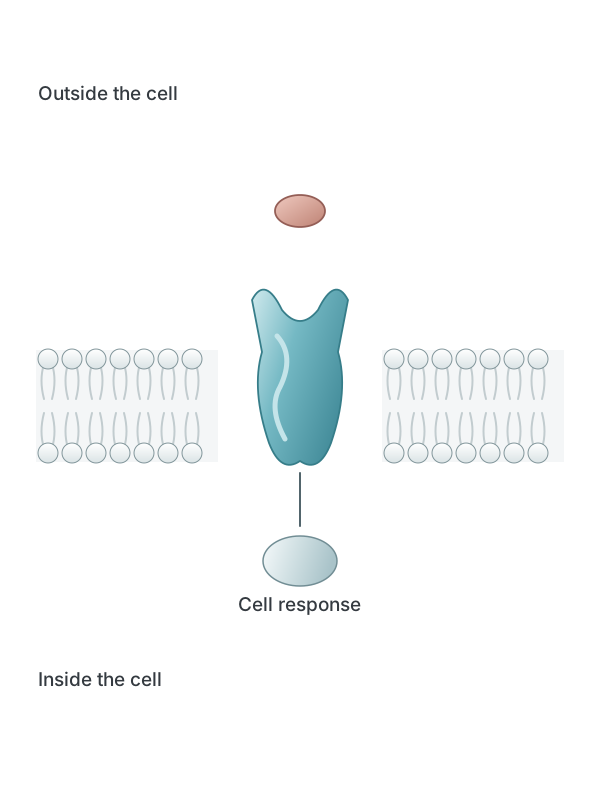
- Guanfacine
The oval identifies the medicine acting at the Alpha-2A receptor. It is a concept symbol, not a molecular shape or binding pose.
- Alpha-2A receptor
This receptor symbol identifies a function, not a molecular structure.
- Guanfacine: activation
The arrow represents a signaling response, not movement through a pore.
Simplified teaching model. Protein shapes, sizes, particle counts and arrows are illustrative, not measurements or experimental structures.
What this model cannot tell us
ADHD mechanism unknown
- ADHD mechanism unknown The clinical explanation remains uncertain.
- Limits of inference An experimental result does not by itself predict one person’s treatment response.
Static overview. Start the steps when you are ready.
Reduced motion is on. Use the step buttons or read the complete sequence.
Guide to the illustration: Outlines identify a cell membrane or target; arrows mark the direction explained in each caption. Medicine symbols are labels, not measured shapes or binding poses. No quantity, size or rate is to scale.
Read the complete sequence
- Before medicine: receptor signaling. A messenger acts at a receptor and changes cell signaling. Alpha-2A is one of several adrenergic receptor subtypes.
- With guanfacine. Guanfacine activates alpha-2A receptors. The medicine symbol identifies the action; it is not positioned at a proven binding site.
- What remains unresolved. Alpha-2A agonism does not by itself explain the clinical benefit in ADHD or predict a person’s response.
Evidence and model limits
Central alpha-2A agonism described in Intuniv labeling; ADHD therapeutic mechanism remains unknown.
A receptor icon is not an anatomical map or a demonstrated explanation of ADHD symptoms.
A Closer Look at the Molecular Level
Known action: alpha-2A receptor agonism is established in product pharmacology. The icon does not show a receptor’s atomic structure or a measured activation level.
Clinical uncertainty: the mechanism of guanfacine’s benefit in ADHD is not known. A receptor interaction does not diagnose a signaling deficit or predict attention in a person.
Sources and References
The sources below support the specific medicine and experimental context described here. Drawings are original qualitative teaching models; positions, arrows and timing do not give atomic geometry, occupancy or rates.
Article Information
- Content updated
- 2026-10-16
- Sources checked
- 2026-10-16
- Publication status
- Published
Illustration information
- How is receptor activation different from reuptake inhibition?
Checked 2026-10-16 · Created for Psychiatry Atlas · Original project artwork