
What should I know first?
Donepezil inhibits acetylcholinesterase, an enzyme that breaks down the messenger acetylcholine. It illustrates a different way medicines can affect communication between cells.
U.S. Aricept labeling covers dementia of the Alzheimer’s type, with evidence in mild, moderate and severe disease. This is not approval for every kind of forgetfulness, and different strengths and forms have their own instructions.
This is a mechanism lesson, not a complete medicine guide. A diagram cannot choose treatment, predict your response, or tell you how to change a prescription.
How Brain Cells Communicate
Acetylcholine is a chemical messenger. After release, an enzyme called acetylcholinesterase helps break it down. An enzyme helps a chemical reaction occur; it is different from a receptor that responds to a messenger.
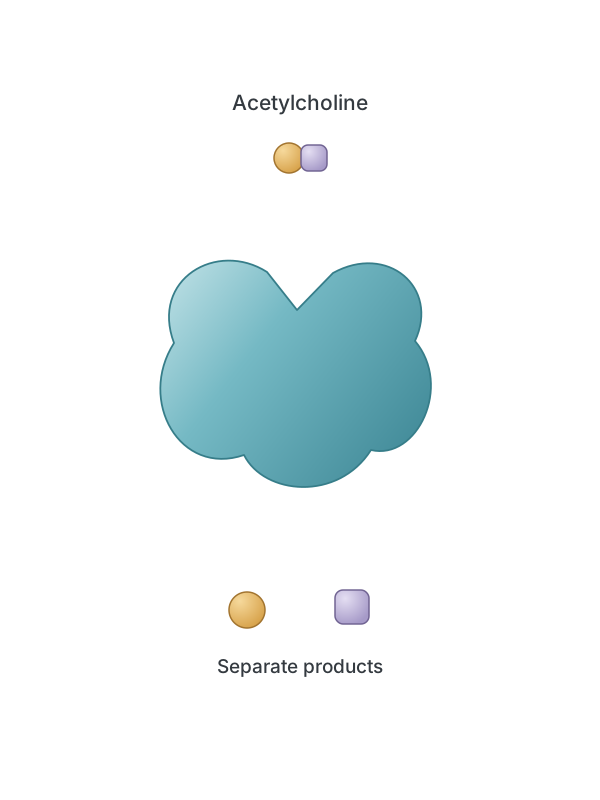
- Acetylcholine
The chemical messenger is the enzyme’s substrate.
- Acetylcholinesterase
An enzyme catalyzes breakdown; it is not a membrane transporter.
- Breakdown products
The two product symbols distinguish a chemical reaction from simple movement.
Simplified teaching model. Protein shapes, sizes, particle counts and arrows are illustrative, not measurements or experimental structures.
About this illustration
Acetylcholinesterase helps break down acetylcholine. The arrow represents a chemical reaction producing breakdown products, not movement through a transporter.
How the Medication Changes Signaling
Donepezil reversibly inhibits acetylcholinesterase. Slowing this breakdown can increase acetylcholine availability and support cholinergic signaling—the name for signaling using acetylcholine.
The illustration shows an enzyme process, not donepezil replacing acetylcholine or directly switching on every acetylcholine receptor. “Reversible” describes the inhibition; it does not mean that Alzheimer’s disease is reversed.
Explore the mechanism
How does slowing breakdown change messenger availability?
- Acetylcholine
The chemical messenger is the enzyme’s substrate.
- Acetylcholinesterase
An enzyme catalyzes breakdown; it is not a membrane transporter.
- Breakdown products
The two product symbols distinguish a chemical reaction from simple movement.
Simplified teaching model. Protein shapes, sizes, particle counts and arrows are illustrative, not measurements or experimental structures.
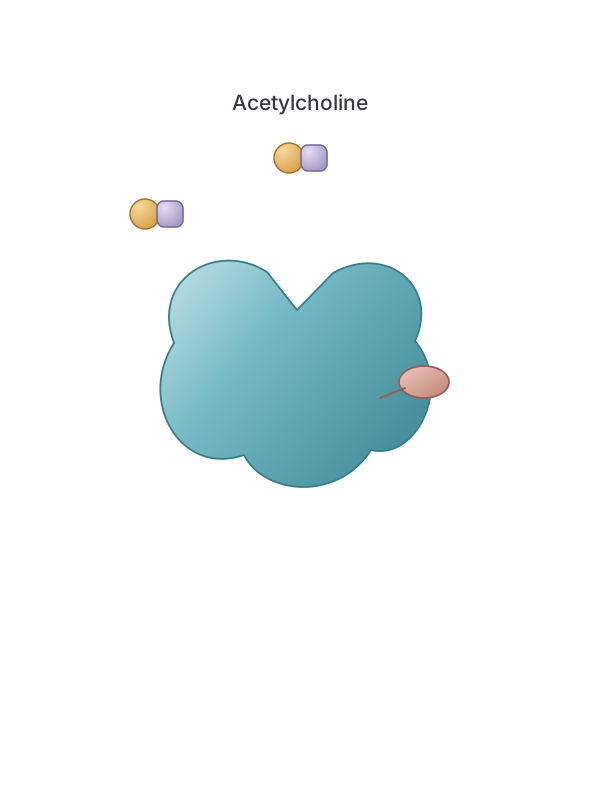
- Acetylcholine
The chemical messenger is the enzyme’s substrate.
- Acetylcholinesterase
An enzyme catalyzes breakdown; it is not a membrane transporter.
- Donepezil: breakdown inhibited
The crossbar marks reversible inhibition. The symbol does not identify an atomic binding pose.
Simplified teaching model. Protein shapes, sizes, particle counts and arrows are illustrative, not measurements or experimental structures.
What this model cannot tell us
Disease course not established
- Disease course not established The clinical explanation remains uncertain.
- Limits of inference An experimental result does not by itself predict one person’s treatment response.
Static overview. Start the steps when you are ready.
Reduced motion is on. Use the step buttons or read the complete sequence.
Guide to the illustration: Outlines identify a cell membrane or target; arrows mark the direction explained in each caption. Medicine symbols are labels, not measured shapes or binding poses. No quantity, size or rate is to scale.
Read the complete sequence
- Before medicine: breakdown. Acetylcholinesterase helps break down acetylcholine. The arrow represents a chemical reaction producing breakdown products, not movement through a transporter.
- With donepezil. Donepezil inhibits this enzyme reversibly, reducing the breakdown of acetylcholine. The medicine icon names an action rather than an atomic binding pose.
- What this cannot show. The mechanism does not establish that the medicine stops the underlying disease. It cannot predict an individual’s improvement.
Evidence and model limits
Aricept current DailyMed record reconciled with latest FDA-linked labeling. Enzyme inhibition is distinct from demonstrated clinical outcomes.
Enzyme inhibition is drawn qualitatively; “reversible” does not mean reversal of Alzheimer’s disease. No docking pose is asserted.
A Closer Look at the Molecular Level
Known action: reversible inhibition of acetylcholine breakdown is established in the pharmacology. The enzyme shape is symbolic rather than an experimental protein structure.
Clinical limitation: the label does not establish that donepezil changes the underlying disease process. Symptomatic treatment and curing or stopping degeneration are different claims. A diagram cannot predict how much an individual will benefit.
Sources and References
The sources below support the specific medicine and experimental context described here. Drawings are original qualitative teaching models; positions, arrows and timing do not give atomic geometry, occupancy or rates.
Article Information
- Content updated
- 2026-10-16
- Sources checked
- 2026-10-16
- Publication status
- Published
Illustration information
- How does slowing breakdown change messenger availability?
Checked 2026-10-16 · Created for Psychiatry Atlas · Original project artwork