
What should I know first?
Aripiprazole, the active medicine in Abilify, illustrates partial agonism. Its receptor effects depend on the target and experimental system.
This lesson uses the U.S. Abilify oral-tablet label, which includes schizophrenia and bipolar mania among its specified uses. It does not transfer these uses to every aripiprazole formulation.
This is a mechanism lesson, not a complete medicine guide. A diagram cannot choose treatment, predict your response, or tell you how to change a prescription.
How Brain Cells Communicate
An agonist activates a receptor. A partial agonist can activate it but produces a smaller maximum response than a full agonist in a defined experimental system. This describes an assay result, not a fixed percentage of a person’s dopamine activity.
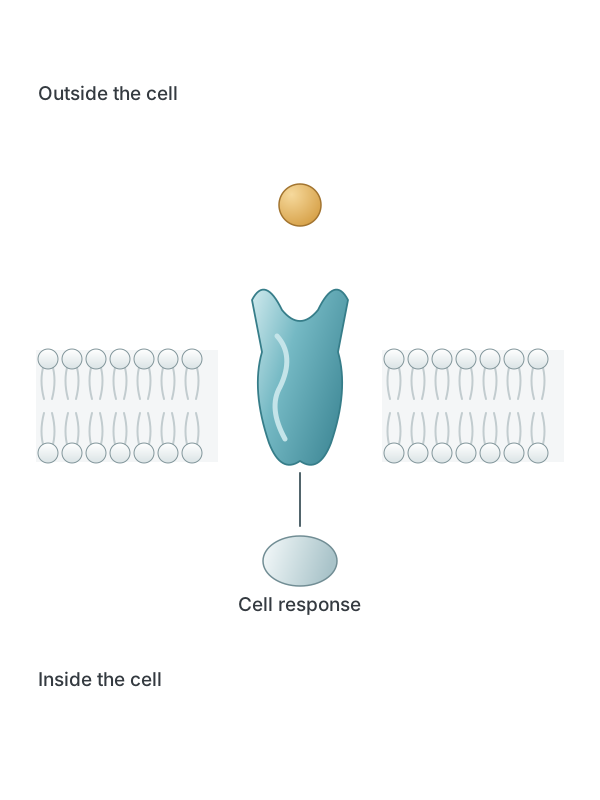
- Dopamine
A messenger can change signaling through its receptor.
- D2 receptor
This receptor symbol identifies a function, not a molecular structure.
- Cell response
The arrow represents a signaling response, not movement through a pore.
Simplified teaching model. Protein shapes, sizes, particle counts and arrows are illustrative, not measurements or experimental structures.
About this illustration
A full agonist is a reference for a larger maximum response in the same experimental system. No universal numerical response is assumed.
How the Medication Changes Signaling
The Abilify label describes partial agonist activity at dopamine D2 and serotonin 5-HT1A receptors, with antagonist activity at serotonin 5-HT2A receptors. One medicine can have different actions at different receptor types.
A partial agonist can also compete with a fuller agonist at a receptor. The net effect depends on the surrounding signaling and the response being measured. It is not an automatic brain-wide “normalizer.”
Explore the mechanism
How is partial agonism different from simple blockade?
- Dopamine
A messenger can change signaling through its receptor.
- D2 receptor
This receptor symbol identifies a function, not a molecular structure.
- Cell response
The arrow represents a signaling response, not movement through a pore.
Simplified teaching model. Protein shapes, sizes, particle counts and arrows are illustrative, not measurements or experimental structures.
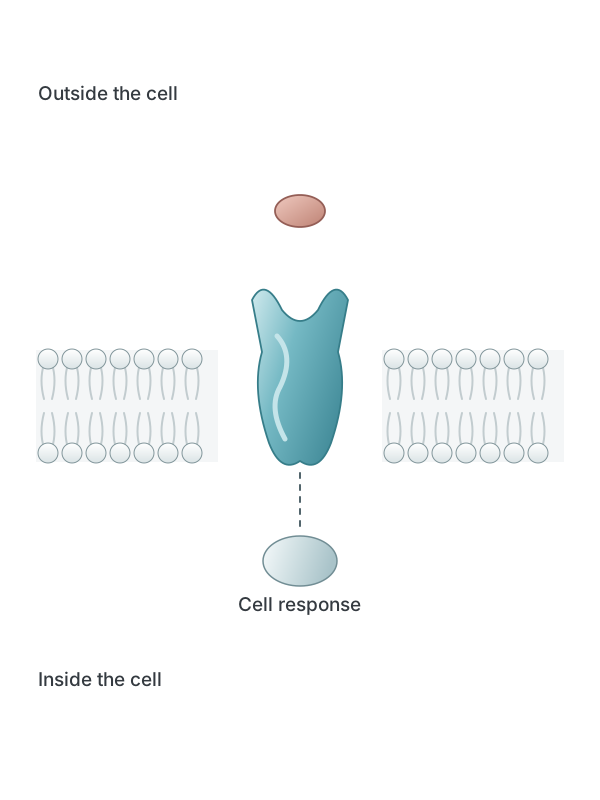
- Aripiprazole
The oval identifies the medicine acting at the D2 receptor. It is a concept symbol, not a molecular shape or binding pose.
- D2 receptor
This receptor symbol identifies a function, not a molecular structure.
- Aripiprazole: partial activation
A dashed arrow marks context-dependent partial activation; it is not a numerical effect scale.
Simplified teaching model. Protein shapes, sizes, particle counts and arrows are illustrative, not measurements or experimental structures.
From experiment to understanding
Several receptor actions
- Several receptor actions The observation belongs to the stated experimental system.
- Limits of inference An experimental result does not by itself predict one person’s treatment response.
What this model cannot tell us
Individual response unresolved
- Individual response unresolved The clinical explanation remains uncertain.
- Limits of inference An experimental result does not by itself predict one person’s treatment response.
Static overview. Start the steps when you are ready.
Reduced motion is on. Use the step buttons or read the complete sequence.
Guide to the illustration: Outlines identify a cell membrane or target; arrows mark the direction explained in each caption. Medicine symbols are labels, not measured shapes or binding poses. No quantity, size or rate is to scale.
Read the complete sequence
- A receptor can be activated. A full agonist is a reference for a larger maximum response in the same experimental system. No universal numerical response is assumed.
- Aripiprazole at D2. Partial agonist activity can produce activation and can oppose a stronger agonist’s effect in that system. This is not identical to pure antagonism.
- Other receptors, other actions. The label also describes serotonin 5-HT1A partial agonism and 5-HT2A antagonism. These cannot be reduced to one on/off switch.
- Limits of prediction. The assay and the cell influence the measured response. Neither a binding result nor the drawing predicts one person’s benefit.
Evidence and model limits
Cloned human receptor systems, with functional activity varying by cell type and assay. Not a measurement of global dopamine in a person.
No occupancy percentage or universal “dopamine balance” is shown. Receptor effects vary with context.
A Closer Look at the Molecular Level
Known action: receptor experiments support context-dependent partial agonism. Studies of cloned human D2 receptors have found different functional responses across cell types and measurements.
Clinical uncertainty: the label describes the therapeutic mechanism in schizophrenia and bipolar mania as unclear. A half-filled symbol would falsely suggest a precise universal fraction, so this lesson uses words instead.
Sources and References
The sources below support the specific medicine and experimental context described here. Drawings are original qualitative teaching models; positions, arrows and timing do not give atomic geometry, occupancy or rates.
Article Information
- Content updated
- 2026-10-16
- Sources checked
- 2026-10-16
- Publication status
- Published
Illustration information
- How is partial agonism different from simple blockade?
Checked 2026-10-16 · Created for Psychiatry Atlas · Original project artwork