
What should I know first?
Alprazolam, the active medicine in Xanax, acts at a benzodiazepine site on GABA-A receptors. GABA is a messenger that often reduces the likelihood of nerve-cell firing.
This example uses U.S. Xanax oral tablets, labeled for acute treatment of generalized anxiety disorder and for panic disorder in adults. Benzodiazepines can cause dependence and dangerous withdrawalSymptoms after reducing or stopping a substanceSymptoms that can occur when a medicine or substance is reduced or stopped after the body has adapted to it.Read the full definition of Withdrawal; combining them with opioids can suppress breathing. This lesson gives no stopping plan.
This is a mechanism lesson, not a complete medicine guide. A diagram cannot choose treatment, predict your response, or tell you how to change a prescription.
How Brain Cells Communicate
GABA-A is a receptor that also forms an ion channel. When activated by GABA, it changes the movement of chloride ions across the membrane. In many mature nerve cells this supports inhibition.
The effect depends on the cell’s ion gradients—the difference in ion concentrations and electrical forces across its membrane. The inward arrow is a common teaching example, not a rule for every cell or developmental stage.
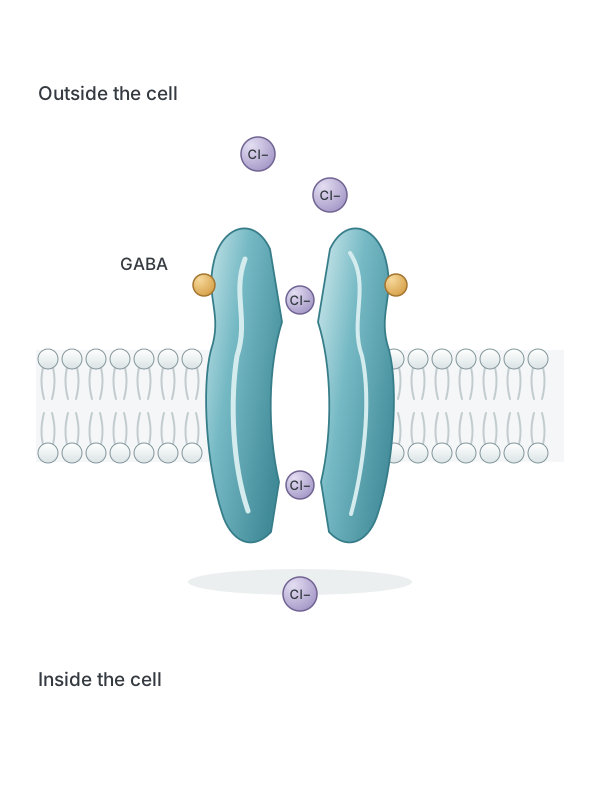
Optional motion shows inward ion movement in this example. Counts and timing are illustrative.
- Chloride · Cl−
Inward movement is a typical mature-cell example; ion gradients can differ.
- GABA-A receptor / channel
GABA activates this ion channel.
- Open channel
The arrow shows a qualitative direction, not an ion count or measured rate.
Simplified teaching model. Protein shapes, sizes, particle counts and arrows are illustrative, not measurements or experimental structures.
About this illustration
GABA-A activation permits ion flow. The arrow illustrates inward chloride movement in a typical mature-cell example, not all cells.
How the Medication Changes Signaling
Alprazolam binds at the benzodiazepine site and enhances GABA-mediated inhibition. It modifies the receptor’s response to GABA rather than serving as GABA itself.
The with-medicine panel still shows an openable GABA-A channel. It does not portray alprazolam as plugging the channel, nor claim that more inhibition is always safer.
Explore the mechanism
How does a benzodiazepine modify GABA signaling?
Optional motion shows inward ion movement in this example. Counts and timing are illustrative.
- Chloride · Cl−
Inward movement is a typical mature-cell example; ion gradients can differ.
- GABA-A receptor / channel
GABA activates this ion channel.
- Open channel
The arrow shows a qualitative direction, not an ion count or measured rate.
Simplified teaching model. Protein shapes, sizes, particle counts and arrows are illustrative, not measurements or experimental structures.
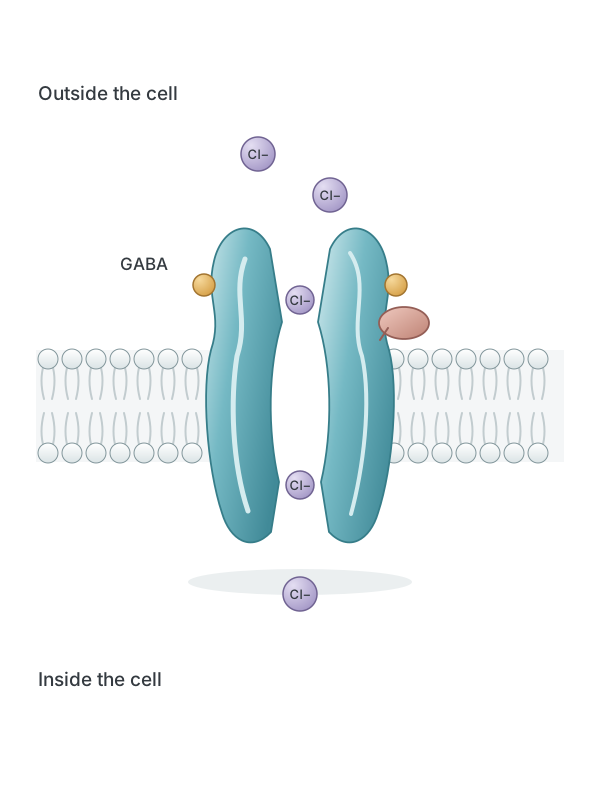
- Chloride · Cl−
Inward movement is a typical mature-cell example; ion gradients can differ.
- GABA-A receptor / channel
GABA activates this ion channel.
- Alprazolam: GABA response enhanced
The medicine symbol labels an action, not an experimentally determined binding position.
Simplified teaching model. Protein shapes, sizes, particle counts and arrows are illustrative, not measurements or experimental structures.
What this model cannot tell us
Effects depend on context
- Effects depend on context The clinical explanation remains uncertain.
- Limits of inference An experimental result does not by itself predict one person’s treatment response.
Static overview. Start the steps when you are ready.
Reduced motion is on. Use the step buttons or read the complete sequence.
Guide to the illustration: Outlines identify a cell membrane or target; arrows mark the direction explained in each caption. Medicine symbols are labels, not measured shapes or binding poses. No quantity, size or rate is to scale.
Read the complete sequence
- GABA opens a channel. GABA-A activation permits ion flow. The arrow illustrates inward chloride movement in a typical mature-cell example, not all cells.
- With alprazolam and GABA. Alprazolam enhances the response to GABA through the benzodiazepine site. The channel remains a channel; the medicine is not shown blocking its pore.
- Inhibition has context and limits. Cell gradients, receptor subtypes and other medicines influence effects. This picture cannot show a safe dose or predict breathing risk.
Evidence and model limits
Alprazolam potentiation of GABA-induced currents in recombinant receptor subtype constructs. Chloride-arrow example is limited to an inward gradient.
A schematic of GABA-mediated inhibition, not a protein pose. Chloride direction and effect depend on the cell; risks cannot be read from the picture.
A Closer Look at the Molecular Level
Known action: the product label identifies enhancement of GABA-mediated inhibition. Experiments with recombinant receptor subtypes measured potentiation of GABA-evoked currents.
Clinical uncertainty and limits: receptor subtype, cell context and other medicines matter. The diagram cannot predict sedation, dependence or breathing risk for a person. No exact binding pose, opening frequency or occupancy is shown.
Sources and References
The sources below support the specific medicine and experimental context described here. Drawings are original qualitative teaching models; positions, arrows and timing do not give atomic geometry, occupancy or rates.
Article Information
- Content updated
- 2026-10-16
- Sources checked
- 2026-10-16
- Publication status
- Published
Illustration information
- How does a benzodiazepine modify GABA signaling?
Checked 2026-10-16 · Created for Psychiatry Atlas · Original project artwork